
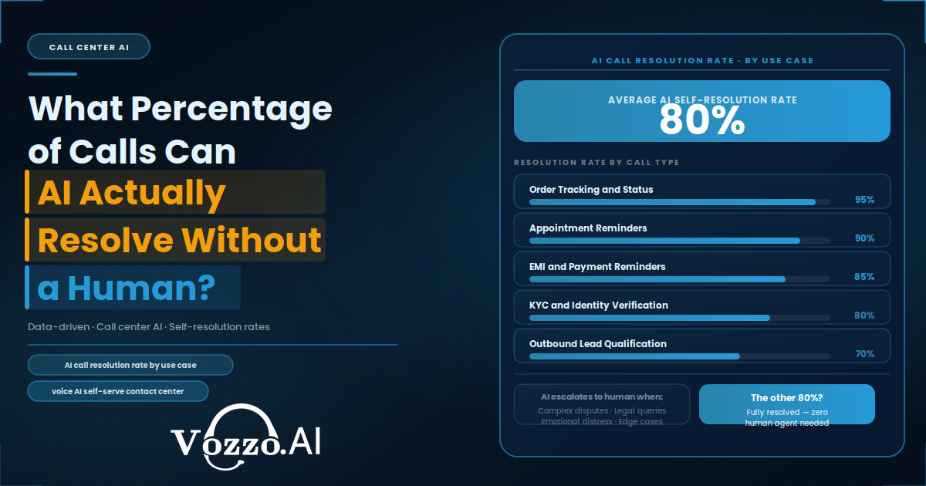
This is the question every call center head asks before buying a voice AI platform, and the honest answer is more nuanced than any vendor will give you in a sales demo. The right number is not a single percentage. It depends on your call type, your industry, your language mix, and how you define "resolved."
The Honest Answer — AI Containment Rates by Call Type
Routine transactional calls: 85-95% AI resolution rate. Order status, appointment confirmation, balance enquiry, prescription refill status, delivery rescheduling, payment due date and branch hours. These calls have one right answer that sits in a database, and AI retrieves it and delivers it. If you are asking what percentage of calls can AI resolve without human help, this category gives the highest number. There is no reason a person needs to be involved. If your AI is not reaching 85%+ containment here, the problem is integration, not AI capability.
Qualification and outbound sales calls: 70-80% AI completion rate. Lead qualification, appointment scheduling, survey completion and product interest capture. AI handles the full conversation for most contacts. The 20-30% that escalate are the ones expressing complex requirements, high buying intent or objections that benefit from a human. That is exactly the 20-30% your sales team should spend its time on.
Collections and payment reminder calls: 60-75% AI resolution rate. Routine reminder calls where the customer acknowledges, commits to a date or requests a callback are handled fully by AI. Disputed amounts, hardship cases, legal threats and broken promises require human judgment. AI should never be the endpoint for a call where the customer is disputing the debt.
Complex service and complaint calls: 30-50% AI resolution rate. Complaints involving multiple touchpoints, policy exceptions, escalations and emotional distress. AI handles information gathering, context capture and the initial response, but human resolution is frequently required. This is correct: these calls should escalate. AI that tries to resolve everything has worse outcomes than AI that knows when to stop.
Healthcare and clinical queries: 40-60% for administrative calls, 0% for clinical. Appointment booking, test result notification and prescription refill confirmation can be handled fully by AI. Any call where the patient describes symptoms, asks for clinical advice or expresses distress must escalate immediately, without exception.
What Drives Containment Rate Up — and What Drives It Down
Deep system integration (drives it up). AI that pulls real-time data from your OMS, CRM, HMS or collections platform resolves calls that AI without integration cannot. Integration is the biggest single driver of containment rate.
Narrow call scope (drives it up). An AI built for one job resolves more of that job than a generic AI trying to handle everything. A prescription refill AI should not also be handling billing disputes.
Language accuracy (drives it up). A customer who cannot understand the AI, or feels the AI does not understand them, will ask for a human. Native language AI dramatically reduces this dropout.
Poor escalation design (drives it down). If AI holds calls too long before escalating, customers become frustrated and the quality of the eventual human handoff suffers. Know your escalation triggers.
Undertrained knowledge base (drives it down). AI that cannot answer the top 20 questions your customers actually ask will escalate everything. This is a content problem, not an AI problem.
Automating calls that should not be automated (drives it down). Complex complaints, grief calls and medical queries. Forcing AI containment on these calls damages customer trust permanently.
The Right Way to Think About AI Containment Rate
Containment rate is not a vanity metric; it is a cost and quality metric. The goal is not the highest possible containment rate. The goal is 100% containment on calls that should be contained and 0% attempted containment on calls that should escalate. An AI that escalates a billing dispute to a human immediately is performing correctly, even though it lowered your containment rate.
Industry Benchmarks — What Good Looks Like in India
Collections reminder calls: 65-75% containment. A good benchmark for NBFC and bank collections AI.
Appointment reminders, healthcare: 88-94% containment. Near-total automation is achievable for routine scheduling.
Order tracking, e-commerce: 85-92% containment. WISMO (where is my order) calls are almost entirely automatable.
Agri outbound sales calls: 70-80% completion rate. Farmers who engage with the AI recommendation convert; complex queries go to an agronomist.
Insurance renewal reminders: 60-70% containment. Straightforward renewals automate; cross-sell and objection handling need a human.
Grievance helpline, government: 50-65% containment. Information and status queries automate; complaint escalations do not.
What to Ask Your Voice AI Vendor About Containment Rate
What is your containment rate benchmark for my specific call type? Not your overall platform average, which mixes easy and hard call types and tells you nothing useful.
How do you define "resolved"? A call where the customer hung up is not the same as a call where the issue was addressed. Make sure resolved means the customer got what they called for.
What triggers escalation, and how fast does it happen? Escalation design is as important as containment design. A frustrated customer waiting four minutes for AI to admit it cannot help is a worse outcome than immediate escalation.
Can you show me containment rates from a deployment in my industry in India? Global benchmarks on English calls do not predict performance on Hindi, Tamil or Marathi calls in your specific use case.
The percentage of calls AI can resolve without a human is high enough to transform your cost structure and your team's workload, if you deploy it on the right calls. The mistake is optimizing for containment rate instead of optimizing for the right calls being contained and the right calls being escalated. Get that boundary right and the number takes care of itself.