
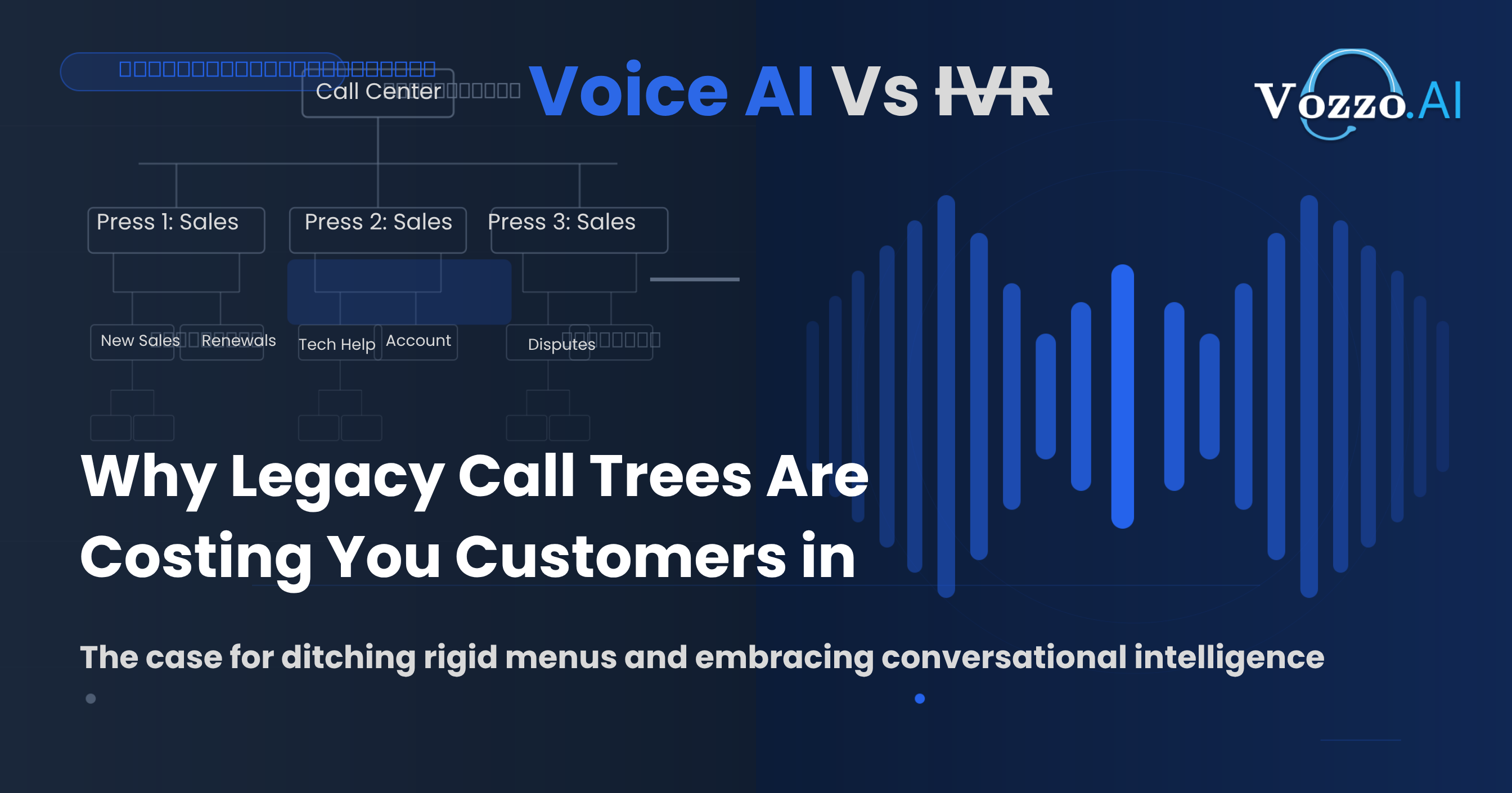
Press 1 for sales. Press 2 for support. Press 3 to repeat these options. Your customers have heard this for 30 years, and in 2026, they are hanging up. IVR was built for a world where calling was the only option. That world no longer exists. Voice AI is not an upgrade to IVR. It is a replacement.
What IVR Actually Costs You , The Numbers Nobody Talks About
The business case against IVR starts with a single statistic: 67% of customers hang up on IVR systems before reaching resolution, according to Forrester. The average IVR abandonment rate sits between 32–40% depending on industry — and each abandoned call represents a lost revenue opportunity worth $5–$15. That is not a rounding error. That is structural leakage happening every hour your IVR is live. When 86% of customers tell PwC they prefer speaking to a human over navigating an IVR menu, the message is unambiguous — and yet most enterprises are still paying $200,000–$500,000 per year in IVR maintenance and licensing. The real debate voice is not a cost-benefit question anymore. IVR is not a free or neutral choice — it is actively costing you customers and revenue every single day.
The 6 Ways Legacy IVR Fails Modern Customers
1. Rigid menu trees that don't match how customers
Customers call with problems, not menu categories. IVR forces them to translate their problem into your internal taxonomy — "Is my issue billing, technical, or account?" Most customers don't know and pick wrong, leading to transfers, frustration, and churn.
- Zero context — every call starts
- IVR has no memory. A customer who called yesterday about the same issue has to re-authenticate, re-explain, and re-navigate the same menu today. Voice AI pulls CRM history instantly and greets the customer with full context from the first second.
- 3. No natural language
- IVR only understands keypad inputs and a narrow set of voice commands. Say "I want to check my last three transactions from November" and IVR will fail. Voice AI understands intent from natural speech — exactly the way a human agent would.
- 4. Cannot handle variation or
- If a customer says something unexpected, IVR breaks. It repeats the menu, escalates, or disconnects. Voice AI handles interruptions, clarifications, topic switches, and accent variation — because it is built on LLM reasoning, not decision trees.
- 5. Escalation rate is a hidden cost
- Every IVR-to-agent escalation costs 4–7x more than an IVR-only resolution. Yet most IVR systems escalate 60–70% of calls because they cannot actually resolve queries. When you replace IVR with AI, that calculus flips — Voice AI resolves 65–80% of tier-1 queries end-to-end, eliminating the escalation tax entirely.
- 6. It signals to your customer that
- IVR is an experience tax. Every second a customer spends navigating menus is a second your competitor — who deployed voice AI — is not making them spend. In 2026, customer experience IS competitive advantage.
Voice AI vs IVR — Head to Head Comparison
The performance gap between IVR and Voice AI is stark across every dimension that matters to contact center leaders. Natural language understanding: IVR has none. Voice AI delivers full intent recognition in 100+ languages, understanding context, nuance, and incomplete sentences. Call resolution rate: IVR resolves 30–40% of calls independently. Voice AI handles 65–80% of tier-1 queries end-to-end without human involvement. Average : IVR with escalation runs 8–12 minutes per call. Voice AI handles routine queries in under 90 seconds. Customer satisfactionhandle time: IVR averages a CSAT of 2.1/5. Voice AI consistently achieves 4.1/5 — nearly double. Deployment cost: IVR costs $200K–$500K per year. Voice AI is usage-based and typically 60–70% cheaper. Scalability: IVR runs on fixed capacity. Voice AI scales to unlimited concurrent calls with zero marginal cost per additional call.
When Does It Make Sense to Replace IVR With AI?
The short answer is almost always now — but the business case is strongest when call volume exceeds 300 per day, when more than 40% of calls are routine queries, and when customer satisfaction scores are declining. For regulated industries like BFSI and healthcare, the compliance benefits of voice AI add an additional ROI layer that makes the transition even more urgent. If you are exploring a conversational IVR alternative, these threshold metrics are where to start your internal business case. Companies in real estate, e-commerce, and logistics are also seeing rapid payback periods as Voice AI tackles order tracking, appointment scheduling, and FAQ resolution at scale.
How the Transition From IVR to Voice AI Actually Works
Most businesses fear that replacing IVR is a 12-month infrastructure project — it is not. Modern voice AI platforms like Vozzo AI sit on top of existing telephony infrastructure (Twilio, Plivo, Telnyx, Amazon Connect, Genesys) and replace the IVR layer without requiring a full system overhaul. A typical migration takes 2–4 weeks from contract to go-live. The IVR call flows become the starting point for voice AI training — so existing documentation accelerates deployment rather than being discarded. This is not a rip-and-replace exercise; it is a layer upgrade that pays for itself in the first quarter.
How Vozzo AI Replaces IVR for Enterprise Contact Centers
Vozzo AI deploys voice agents that connect to your existing telephony stack, pull live data from your CRM, and handle inbound and outbound queries in 100+ languages — 24/7, with no IVR menus, no hold music, and no dead ends. Whether your contact center runs 500 calls a day or 50,000, Vozzo AI scales instantly without adding headcount. SOC 2 Type II certified and DPDP compliant, Vozzo AI has active deployments across BFSI, healthcare, e-commerce, and real estate in India and globally — with measurable reductions in average handle time, escalation rates, and cost-per-contact from day one.
IVR had a 30-year run. It solved a real problem for a different era of customer expectations. In 2026, it is not a neutral choice — it is an active decision to frustrate your customers and lose them to competitors who moved faster. The conversational IVR alternative is here, it works, and it is cheaper than what you are running today. See how Vozzo AI replaces IVR for your contact center — book a demo at vozzo.ai