Your contact center budget just got approved for one AI deployment in Q1 2026, but your CTO is demanding proof of concept within 90 days. The choice between voice AI and chatbot will dictate whether you automate 30% or 70% of customer interactions and whether your team spends the next quarter fixing errors or scaling success.
The Problem: Misaligned Deployment Creates 6-Month Delays
Banks and fintech companies lose an average of $540,000 annually when they deploy the wrong automation channel first. Chatbots handle text-based queries efficiently but fail when 68% of banking customers prefer phone calls for account disputes, loan inquiries, and fraud alerts. Voice AI agents process natural speech and intent in real-time, but deploying them for simple FAQ resolution wastes engineering resources. The core issue: most organizations choose based on vendor pitch decks rather than actual customer contact patterns. Industry data shows that 41% of financial institutions redeploy their automation stack within 18 months because initial channel selection ignored call volume distribution, customer demographics, and use case complexity.
How It Works: Decision Framework for Channel Priority
Audit your last 90 days of customer interactions across all channels. If inbound calls exceed 60% of total contact volume and involve identity verification or multi-step processes, prioritize voice AI deployment. If web and app interactions dominate and queries require document sharing or visual confirmation, deploy chatbots first. Voice AI agents use speech recognition, natural language understanding, and telephony integration to handle complex conversations—loan applications, payment disputes, card activations. Chatbots excel at transactional queries: balance checks, transaction history, password resets. Map your top 20 use cases to channel capabilities. Deploy the technology that covers the highest-impact workflows first, then expand to the secondary channel within 120 days using shared intent models and unified customer data.
Before vs After: Real Workflow Transformation
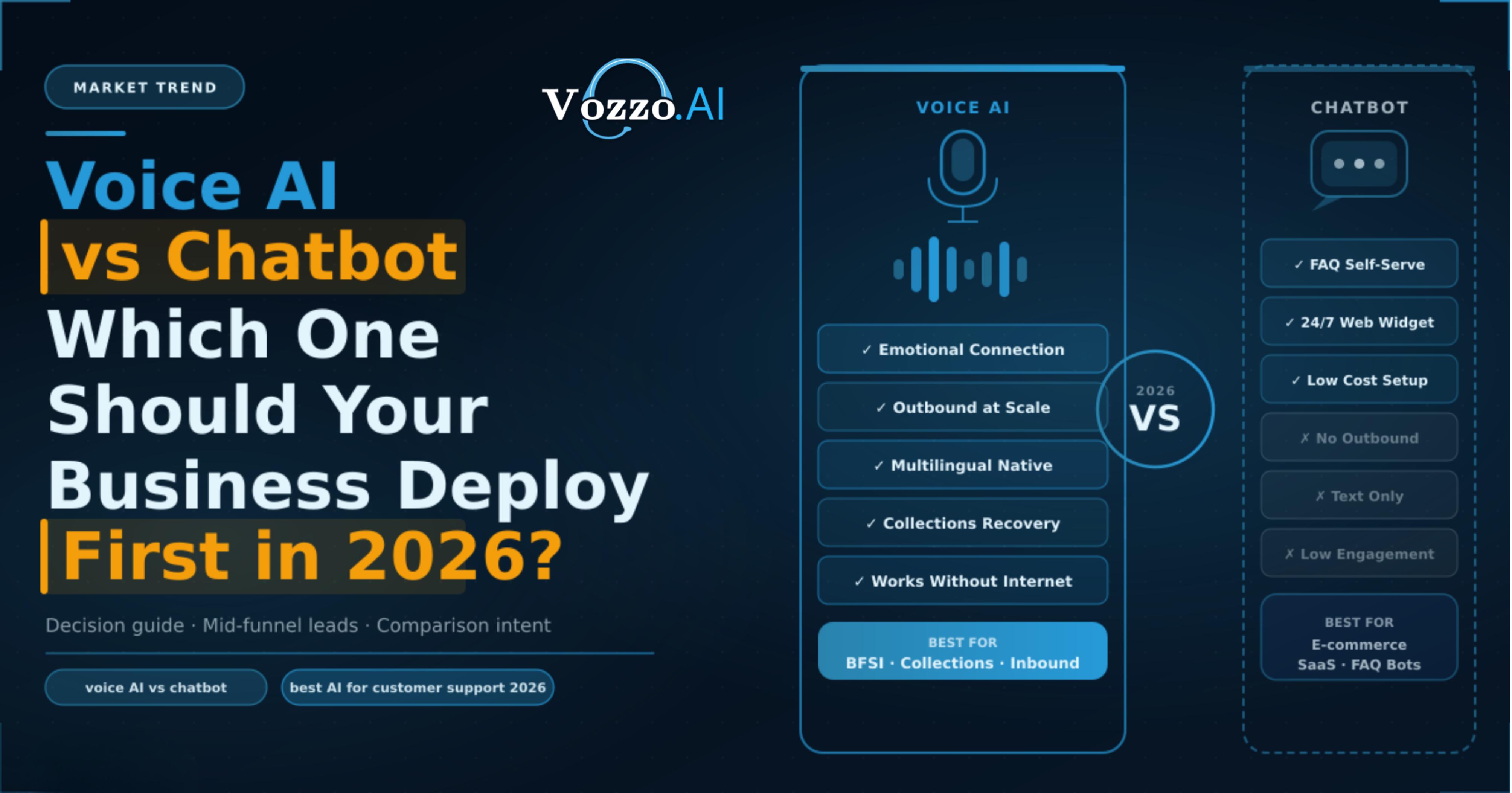
Before voice AI: A customer calls about a suspicious transaction. IVR routes to queue. Average wait time: 8 minutes. Agent verifies identity (2 minutes), pulls transaction data (1.5 minutes), initiates dispute (3 minutes). Total handle time: 14.5 minutes. After voice AI: Customer calls, agent authenticates via voice biometrics (12 seconds), retrieves transaction context automatically, completes dispute filing through conversational interface. Total handle time: 3.2 minutes. Chatbot before-after shows similar compression but for different workflows. Before: Customer opens app, navigates menu, types balance inquiry, waits for response. After: Types "balance" in chat widget, receives instant response with breakdown. The critical difference: voice AI vs chatbot | AI voice agent vs chatbot | best AI for customer support 2026 depends on whether your bottleneck is call queues or digital self-service adoption.
Business Impact: Deployment Metrics That Matter
Voice AI deployments in banking show 62% reduction in average handle time for tier-1 calls, 89% authentication accuracy via voice biometrics, and $4.20 cost per interaction versus $12.50 for live agents. Chatbot deployments achieve 91% resolution rate for balance and transaction queries, 24/7 availability with zero wait time, and $0.70 cost per interaction. Containment rate differences are significant: voice AI contains 73% of payment and dispute calls, while chatbots contain 84% of informational queries. Revenue impact varies by use case—voice AI drives 34% faster loan origination by automating document collection and verification calls, while chatbots increase card activation rates by 28% through proactive in-app prompts during onboarding flows.
Integration and Compliance: Trust Infrastructure Requirements
Voice AI requires telephony stack integration (SIP trunking, CTI middleware), voice biometrics enrollment, and PCI-DSS compliance for payment handling over phone channels. Expect 6-8 week implementation timelines for core banking system integration. Chatbots need API connections to account databases, session management for secure authentication, and WCAG 2.1 accessibility compliance for web deployment. Both channels must maintain conversation logs for regulatory audit trails—GDPR for EU customers, SOC 2 Type II for enterprise contracts. Vozzo AI provides pre-built connectors for Temenos, FIS, and Finastra core systems, reducing integration time to 3 weeks. Compliance certifications include ISO 27001, PCI-DSS Level 1, and built-in consent management for voice recording and data processing across 47 regulatory jurisdictions.
Conclusion
The winner in 2026 is not voice AI or chatbot—it's sequential deployment based on your interaction data. Organizations that deploy the right channel first achieve ROI 4.3 times faster than those who guess. Your competitors are making this decision right now, and the 90-day proof-of-concept window is already closing.