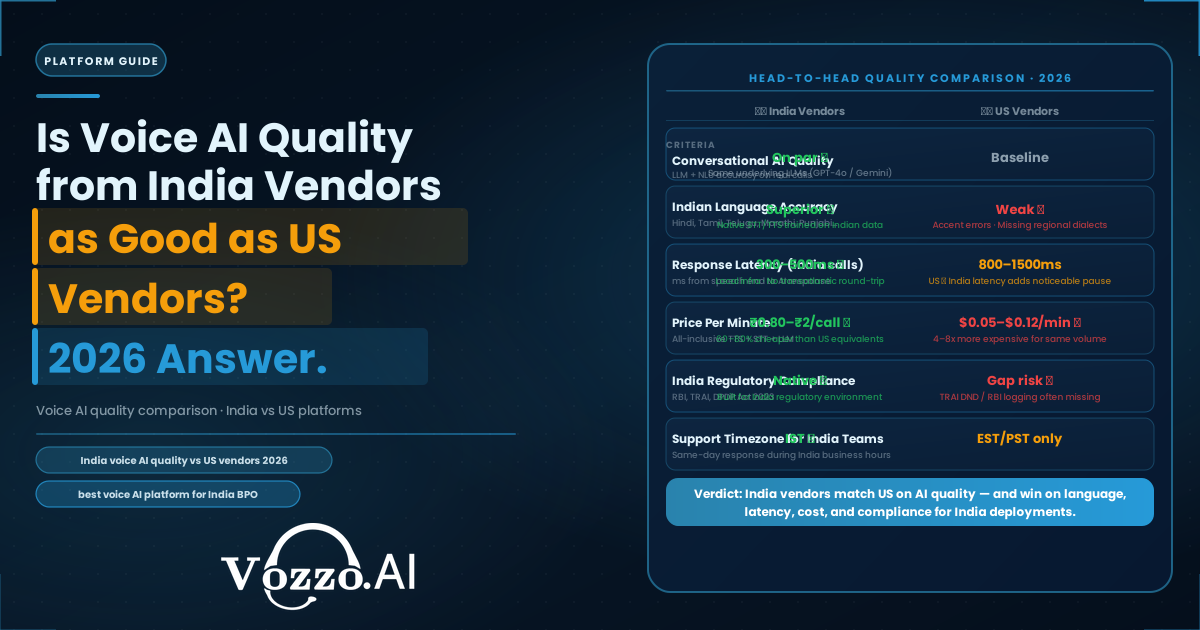
The honest answer is more nuanced than either the Indian vendor sales team or the US vendor sales team will give you: leading Indian vendors are ahead on multilingual Indian language accuracy, high-volume concurrency at low cost, and production experience in BFSI and BPO, while US platforms still lead on European language support, certain compliance infrastructure, and brand recognition in Western procurement. So the real question is not which country makes better voice AI. It is which platform is better for your specific use case, language mix, and geography.
Where Indian Voice AI Vendors Lead US Platforms in 2026
Indian and South Asian language accuracy
No US platform has invested in Hindi, Tamil, Telugu, Marathi, Kannada, Bengali, Punjabi, and Gujarati with the depth of leading Indian vendors, whose training data reflects years of real production call recordings in these languages. The gap on Indian English accents is particularly significant, as US platforms trained primarily on American English consistently underperform on the accent variation that characterises Indian call center audio. For any deployment where a large share of callers speak Indian English or regional Indian languages, the best Indian vendors outperform US equivalents on raw accuracy.
High-volume concurrency at production scale
India's BFSI, telecom, and e-commerce sectors have run voice AI at 10,000–50,000 daily calls for longer than most Western markets. Engineering teams at leading Indian vendors have already solved the latency, concurrency, and quality-under-load problems that come with these volumes. US platforms with comparable concurrency experience tend to be significantly more expensive.
Cost-to-performance ratio
At equivalent accuracy for supported languages, the best Indian voice AI vendors price 40–70% below US equivalents. That is not a sign of inferior technology — it reflects a lower cost base and development investment amortized across a large domestic market. In any honest assessment of voice AI quality India vendors vs US vendors, this pricing difference is often the deciding variable for enterprises and BPOs whose automation economics must work at scale.
Domain-specific deployment experience in BFSI and healthcare
Indian voice AI vendors have been deployed in high-stakes regulated environments — bank collections, insurance renewals, hospital appointment systems — under RBI and IRDAI oversight. That experience produces platforms with stronger audit logging, compliance reporting, and escalation handling. Platforms whose production history sits mainly in lower-stakes consumer applications rarely match it.
Where US Voice AI Platforms Still Lead Indian Vendors in 2026
European language support
Dutch, German, French, Swedish, and other European languages are significantly better supported by US and European providers than by Indian vendors. This reflects where each has deployed at scale: US platforms have more European enterprise clients and more European-language training data. For global BPOs serving European-language customer bases, this remains a meaningful gap in most Indian vendor offerings.
Brand recognition in Western procurement processes
A UK or Dutch procurement team will already have relationships with AWS, Microsoft, and Google that Indian vendors do not. This is a sales and relationship gap rather than a quality gap. It still affects procurement timelines and the risk tolerance of buyers making their first Indian vendor selection.
Consumer and retail voice applications
US platforms have invested heavily in consumer-facing voice — smart speakers, retail AI, and in-app voice features — where voice naturalness and conversational breadth matter more than domain-specific accuracy. If your use case is consumer-facing with broad conversational scope, US platforms have more mature offerings. Indian vendors have focused more on structured enterprise workflows.
The Dimensions That Are Now Equal
LLM integration and conversational intelligence. The large language models behind conversational voice AI are largely the same globally. Whether an Indian or US vendor uses GPT-4, Claude, or Gemini as the intelligence layer, the conversational quality ceiling is set by the same foundation models.
TTS voice naturalness for English. The gap in English text-to-speech naturalness between leading Indian and US vendors closed significantly across 2025–2026. Both now use neural TTS that is hard to distinguish from human speech in controlled listening tests.
API and integration ecosystem. Leading Indian vendors now offer integrations with Salesforce, SAP, Genesys, Twilio, and Microsoft Teams comparable to US alternatives. The "easier to integrate" advantage US platforms once held has largely disappeared for enterprise deployments.
How to Make the Right Decision for Your Deployment
Any India vs US voice AI platform comparison in 2026 should start from your language mix and economics, not the vendor's country of origin.
If your primary language mix is Indian languages or Indian English — evaluate Indian vendors first. The accuracy advantage is real, the cost advantage compounds at scale, and US platforms are playing catch-up in this segment.
If your deployment is European-language-only — evaluate US and European platforms first. Indian vendors are improving, but the production evidence base for European languages is thinner.
If your deployment spans Indian and European languages — run a rigorous accuracy benchmark across your exact language mix on real audio from your actual use case. When comparing Indian voice AI vs US voice AI quality here, the answer will be vendor-specific, not country-specific.
If cost is a primary variable in the business case — Indian vendors will almost always produce stronger unit economics at comparable accuracy for supported languages.
If Western procurement relationships and compliance documentation are critical path — factor in a 3–6 month relationship-building timeline with an Indian vendor your procurement team has not worked with before.
Vozzo AI — Indian Voice AI Built for Global Quality Standards
Vozzo AI is built on the premise that Indian voice AI must meet global enterprise quality standards — not as a future ambition but as a current production requirement. Deployed at scale across BFSI, healthcare, and BPO in India, with active enterprise clients in the UK and broader international markets, Vozzo AI brings multilingual Indian language accuracy, high-volume production experience, and GDPR-compliant infrastructure into a single platform. British and Irish English accuracy is validated on real client audio, not benchmark datasets. Enterprise procurement teams can access reference clients, compliance documentation, and live accuracy testing before any commercial commitment.
Conclusion
Whether Indian voice AI quality matches US quality no longer has a simple answer, because in the dimensions that matter most for high-volume multilingual enterprise deployments, leading Indian vendors are not catching up to US platforms — they are ahead of them. Enterprises that evaluate on evidence — live accuracy tests, production references, compliance documentation — rather than brand recognition will build voice AI operations that are more accurate, more cost-effective, and better suited to the language realities of their customer base.