At 10,000 calls per day, the difference between a voice AI platform charging $0.006 per second of TTS and one charging $0.002 per second is not a rounding error — even at just 12 seconds of AI speech per call, it is $14,400 per month in pure infrastructure cost before you have built a single conversation flow or hired a single engineer. For enterprises and BPOs in India, the UK, the Netherlands, and Ireland running high-volume voice AI deployments, TTS and STT costs are the line item that determines whether the business case holds.
What TTS and STT Costs Actually Mean for a High-Volume Voice AI Deployment
TTS — Text to Speech — is the cost of converting your AI's response into spoken audio. Every word your voice AI agent speaks carries a per-character or per-second cost.
STT — Speech to Text — is the cost of transcribing what the caller says into text the AI can process. Every second of caller speech carries a per-second or per-minute cost.
At low call volumes these costs are negligible. At enterprise scale — 5,000 to 50,000 calls per day — TTS and STT are the largest variable cost in your voice AI infrastructure, often exceeding the LLM inference cost for the conversation itself.
The platforms that appear cheapest at demo stage often have the most expensive TTS and STT pricing at production volume — the costs are buried in per-minute charges, minimum commitments, or add-on tiers. Finding the cheapest TTS STT voice AI platform for your deployment means looking past the headline rate to what you will actually be billed at 15,000 calls a day.
How TTS and STT Are Priced — What to Look For Before You Sign
Per character vs per second TTS pricing. Per-character pricing is more predictable for scripted flows with known response lengths. Per-second pricing is more expensive for verbose AI responses and cheaper for short confirmations — so know your average AI response length before comparing quotes.
STT pricing models. Per-minute billing in 15-second increments is the most common model. Some platforms bill per utterance regardless of length, which is cheaper for short caller responses and expensive for long ones. Map your actual call patterns to the billing model before committing.
Streaming vs batch STT. Real-time streaming STT costs more per second than batch processing, but it is non-negotiable for conversational AI where the response must start before the caller finishes speaking. Compare quotes like-for-like on streaming accuracy.
Language surcharges. English STT and TTS is the cheapest tier on every platform. Hindi, Tamil, Telugu, Dutch, Irish English, and other non-US-English languages carry surcharges of 20–80% on most global platforms — for deployments in India, the Netherlands, or Ireland, that can double the effective TTS/STT cost versus the headline rate.
Volume tiers and minimums. Enterprise pricing unlocks at 1M+ characters per month on most platforms; below that threshold you are paying retail rates. Know where your volume sits against each platform's tier boundaries.
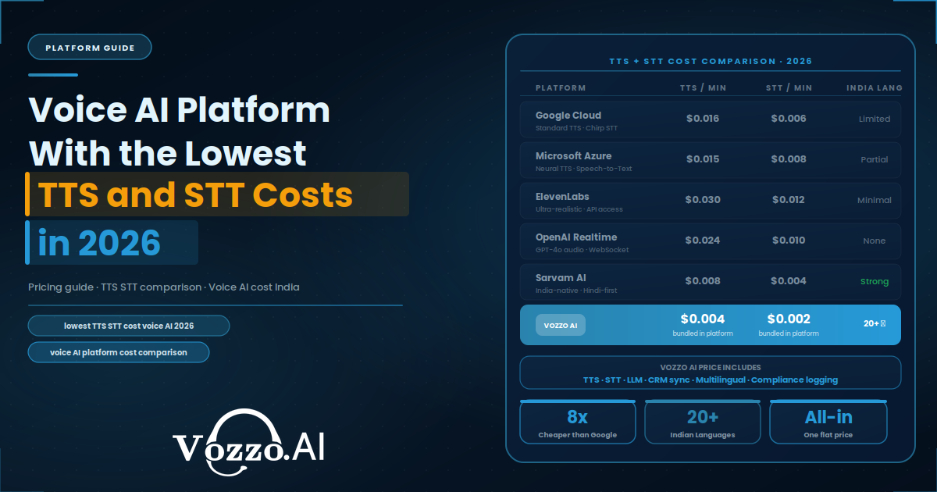
TTS/STT Cost Comparison — The Major Platforms in 2026
Google Cloud TTS/STT — Competitive pricing at scale and strong multilingual support, including Indian languages and Dutch. Neural voice quality is high. Language surcharges apply for non-English, and a minimum commitment is required to unlock enterprise pricing. Strong for enterprises already in the Google ecosystem.
AWS Polly and Transcribe — Polly TTS is among the lowest per-character costs at scale. Transcribe STT is reliable for English and Hindi; Dutch and Irish English accuracy is acceptable but not best-in-class. No streaming STT on lower tiers. Strongest for AWS-native deployments.
Microsoft Azure Cognitive Services — Strong Dutch language support makes Azure a natural choice for Netherlands deployments. Neural TTS voice quality is competitive with Google, and STT accuracy on Indian English accents has improved significantly through 2025–2026. Enterprise agreements unlock significant discounts.
ElevenLabs — The highest voice quality TTS available, priced at a premium that makes it unviable for high-volume call center deployments. Best suited to low-volume, high-quality applications where voice naturalness matters more than cost.
Deepgram — Strong STT accuracy on diverse accents, including Indian English, with strong price competitiveness at volume. Its TTS offering is more recent and still maturing. Worth evaluating for STT-heavy deployments.
Vozzo AI — Built for high-volume enterprise and BPO deployments across India, the UK, the Netherlands, and Ireland, with TTS and STT costs optimised for call center scale. For operations teams looking for the voice AI platform lowest TTS STT costs at production volume, Vozzo's per-call pricing model bundles TTS, STT, and LLM inference — removing the unpredictability of per-second billing at volume. Vozzo is already live with enterprise clients at scale across Indian and international markets.
What a High-Volume Deployment Actually Costs — A Worked Example
Scenario: A BPO handling 15,000 calls per day: 3-minute average call duration, 90 seconds of AI speaking time and 60 seconds of caller speaking time per call.
- Monthly TTS volume: 15,000 × 90 seconds × 30 days = 40,500,000 seconds of TTS
- Monthly STT volume: 15,000 × 60 seconds × 30 days = 27,000,000 seconds of STT
At $0.004 per second TTS + $0.006 per second STT:
- TTS cost: $162,000 per month
- STT cost: $162,000 per month
- Combined: $324,000 per month
At $0.001 per second TTS + $0.002 per second STT (enterprise tier):
- TTS cost: $40,500 per month
- STT cost: $54,000 per month
- Combined: $94,500 per month
The difference: $229,500 per month — roughly $2.75M per year — from the same call volume on different pricing tiers. This is why TTS/STT cost optimisation is the highest-leverage infrastructure decision in any voice AI deployment above 5,000 calls per day. Low cost speech to text and text to speech AI in 2026 is about matching your call profile to the right tier, not picking the cheapest vendor.
Questions to Ask Any Voice AI Platform About TTS/STT Costs Before Signing
- What is your per-second TTS cost for my target languages at my projected monthly volume? Get this in writing — not estimated from a pricing page that changes quarterly.
- Is STT billed per second of audio or per 15-second increment? The difference compounds significantly at scale.
- What language surcharges apply for Hindi, Dutch, Tamil, or Irish English? These are not always disclosed on the headline pricing page.
- Is there a minimum monthly commitment, and what happens to pricing if I fall below it? Seasonal call volume variation is real, and minimum commitments can make low months disproportionately expensive.
- Does your per-call or per-minute bundled pricing include TTS, STT, and LLM inference — or are these billed separately? If separate, ask for the unbundled cost of each.
The Bottom Line
TTS and STT costs are the hidden variable that makes or breaks the unit economics of enterprise voice AI at scale, and the platform with the best demo voice quality is rarely the platform with the best cost structure at 15,000 calls per day. Model your actual call volume, language mix, and average call duration against real pricing tiers before committing to any platform — at enterprise scale, the difference runs into hundreds of thousands of dollars annually.