
A European enterprise deploys a voice AI platform for its Indian BPO partner. Six months in, the GDPR audit asks one question: where is the voice data being processed and stored? The answer — US-based servers, no data processing agreement, no data residency confirmation — triggers a remediation and breach-assessment process that costs more than the entire voice AI contract was worth. It is the scenario playing out across enterprises that bought voice AI on capability and forgot to buy it on compliance.
Why GDPR and RBI Compliance Are Not the Same Problem — But Both Apply to Voice AI
GDPR (and UK GDPR) governs how EU and UK residents' personal data is collected, processed, stored, and transferred. Voice calls containing customer names, account details, and health information are personal data under GDPR's definition — health information is special category data under Article 9.
RBI's directions govern how banks, NBFCs, and payment companies in India handle customer data — including call recordings from collections, lending, and banking service interactions. Payment system data must be stored in India, and recordings must be produced promptly on regulatory or ombudsman request. The DPDP Act, 2023 adds consent and Data Fiduciary obligations on top.
For enterprises operating across both jurisdictions, both frameworks apply simultaneously, and their requirements do not always align cleanly. A GDPR compliant voice AI India deployment is an architecture decision, not a checkbox.
The conflict point: GDPR restricts the transfer of EU personal data outside the EEA without adequate safeguards, while RBI requires Indian payment data to remain in India. An enterprise spanning both must architect its voice AI data flows to satisfy both at the same time.
What GDPR Requires From a Voice AI Platform — The Non-Negotiables
Lawful basis for processing voice data. Every call recording processed by an AI platform requires a lawful basis under GDPR Article 6. Usually that is legitimate interest or contractual necessity — documented and defensible, not assumed.
Data minimisation. The voice AI platform must process only the data necessary for the stated purpose. A collections AI that stores unrelated personal information is processing beyond its lawful basis.
Data subject rights. Callers have rights to access, erasure, and objection, and the platform must support them operationally — not just in the privacy policy. Can you delete one customer's call data on request without disrupting the rest of the dataset?
Data Processing Agreements. Any voice AI vendor processing EU personal data on your behalf is a data processor under GDPR Article 28. A signed DPA — with Standard Contractual Clauses wherever data leaves the EEA — must be in place before a single call is processed. Without one, every call processed is a compliance exposure.
Data residency within the EEA or UK. For UK and EU enterprise clients, call data processing and storage within the EEA or UK is the cleanest compliance position. Transfers outside require either an adequacy decision or SCCs with a transfer risk assessment — and the vendor must document which applies.
What RBI Requires From a Voice AI Platform — The Indian Compliance Framework
Data localisation for financial data. RBI mandates that payment system data is stored only in India. For banks, NBFCs, and lenders, call recordings and transcriptions containing financial customer data should sit on servers in India.
Call recording retention and retrieval. Regulated entities must retain call recordings for the period their record-retention policies and applicable RBI directions require, and produce them quickly when the RBI Ombudsman or an internal grievance review asks. The platform must support this operationally.
Fair Practices Code for collections calls. Voice AI platforms making automated collections calls must respect RBI's recovery conduct norms: calls only between 8am and 7pm, clear identification at the start of each call, and no coercive or threatening language. Enterprises should treat these rules as applying to automated AI calls exactly as they apply to human agents.
Audit trail completeness. Every AI-initiated customer interaction should be logged with caller ID, timestamp, call outcome, and agent identification for regulatory audit. A voice AI platform that does not produce complete audit logs per call leaves the regulated entity unable to evidence compliance.
The Five Questions to Ask Any Voice AI Vendor Before Signing on Compliance
1. Where is voice data processed and stored — name the data centers and jurisdictions?
Not "we use cloud infrastructure" — specific regions: EEA or UK for European clients, India for Indian financial services. A voice AI platform GDPR RBI compliant by design will put this in the contract, not just the sales deck.
2. Do you have a signed DPA template that meets GDPR requirements, including SCCs?
Ask to see the DPA before the commercial negotiation starts. A vendor without a current DPA template has not been through GDPR compliance seriously.
3. How do you support data subject access and erasure requests?
Ask for the operational process, not the policy statement. Can they delete one customer's data without a database operation that requires vendor professional services? If not, your compliance depends on their responsiveness.
4. What is your RBI data localisation position for Indian financial services clients?
If the vendor's infrastructure is not in India, ask specifically about their Indian data residency option. Some global platforms offer India regions only at a premium, with feature gaps.
5. What compliance certifications do you currently hold, and when were they last audited?
ISO 27001, SOC 2 Type II, PCI-DSS for payments, HIPAA for healthcare if applicable. Ask for the audit reports, not the logos on the website. Current means audited within the last 12 months.
How Vozzo AI Approaches GDPR and RBI Compliance
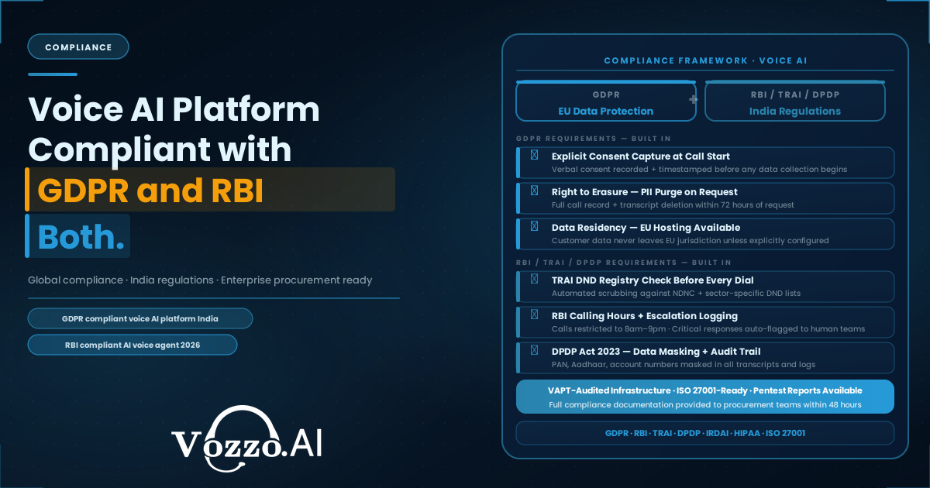
Vozzo AI operates with Indian data residency for Indian financial services deployments — call recordings, transcriptions, and customer interaction data are stored within India in line with RBI localisation requirements. For European and UK enterprise clients, Vozzo AI supports EEA-compliant data processing, with DPA documentation and Standard Contractual Clauses available for review before contract signature. The platform produces complete audit logs per call — timestamp, caller identification, call outcome, and agent identification — supporting RBI retrieval expectations and GDPR's accountability principle simultaneously. Compliance documentation, including current security certifications, is available to enterprise procurement teams on request.
Before vs After Compliance-First Voice AI Platform Selection
Before: platform chosen on capability and price, compliance a legal checkbox, DPA signed six months after go-live, data residency unconfirmed, audit logs incomplete — and the first regulatory inquiry triggers a three-month remediation project.
After: compliance requirements defined before shortlisting, DPA reviewed before negotiation, data residency confirmed in contract, audit logs validated against regulatory requirements — and the first regulatory inquiry answered within 24 hours from complete records.
Conclusion
GDPR and RBI compliance are not post-deployment problems — they are pre-selection criteria that determine which voice AI platforms are even eligible for enterprise consideration. The enterprises that build compliance requirements into their vendor evaluation in 2026 avoid the remediation costs that enterprises who selected on capability alone are paying now. A voice AI platform that cannot answer the five questions above clearly and in writing is not ready for regulated enterprise deployment.