In the renewal meeting, a BPO's largest client stops the slide deck and asks one question: what is your AI roadmap? The honest answer is uncomfortable. Building production voice AI in-house would take more than a year and a team of speech, LLM and telephony engineers the BPO does not have.
Why BPOs Need an Infrastructure Partner, Not Another Tool
AI-enabled service has moved from a nice-to-have to a line item in client RFPs. Clients want automated handling of routine calls, after-hours coverage and faster resolution, and they expect their BPO to deliver it. A BPO's job is to run operations at scale, not to become an AI research lab.
There are three ways to get there:
- Build. Maximum control and full ownership of the stack, but the slowest and most expensive route. You carry hiring, telephony integration, security reviews and maintenance, plus the risk that the stack is outdated by launch.
- Buy a branded tool. Fast to start, but the vendor's name sits in front of your client. You resell someone else's product, the client can go direct, and your margin and differentiation shrink.
- White label. Launch speed close to buying, with your brand on the service and the client relationship staying with you. You trade some control over the underlying platform for speed and lower capital outlay, so partner selection becomes the critical risk.
For most mid-sized and large operators, white label voice AI for BPOs is the route that balances speed, cost and client ownership.
What a White Label Voice AI Partner Must Provide
1. Your brand on dashboards and reporting. Clients should log into your portal, see your logo and receive reports under your name. A true voice AI infrastructure partner for BPOs stays invisible to your end clients.
2. Multi-client architecture with data isolation. You will run voice agents for a bank, a retailer and a healthcare provider on the same platform. Each client's recordings, transcripts and configurations must be logically separated, with access controls that keep one client's data out of another's view.
3. No-code flow building your ops team can use. Your process leads know the call flows better than any engineer. They should be able to build, test and change conversation flows without filing a ticket with the vendor.
4. Multilingual coverage for your client base. If you serve clients across regions, the platform needs to handle the languages and accents your callers actually use. Test on real call samples, not a demo script.
5. A commercial model that leaves BPO margin. Per-call or per-minute wholesale pricing lets you mark up and package the service your way. Watch for minimum commitments or seat-based fees that eat into margin before volume ramps.
6. Analytics clients can see as part of your service. Containment, resolution, escalations and sentiment should be reportable per client. When clients can see outcomes in your dashboard, the AI becomes part of the value you sell, not a cost you absorb.
7. SLA and support aligned to your operating hours. If your floors run around the clock, your partner's support cannot stop at 6 pm in another time zone. Get uptime commitments and escalation paths in writing.
How a BPO Launches a Voice AI Service Line, Step by Step
- Pick two or three high-volume use cases per client. Order status, payment reminders, appointment booking and first-level triage are common starting points.
- Configure flows and languages. Map the existing script, define the escalation triggers and set up the languages that client's callers use.
- Pilot on a slice of volume. Route a small, controlled share of calls to the voice agent while agents handle the rest.
- Set success metrics with the client. Agree on containment, resolution, handling time and satisfaction targets before you scale.
- Go live with human escalation paths. Every flow needs a clean handoff to a live agent with full context, so callers never get stuck.
- Report outcomes under your brand. Share regular performance reports from your own dashboard, tied to the agreed metrics.
- Expand to adjacent processes. Once the first use cases prove out, extend to collections, surveys, outbound reminders or after-hours support.
The Commercial Model for BPOs
The margin logic is simple. You pay the platform a wholesale rate and bill the client at a rate that reflects your service: flow design, operations, quality monitoring, reporting and the escalation path to your human agents. The spread between the two is your gross margin on the AI line.
There are three common ways to package it. AI can be added to existing contracts as an add-on, priced per call or per minute. It can be bundled into a blended rate alongside human agents. Or it can be priced on outcomes, such as per resolved call or per successful payment reminder, which suits clients who want to pay for results.
Illustrative example (hypothetical, round numbers, not based on real client results): suppose a BPO pays a wholesale rate of $0.10 per AI minute and bills its client $0.20 per minute. At 100,000 AI minutes a month, platform cost is $10,000 and client billing is $20,000, leaving $10,000 in gross margin before the BPO's own setup and operating costs. Actual rates, volumes and margins will vary by partner, use case and contract.
Where Vozzo AI Fits
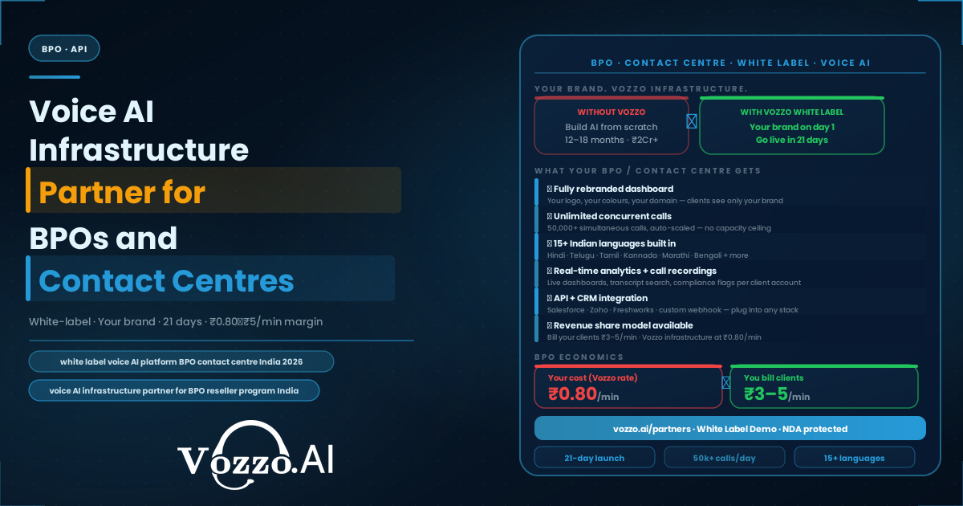
Vozzo AI offers white label voice AI solutions for BPOs and contact centers. White label means a BPO can offer voice AI to its clients under its own brand, rather than reselling another vendor's product. If you are evaluating partners for an upcoming renewal or RFP, talk to the Vozzo AI team about your use cases and client mix.
Questions BPOs Should Ask Any White Label Voice AI Partner
- Is it truly white label, or co-branded? Check dashboards, reports, emails, call recordings and any caller-facing elements for vendor branding.
- How is each client's data isolated? Ask how recordings, transcripts and configurations are separated, and who on the vendor side can access them.
- Who owns the client relationship and the data? The contract should state that your clients are yours and that the vendor will not approach them directly.
- What happens to flows and data if you leave? Confirm export formats, deletion timelines and whether your flow configurations are portable.
- What is the SLA and support coverage? Get uptime, response times and support hours in writing, matched to your operating shifts.
Voice AI is now part of what clients expect from a BPO. Operators that add it as a managed service protect their existing contracts and open a revenue line that does not scale with headcount.