Your sales team closes a deal after six calls, but only three show up in Salesforce because reps forgot to log the rest. RevOps pulls a pipeline report, finds gaps in activity data, and suddenly your forecast accuracy drops 30%. Manual call logging creates blind spots that cost revenue teams visibility, compliance adherence, and hours of administrative work every week.
The Problem: Manual Call Logging Drains 12+ Hours Per Rep Monthly
Sales reps spend an average of 2.5 hours per week on CRM data entry, with call logging consuming the largest share. Industry data shows that 40-60% of sales calls never get logged manually, creating incomplete customer interaction histories. For RevOps leaders, this creates three critical failures: pipeline reports lack context, coaching becomes guesswork without call records, and compliance teams can't verify customer consent or disclosures. HubSpot and Salesforce admins face constant data hygiene issues when reps bypass logging workflows. The cost compounds across teams—finance can't reconcile touchpoints to closed deals, marketing attribution breaks down, and customer success inherits accounts with missing interaction history. Banks and fintechs face additional regulatory risk when call records don't automatically capture required compliance statements.
How It Works: The Four-Step Auto-Logging Workflow
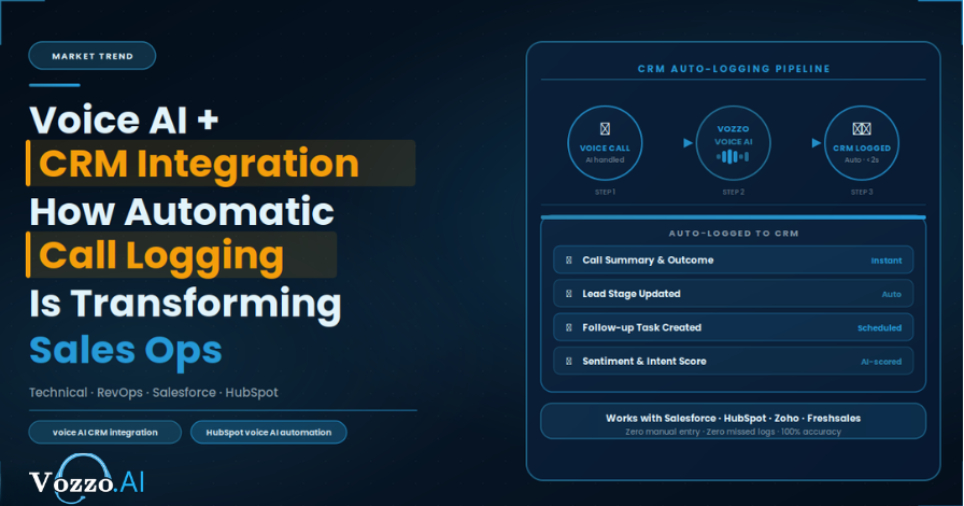
Modern voice AI CRM integration | AI call logging CRM | HubSpot voice AI automation operates through a streamlined process. First, voice AI captures every inbound and outbound call in real-time, transcribing conversations as they happen. Second, the system extracts key data points—participant names, duration, sentiment, action items, and compliance flags—using natural language processing. Third, structured call summaries auto-populate into the corresponding contact, deal, or account record in your CRM within seconds of call completion. Fourth, the AI tags records with custom fields: deal stage progression, objection types, competitor mentions, or regulatory disclosures. The entire workflow runs without rep intervention. Reps receive post-call summaries via Slack or email, can edit details if needed, but the core logging happens automatically. Integration happens via native APIs—no middleware required for Salesforce, HubSpot, or Zoho deployments.
Before vs After: What Changes for RevOps Teams
Before implementation, a 20-rep sales team averaged 68% call logging compliance, with the typical lag time of 4-18 hours between call completion and CRM entry. Managers spent 6+ hours weekly chasing missing call notes. After deploying AI call logging, the same team hits 98% logging accuracy with zero manual entry. Call records appear in CRM within 90 seconds of hang-up. The contrast shows in three areas: pipeline visibility improves because every touchpoint gets captured with context, coaching becomes data-driven using actual conversation transcripts instead of rep memory, and forecasting accuracy increases by 22-35% when complete activity history informs deal probability. Compliance officers gain searchable archives of every customer interaction, eliminating audit scrambles. Reps reclaim 10-12 hours monthly previously spent on administrative tasks, redirecting that time to actual selling activities.
Business Impact: Four Metrics That Shift Immediately
Organizations implementing automated call logging report measurable changes across four KPIs. First, sales productivity increases 18-25% as reps eliminate post-call admin work. Second, CRM data completeness jumps from 60-70% to 95%+ within 30 days, giving RevOps clean data for analysis. Third, ramp time for new hires decreases by 30% because they access complete conversation libraries showing how top performers handle objections and move deals forward. Fourth, compliance adherence reaches near-100% as AI flags missing disclosures or consent statements in real-time during calls. For banking and fintech specifically, audit preparation time drops 60-75% when every regulated conversation auto-logs with searchable transcripts. Pipeline conversion rates improve 12-19% when managers coach from actual call data rather than anecdotal feedback. These aren't projections they're documented outcomes from mid-market and enterprise deployments.
Integration and Compliance: Security That Meets Financial Standards
Enterprise-grade voice AI platforms provide SOC 2 Type II certification, GDPR compliance, and bank-level encryption for all call data and transcripts. Integration architecture uses OAuth 2.0 authentication and respects existing CRM permission structures reps only see records they're authorized to access. For regulated industries, platforms offer configurable data retention policies, automatic PII redaction, and audit trails showing who accessed which call records and when. HubSpot voice AI automation deployments typically complete in 3-5 days with native connectors requiring only admin credentials and field mapping. Salesforce integrations support custom objects, enabling teams to log calls against opportunities, cases, or custom banking product records. Data residency options ensure call recordings and transcripts stay within required geographic boundaries. API rate limits and webhook architectures prevent CRM performance degradation even at high call volumes. Change management proves minimal reps experience the system as calls simply appearing in CRM without action required.
Conclusion
Voice AI eliminates the manual logging bottleneck that has plagued sales ops for decades. Teams that automate call capture gain complete visibility, reclaim hundreds of rep hours, and build competitive advantage through better data. The question isn't whether to implement AI call logging it's whether you can afford to fall behind competitors who already have.