
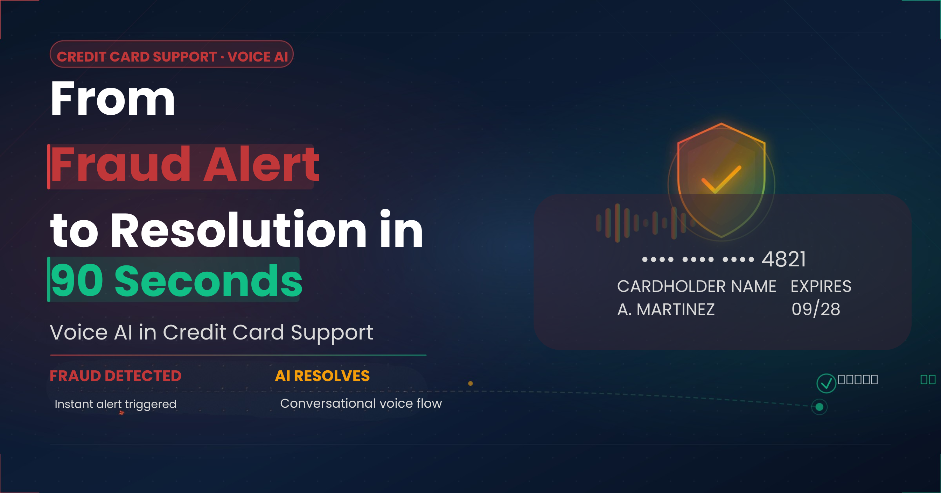
It is 2am. A fraudulent transaction hits your customer's credit card. Your fraud detection system flags it instantly. But then what? If your answer is 'the customer calls us in the morning' or 'they wait in a queue' you are about to lose that customer permanently. Voice AI resolves the entire fraud alert workflow in 90 seconds, at 2am, in the customer's language, without a single human agent.
The Fraud Response Gap Where Banks Lose Customer Trust
Credit card fraud costs global banks $32 billion annually, according to the Nilson Report 2025. The average time for a human agent to resolve a fraud alert runs between 11 and 18 minutes including hold time. According to J.D. Power, 43% of customers who experience fraud and a poor resolution experience switch banks within 90 days. Fraud-related calls are the highest-stress customer interaction in banking — getting this wrong is disproportionately damaging to lifetime customer value. The most striking finding: 78% of fraud victims say speed of resolution matters more than the outcome itself.
The fraud detection system is not the weak link — the resolution workflow is. Banks that have deployed an AI are reducing that 43% churn rate. Every hour that a fraud resolution sits in a queue is an hour your customer is deciding whether to stay.
The Complete 90-Second Voice AI Fraud Resolution Workflow
Step 1: Fraud detection triggers outbound AI call — 0 seconds
The moment your fraud detection system (Feedzai, FICO, Actimize, or internal rule engine) flags a suspicious transaction, it fires a webhook to Vozzo AI. The voice agent initiates an outbound call to the cardholder within seconds — no human needed to trigger, review, or queue the call. The customer's phone rings before they have even noticed the transaction.
Step 2: Identity verification — 0–15 seconds
The AI greets the customer by name and initiates voice-based authentication — last 4 digits of card, date of birth, or OTP sent simultaneously via SMS. This replaces the 3–4 minute manual verification process human agents run. Multi-factor authentication completes in under 15 seconds.
Step 3: Fraud transaction presented — 15–25 seconds
The AI reads the flagged transaction details clearly: merchant name, amount, location, and timestamp. It asks one binary question: "Did you make this transaction — yes or no?" Natural language processing handles any variation of yes, no, or "I'm not sure."
Step 4: Confirmed fraud — card block initiated — 25–40 seconds
If the customer confirms fraud, the AI immediately triggers a card block via API call to the core banking system. The customer hears confirmation within the same call: "Your card ending in XXXX has been blocked. No further transactions will be processed." Zero delay between confirmation and action.
Step 5: Replacement card initiated — 40–60 seconds
The AI triggers the replacement card dispatch workflow automatically — pulling the customer's registered address from CRM and initiating the card printing and courier API. Delivery timeline is communicated to the customer on the call: "Your new card will arrive within 3–5 business days." This is how a credit card fraud voice agent transforms the worst customer moment into a seamless recovery experience.
Step 6: Dispute and chargeback initiated — 60–75 seconds
The AI logs the fraudulent transaction as a formal dispute in the core banking system, assigns a case reference number, and reads it to the customer. The chargeback process is initiated automatically — no form to fill, no callback required, no follow-up visit to the branch.
Step 7: Resolution confirmation and case summary — 75–90 seconds
The AI summarises everything completed in the call: card blocked, replacement dispatched, dispute raised, case number provided. An SMS and email summary is triggered simultaneously. The call ends. Total elapsed time: under 90 seconds. This is AI banking support automation at its most complete — every action taken, every confirmation given, every record updated, in a single uninterrupted workflow.
What This Workflow Replaces
Before voice AI: customer discovers fraud, calls bank, waits on hold 8–14 minutes, agent verifies identity manually 3–4 minutes, agent checks transaction system, agent initiates block, transfers to disputes team, customer waits again, dispute logged, call ends after 18–25 minutes. Total: 18–25 minutes, 2 agents, significant customer stress.
After voice AI: fraud detected, outbound AI call within seconds, full resolution in 90 seconds, zero hold time, zero transfers, zero agent involvement for routine fraud. Human agents reserved only for complex fraud cases requiring investigation. The difference is not incremental — it is structural. AI banking support automation does not speed up the old process. It replaces it entirely.
The CX and Commercial Impact for Banks and Fintechs
Banks deploying Vozzo AI's fraud resolution workflow consistently report four measurable outcomes: an 87% reduction in average fraud resolution time, down from 18 minutes to 90 seconds; a 94% first-contact resolution rate on standard fraud alerts with no callbacks or follow-up needed; a 31% improvement in post-fraud CSAT scores when resolution happens proactively via outbound AI call; and a 60% reduction in fraud-related call center volume, freeing agents for complex investigations and relationship banking. These are not projections — they are the operational reality of replacing a manual queue with an AI-driven outbound workflow.
Compliance and Security Built Into Every Fraud Call
Every fraud resolution call by Vozzo AI is recorded, timestamped, and stored with tamper-evident audit logs meeting RBI, PCI-DSS, and DPDP compliance requirements. Voice authentication follows NIST standards. Card block and dispute APIs connect directly to core banking systems via encrypted channels with full transaction logging. The entire workflow is auditable end-to-end — critical for regulatory reporting and dispute resolution in the event of a customer escalation.
How Vozzo AI Integrates With Your Fraud Stack
Vozzo AI connects to fraud detection platforms via webhook or API — Feedzai, FICO Falcon, Oracle FLEXCUBE, Temenos, and custom rule engines. On the banking side, it integrates with core banking systems for real-time card block, replacement dispatch, and dispute logging. On the communication side, it works with your existing telephony (Twilio, Plivo, Amazon Connect, Genesys) — no rip-and-replace required. If your fraud stack can fire a webhook, you can have a credit card fraud voice agent live within weeks.
Fraud is the moment of truth in banking. Every customer who experiences fraud is deciding — consciously or not — whether to stay with your bank. The banks winning customer loyalty in 2026 are not the ones with the best fraud detection. They are the ones who resolve it fastest. 90 seconds is not a benchmark — it is a competitive weapon. See how Vozzo AI builds your fraud resolution workflow — book a demo at vozzo.ai