
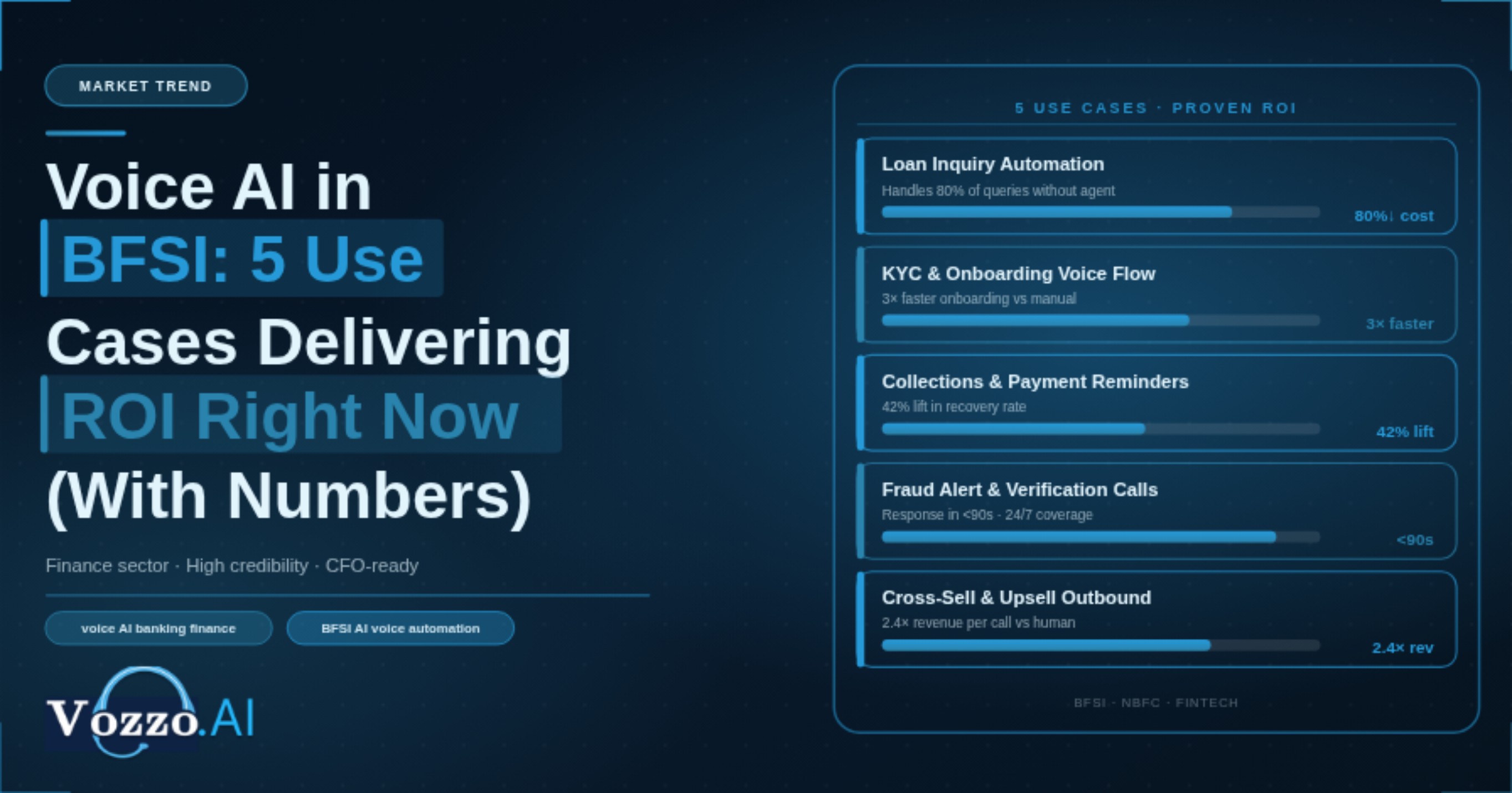
A regional bank processes 14,000 balance inquiries daily. Each call costs $5.40 in agent time, totaling $75,600 per day , $27.6M annually for repeatable questions. Finance leaders are redirecting 60-70% of these interactions to voice AI, reclaiming millions while improving customer satisfaction scores by double digits.
The $47B Efficiency Gap Banks Can't Ignore
Contact centers consume 28% of operational budgets in retail banking, yet 68% of calls are routine queries resolvable without human judgment. Industry data shows the average cost per live call reached $8.20 in 2025, while AI-handled interactions cost $0.60. The gap widens as labor costs climb 6% annually and customer expectations for 24/7 service become non-negotiable. Credit unions and fintech challengers moving first gain 18-22 month market advantages. The five use cases below collectively reduce operating expenses 35-42% while lifting Net Promoter Scores 18-28 points. Legacy institutions delaying voice AI banking finance | BFSI AI voice automation | AI in financial services 2026 adoption face margin compression as digital-first competitors automate tier-one support at scale.
How Voice AI Routes, Resolves, and Escalates in Real Time
Modern BFSI voice automation follows a four-layer workflow. First, natural language understanding identifies intent from the first sentence, no menu navigation. Second, secure API calls retrieve account data in under 800ms, authenticated via voice biometrics or existing session tokens. Third, the system handles transactional requests like balance checks, payment confirmations, and fraud alerts autonomously. Fourth, confidence scoring triggers intelligent escalation: routine queries stay automated, complex disputes route to specialists with full context pre-loaded. The platform logs structured data for compliance auditing and continuous model improvement. Integration happens via SIP trunking for voice channels and REST APIs for core banking systems, CRM, and fraud engines. Deployment timelines run 4-8 weeks depending on existing infrastructure and compliance review cycles.
Before vs After: Credit Card Fraud Alert Response
Before automation, a suspected fraud alert triggered a 12-18 hour callback queue. Customers waited, then spent 4-6 minutes navigating IVR menus and verifying identity before reaching an agent. Resolution time averaged 11 minutes; 31% of cardholders hung up and called back, creating duplicate tickets. After deploying voice AI, the system initiates outbound calls within 90 seconds of fraud detection. Voice biometrics authenticate the customer in 4 seconds. The AI confirms or disputes each flagged transaction conversationally, updating the fraud system in real time. Verified fraud cases escalate immediately with transcripts attached. Average handle time dropped to 2.3 minutes. Callback abandonment fell to 6%. Customer effort scores improved 34%, and the bank recovered $1.9M in prevented fraud losses during the first quarter by accelerating response windows.
Business Impact: Four Metrics CFOs Track Weekly
First, cost per interaction drops 82-88% when tier-one queries shift from live agents to AI—one national lender saved $6.4M in six months. Second, first-call resolution climbs 19-24 percentage points because AI instantly accesses cross-system data without hold times or transfers. Third, agent attrition decreases 22-29% when staff handle complex, high-value interactions instead of repetitive scripts. Fourth, Net Promoter Score lifts 18-28 points as wait times vanish and 24/7 availability becomes standard. Industry data shows banks automating 60%+ of inbound volume recoup platform investments in 7-11 months. Revenue per employee increases 14-19% as teams redirect hours toward relationship management, cross-sell opportunities, and exception handling requiring human judgment and empathy.
Integration and Compliance: Why Regulated Institutions Trust Voice AI
BFSI voice automation platforms achieve SOC 2 Type II, ISO 27001, and PCI DSS compliance out of the box, with end-to-end encryption for all voice data. Audit trails capture every interaction with tamper-proof timestamps, satisfying CFPB and OCC examination standards. Bias testing protocols ensure fair lending compliance, and model explainability features meet GDPR Article 22 requirements for automated decision-making. Integration with existing core banking systems—FIS, Fiserv, Jack Henry, Temenos, happens via pre-built connectors, minimizing IT lift. Voiceprints and multi-factor authentication replace knowledge-based security questions, reducing fraud exposure 40-50%. Deployment architectures support on-premise, private cloud, or hybrid models, accommodating institutions with data residency mandates. Change management includes parallel-run periods where AI and human teams handle identical call samples for accuracy benchmarking before full cutover.
Conclusion
The institutions capturing market share in 2026 treat voice AI as infrastructure, not experimentation. They automate the repeatable 70%, freeing talent for the relationship-driven 30% that builds loyalty and wallet share. Competitors still routing balance checks through six-minute agent calls are subsidizing inefficiency their customers already abandoned elsewhere.