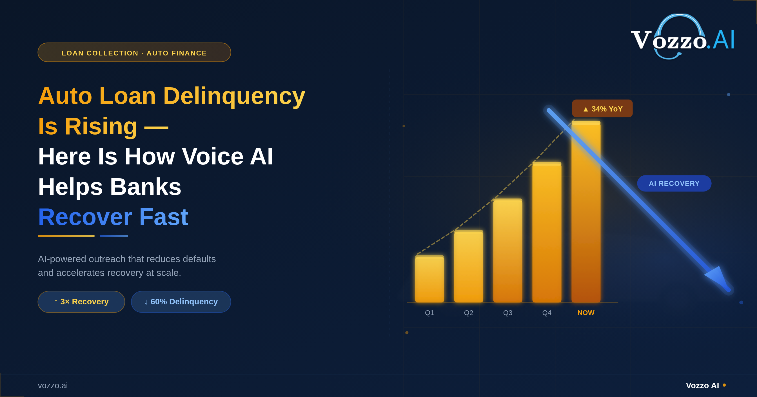
A borrower misses their second auto payment. Your collections team places three calls over two weeks — all ignored. By the time a live agent reaches them, the account is 45 days past due and repossession conversations begin. This scenario repeats across portfolios as auto loan delinquency rates climbed to 7.9% in Q4 2024, the highest level since 2010, driven by rising interest rates and tightening household budgets.
The Problem: Delinquency Costs Multiply With Every Missed Contact
Auto finance companies face a brutal equation: every day of delinquency adds collection costs while vehicle depreciation erodes collateral value. Industry data shows the average cost to recover a delinquent auto loan ranges from $150 to $400 per account when factoring in agent time, system overhead, and legal fees. Traditional collection workflows rely on manual outreach with contact rates below 30% in the first 15 days. Borrowers screen calls from unknown numbers or work hours that don't align with agent availability. Meanwhile, charge-off rates for subprime auto loans reached 6.5% in early 2024. The window to engage borrowers shrinks rapidly, and manual processes cannot scale to meet rising delinquency volumes without proportional increases in headcount and overhead.
How It Works: AI Agents Handle Outreach, Triage, and Resolution
Voice AI platforms deploy conversational agents that operate across the entire collection lifecycle. The system triggers outreach automatically when an account hits predefined delinquency thresholds — typically at 10, 20, and 30 days past due. AI agents place calls across morning, afternoon, and evening windows to maximize contact rates. When a borrower answers, the agent authenticates identity, explains the situation in compliant language, and offers immediate resolution paths: pay now via integrated payment link, schedule a one-time payment for a specific date, or arrange a modified payment plan. The auto loan delinquency AI | voice AI auto loan collection | AI for vehicle loan recovery platform escalates complex cases to human agents with full conversation transcripts and borrower sentiment analysis, ensuring continuity and eliminating redundant calls.
Before vs After: Contact Rates and Time-to-Resolution Transform
Before AI: A 500-account delinquency portfolio requires 12 full-time agents. Contact rate averages 28% within the first 15 days. Average time-to-first-payment is 23 days. Agents spend 60% of their time on repetitive early-stage calls, leaving limited capacity for hardship negotiations or complex accounts.
After AI: The same portfolio operates with 4 agents handling escalations only. AI handles 80% of early-stage outreach with contact rates exceeding 65% in the first 10 days. Average time-to-first-payment drops to 11 days. Human agents focus exclusively on high-value accounts, restructuring negotiations, and legal pre-escalation reviews. Cost per recovered dollar declines by 42%, and portfolio performance improves measurably within the first quarter.
Business Impact: Four Metrics That Drive ROI
Voice AI for auto loan collections delivers measurable performance across key indicators. **Contact rate improvement**: AI-driven outreach achieves 60-70% contact rates versus 25-35% for manual dialing, reaching borrowers earlier in the delinquency cycle. **Resolution speed**: Time-to-first-payment decreases by 40-50%, reducing roll rates into severe delinquency buckets. **Agent productivity**: Human collectors handle 3x more complex accounts when AI manages routine outreach and payment arrangements. **Charge-off reduction**: Industry data shows lenders deploying conversational AI reduce charge-offs by 15-20% through faster intervention and higher cure rates. These gains compound across portfolio size — a $500 million auto loan book with a 6% delinquency rate can recover an additional $3-4 million annually while cutting collection costs by $1.2 million.
Integration and Compliance: Built for Regulated Lending Environments
Voice AI platforms integrate with core lending systems including Nortridge, FORGE, and ALFA through REST APIs and webhooks, syncing account status, payment history, and contact preferences in real time. All conversations comply with FDCPA, TCPA, and state-specific regulations governing contact frequency, permissible hours, and disclosure language. The system automatically applies do-not-call lists, honors cease-and-desist requests, and logs every interaction with timestamped audit trails for regulatory review. SOC 2 Type II certification and end-to-end encryption protect borrower data across voice channels. Voiceprint authentication prevents unauthorized account access during payment discussions. Lenders maintain full control over scripts, escalation logic, and offer parameters, ensuring AI-driven outreach aligns with internal risk policies and brand standards while reducing compliance risk.
Conclusion
Auto loan delinquency is not a temporary spike — it reflects structural shifts in borrower capacity and economic conditions that will persist through 2025. Lenders relying on legacy collection models will absorb higher costs and worse portfolio performance quarter after quarter. Voice AI gives auto finance teams the speed, scale, and precision to recover faster while competitors burn through agent hours on unproductive outreach.