
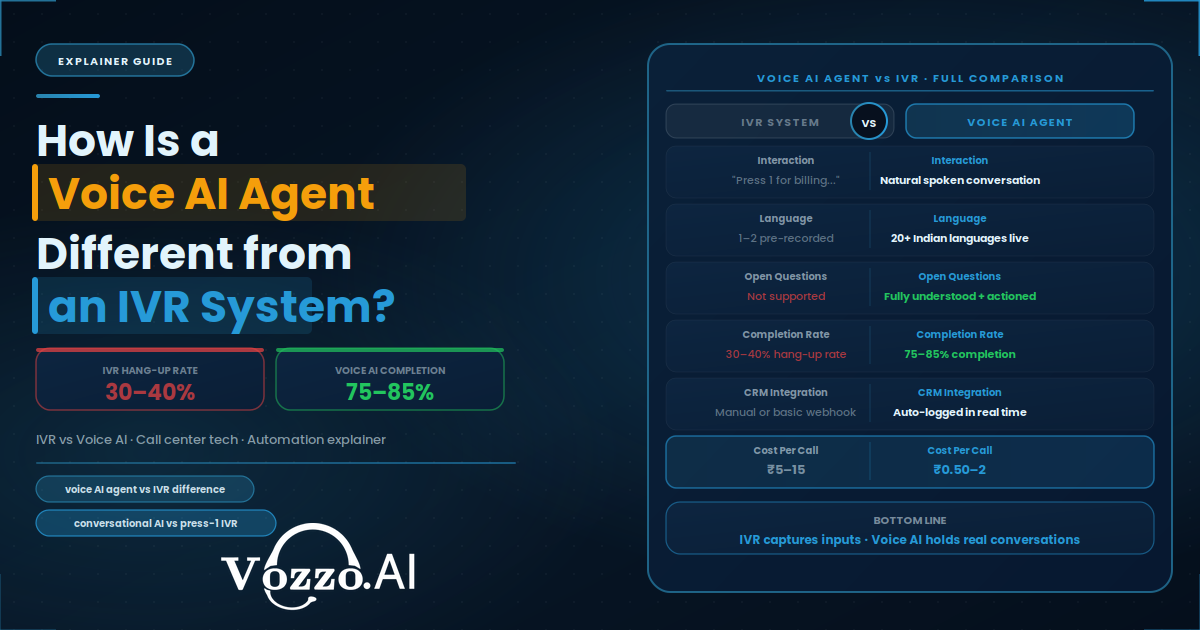
Everyone who has ever called a bank, an insurance company or a hospital helpline knows what an IVR feels like. Press 1 for English. Press 2 for Hindi. Press 3 for account balance. Press 4 for other queries. Press 0 to repeat this menu, and then press 0 again because you could not find what you were looking for in a list of eight options designed in 2009. Voice AI is not a better IVR; it is a fundamentally different technology solving the same problem in a completely different way.
What an IVR System Actually Is — and What It Cannot Do
IVR stands for Interactive Voice Response. It is a pre-programmed menu tree that routes callers to pre-defined options based on keypad input or basic voice commands like "yes" or "no." It was designed for call routing, not call resolution: its job is to get the caller to the right queue or the right information page, not to solve their problem on the call.
IVR is deterministic. Every caller follows the same decision tree, with no understanding of what the caller actually said, no context carried across the conversation, and no ability to handle a question that was not anticipated when the menu was built.
The fundamental limitation is that IVR listens for inputs, not for meaning. "I want to check my EMI due date" and "when is my next payment" are the same question. IVR cannot recognize that; voice AI can. That is the core of the IVR vs conversational AI divide, and every other difference follows from it.
What a Voice AI Agent Does That IVR Cannot
Understands natural language, not just commands. A caller can say "I received a transaction alert on my card but I didn't make that purchase," and the voice AI understands this is a fraud query, not a balance enquiry. This is the clearest voice AI agent vs IVR system difference in practice: an IVR would route the call to "other queries" and transfer it to a queue.
Carries context across the conversation. If a caller gives their name and account number early in the call, voice AI remembers it and uses it throughout. IVR resets with every menu selection, so callers repeat themselves at every transfer.
Handles unexpected responses. Callers do not follow scripts. They ask unrelated questions mid-call, give incomplete answers, or change their mind. Voice AI adapts. IVR breaks and falls back to the main menu or transfers to an agent.
Conducts outbound conversations. IVR is purely inbound. Voice AI makes outbound calls that are genuine two-way conversations: collecting information, handling objections, qualifying leads and confirming appointments, not just playing a recorded message.
Learns and improves. IVR stays static until a human reprograms it. Voice AI improves with each interaction, with updated training data and with feedback from call outcomes.
Resolves calls without human handoff. IVR routes callers to humans. Voice AI resolves the majority of routine call types without them.
The Customer Experience Gap Between IVR and Voice AI — In Numbers
67% of customers say navigating an IVR is frustrating. It is one of the top three drivers of customer dissatisfaction in call center interactions globally.
30-40% is the average IVR abandonment rate: callers who hang up before reaching resolution or a human agent.
6-9 minutes is the average handle time for IVR-routed calls that reach a human agent, because the agent starts from zero with no context from the IVR interaction.
60-180 seconds is the average voice AI handle time for routine queries, with full resolution and no human involved.
15-22% higher customer satisfaction scores on voice AI interactions for routine queries, compared with IVR-routed interactions for the same query type.
When IVR Still Makes Sense — and When It Does Not
IVR still makes sense for pure call routing at very high volume. Directing 10,000 calls per hour to the right department queue, where no resolution is expected, is a job IVR does well. It also fits emergency services and critical infrastructure, where deterministic behavior is a safety requirement, and extremely simple binary interactions such as a payment confirmation where the caller presses 1.
IVR no longer makes sense in most other situations. That includes any interaction where the caller needs to provide information in natural language, and any interaction where the outcome depends on the caller's specific situation. It also includes any outbound communication that requires a response, any interaction where customer experience affects retention or satisfaction scores, and any language mix beyond the two or three languages your IVR was originally built for.
Replacing IVR With Voice AI — What the Transition Looks Like
Audit your current IVR call flows. Identify the top 10 call types by volume and the percentage of each type that currently reaches a human agent. These are your automation candidates.
Map resolution criteria per call type. Define what "resolved" means for each call type before you build. The AI needs a clear success condition for each conversation flow.
Start with the highest-volume routine call types. Order tracking, appointment confirmation, balance enquiry and payment reminders are the usual starting points. Build containment on these before moving to complex flows.
Keep escalation paths clean. Every voice AI deployment needs a clear and fast path to a human agent. The handoff should include full call context so the agent does not start from zero.
IVR was the right technology for the 1990s call center, when the alternative was a busy signal. Voice AI is the right technology for the 2026 call center, where customers expect to be understood the first time, in their language, without pressing 4 for other queries. The question is not whether to replace IVR. It is which call types to start with.