A fertilizer company's marketing team builds a database of 80,000 farmers from dealer records, government scheme registrations, and field rep visit logs, then briefs a voice AI vendor to run outbound calls before kharif sowing. Three days after launch, TRAI notices arrive for calls to DND-registered numbers, the campaign is suspended, and the sowing window keeps closing. This is not a hypothetical — it is what happens when agri input companies run outbound campaigns without understanding TRAI's commercial communication framework.
The TRAI Framework That Governs All Outbound Commercial Calls in India
- TRAI's Telecom Commercial Communications Customer Preference Regulations — commonly called the DND framework — govern every commercial outbound call in India, regardless of industry, recipient geography, or channel.
- Subscribers can register their mobile numbers on the National Do Not Call Registry, which prohibits unsolicited commercial calls from reaching them.
- The framework applies equally to human agent calls, automated IVR calls, and AI voice agent calls. There is no exemption for agricultural advisory calls, farmer outreach, or agri input promotions — so agri input outbound calling compliance TRAI requirements must be planned before a campaign, not after a complaint.
- Violations carry penalties per call to a DND-registered number, and operators must block senders whose complaints cross defined thresholds. A non-compliant campaign can get your calling CLI blacklisted.
What DND Compliance Actually Requires for an Agri Outbound Campaign — Step by Step
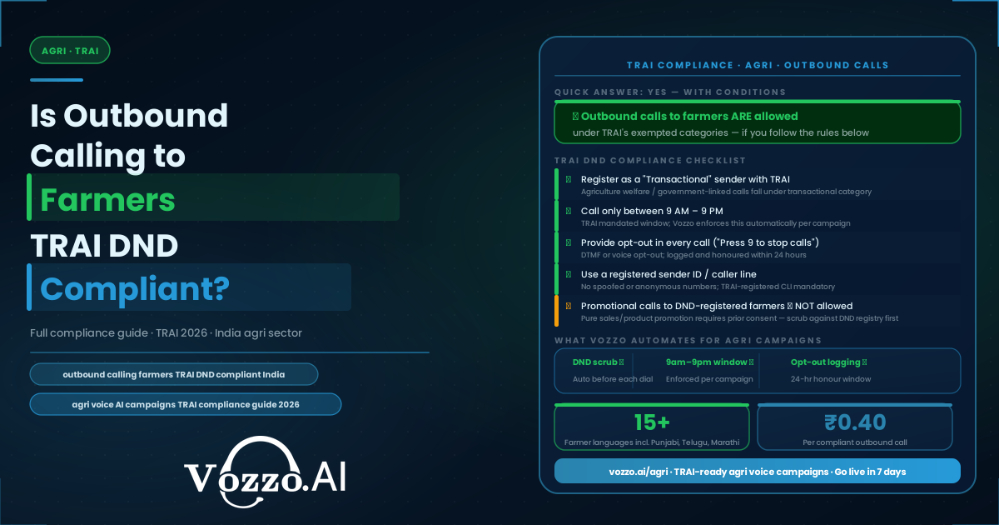
Step 1 — Scrub your farmer database against the National DND Registry before every campaign. TRAI requires the scrub within 7 days of launch, so a scrub done 30 days earlier is not compliant at launch. Every programme for TRAI DND compliant outbound calling farmers India-wide starts here, for every batch and every season.
Step 2 — Register as a Principal Entity on the DLT platform. Distributed Ledger Technology is TRAI's blockchain-based system for registering senders of commercial communications. Without PE registration, your calls have no legal authorisation, regardless of DND scrubbing.
Step 3 — Register your calling templates. Every message or conversation script used in your calls must be registered on DLT, and each script variation needs its own template. Unregistered templates are non-compliant even when the number is not on DND.
Step 4 — Register your CLI. The CLI is the number shown on the farmer's phone when your AI agent calls. Calls from unregistered CLIs are blocked at network level before they reach the farmer.
Step 5 — Call only between 9am and 9pm. These are TRAI's permitted commercial communication hours. A 6am call before field work begins is non-compliant, however convenient it is for farmers.
Step 6 — Maintain records of consent where applicable. For certain categories, documented farmer consent provides an alternative basis to DND registration. It must be timestamped and retrievable for TRAI dispute resolution.
Step 7 — Monitor complaint rates per CLI. TRAI tracks complaints per sender, and operators must block CLIs above the permitted threshold. Real-time monitoring is essential for high-volume agri campaigns.
The Consent Route — How Agri Input Companies Can Call DND-Registered Farmers Legally
TRAI's framework allows commercial calls to DND-registered numbers when the subscriber has explicitly consented to communications from a specific sender or category. For agri input companies, farmers who have bought your product, registered for your advisory service, or shared their details through your dealer network with a consent clause can be called even if their number is on DND. The consent must be specific — "I agree to receive agricultural advisory calls from [Company Name]" — not a generic terms and conditions checkbox. Records must capture the timestamp, the channel, and the exact consent language, and be producible within 24 hours if a TRAI complaint is raised. A consent-collected farmer database is the most durable compliance strategy for recurring seasonal campaigns.
The DLT Registration Process — What It Is and How Long It Takes
Principal Entity registration — 3-7 working days. Register through any operator's DLT portal — Jio, Airtel, Vi, BSNL, MTNL, Tata, or Quadrant — with GST details, an authorised signatory, and a business category. The PE ID is then valid across all operators.
Header registration — 1-3 working days. The header is your sender ID — a brand name or registered short code — registered per operator and matched to your PE. For voice calls, CLI registration serves the equivalent function.
Template registration — 1-5 working days. Every distinct script needs its own template: one per product recommendation, per crop advisory, per promotional offer. Plan your template library before the sowing season, not during it.
Compliance timeline reality for seasonal campaigns. Full DLT registration — PE, header, template, and CLI — takes 2-3 weeks minimum. For kharif campaigns, start no later than 6 weeks before launch; companies that begin 10 days out will not be compliant at launch.
What Happens When Agri Companies Call Without TRAI Compliance
- CLI blacklisting. A blacklisted CLI cannot make any outbound calls until reinstated, which can take weeks. A campaign on a blacklisted CLI has zero reach.
- TRAI financial penalties. Penalties apply per call to a DND-registered number without consent or compliant registration, and accumulate rapidly at campaign volumes.
- Campaign suspension. Operators can suspend outbound traffic the moment the complaint threshold is breached. A mid-campaign suspension during the sowing window is commercially catastrophic.
- Reputational damage with your farmer base. Farmers who receive unwanted calls associate the experience with your brand. In rural markets driven by word-of-mouth, that damage is disproportionate.
How Compliant Agri Outbound Calling Works With Voice AI
A TRAI-compliant voice AI campaign for agri input companies combines DLT-registered CLIs, DND-scrubbed farmer databases, registered call templates, and calls within permitted hours — with the checks automated in the platform rather than managed manually. The platform should scrub against DND before each batch, flag scripts that differ from registered templates, and monitor complaint rates per CLI in real time. Build this infrastructure once and you run compliant campaigns every season, because the farmer database, consent records, and DLT registrations persist across kharif and rabi cycles.
The Bottom Line for Agri Input Companies
Outbound calling to farmers is legal, effective, and TRAI-compliant when done correctly — and non-compliant the moment DLT registration, DND scrubbing, and consent documentation are skipped in the rush of a sowing window. The agri input companies that build compliance into their outbound infrastructure before the season are the ones whose campaigns reach farmers when it matters. The ones that skip it are the ones whose CLIs get blacklisted mid-campaign.