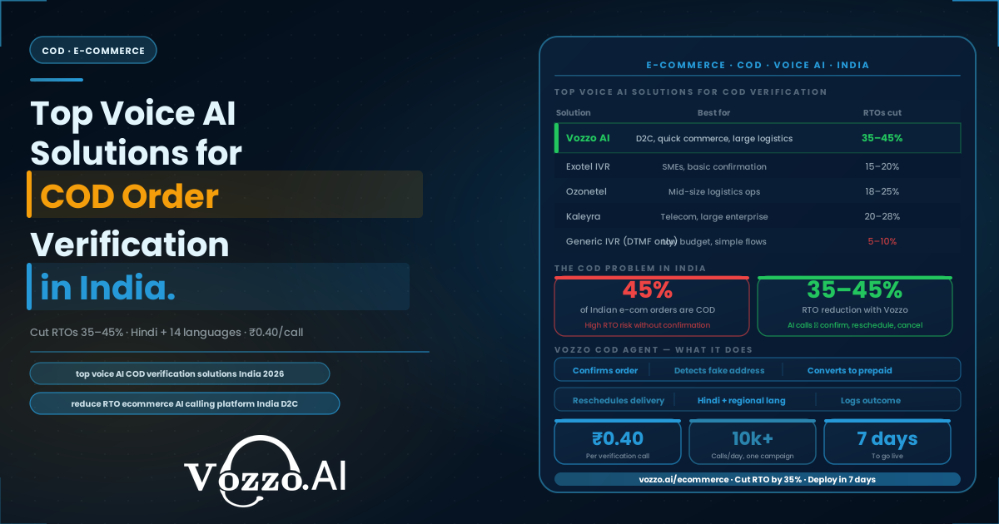
Cash on delivery accounts for 55-65% of e-commerce orders in India, and RTO rates on COD orders run 25-40% for most D2C brands — versus 5-8% for prepaid. With every COD RTO costing Rs 120-250 in forward and reverse logistics, a brand shipping 500 COD orders a day at a 30% RTO rate loses Rs 18,000-37,500 daily, before inventory tie-up and wasted delivery attempts. Voice AI COD verification catches the orders that will not be accepted before they leave the warehouse.
Why COD Verification Calls Reduce RTO — The Mechanism
- A COD RTO happens for one of four reasons: the customer placed the order impulsively or fraudulently, forgot they ordered and is unavailable at delivery, gave a wrong or incomplete address, or changed their mind without cancelling.
- A verification call 30-60 minutes after order placement catches all four. The impulsive order is cancelled before dispatch, the forgotten order becomes an acceptance, the wrong address is corrected in the OMS before the label prints, and the changed-mind customer cancels cleanly instead of refusing at the door.
- The economics are simple: one prevented RTO saves Rs 120-250, and at Rs 3-6 per AI call that is a 20-80x return on a single call. The real variable is how many customers the call reaches and engages — which is where COD order confirmation voice AI India deployments significantly outperform SMS verification.
What a Voice AI COD Verification Call Does — End to End
Step 1 — COD order placed. The OMS automatically triggers an AI verification call within 30-60 minutes, before the order enters the packing queue. This trigger is the backbone of all voice AI solutions COD verification India brands deploy.
Step 2 — AI calls the customer. It greets them by name on their registered mobile number and reads back the product, quantity, price, and delivery address.
Step 3 — Customer confirms. The order is logged as verified and proceeds to fulfilment normally.
Step 4 — Wrong address reported. The AI captures the corrected address and updates the OMS in real time before the order moves on.
Step 5 — Customer wants to cancel. The AI captures the cancellation reason and updates the OMS immediately, removing the order before any packing or dispatch cost is incurred.
Step 6 — No answer. The AI retries twice at 20-minute intervals. After three failed attempts, the order is flagged as high-RTO-risk for manual review or an automatic hold.
Step 7 — Suspicious orders. High-value COD orders from first-time customers in high-RTO pin codes are flagged for additional verification or offered a prepaid conversion before the call ends.
COD Fraud Detection — What Voice AI Catches That SMS Cannot
Fake address orders. Customers who enter random addresses cannot sustain a real-time conversation about the order. They either confirm a non-existent address or hang up — both outcomes flag the order before dispatch.
Bulk impulsive orders. Customers who place 3-5 COD orders at once across platforms — a common high-RTO pattern — receive a verification call for each. The friction of answering multiple calls converts impulsive orders into cancellations before dispatch.
Wrong contact number orders. Orders with a wrong or disconnected number fail all three call attempts and are held for review or cancelled, depending on your RTO risk policy. SMS cannot detect a disconnected number until the delivery fails.
Reseller and high-volume fraud. Bulk COD orders placed for resale without intent to pay — common in fashion and electronics — surface during the conversation. The AI captures inconsistencies between order details and customer responses and flags them for fraud review.
The RTO Economics of Voice AI COD Verification — A Worked Example
Take a D2C brand shipping 500 COD orders per day at a 30% RTO rate — 150 RTOs daily. At an average RTO cost of Rs 180 in forward and reverse logistics, that is Rs 27,000 per day in losses. Voice AI verification at Rs 5 per call costs Rs 2,500 per day for all 500 orders. If verification brings the RTO rate down from 30% to 14%, the brand sees 70 RTOs a day instead of 150. That is 80 fewer RTOs × Rs 180 = Rs 14,400 saved per day, or Rs 11,900 net after call costs — about Rs 3,57,000 per month from a single automation running in the background, before festive season volume spikes.
What D2C Brands and E-Commerce Operations Need From a COD Verification Voice AI
- Real-time OMS integration. The AI must pull each customer's order details from your OMS and push verification outcomes back instantly. Manual export-import or a daily sync defeats the purpose of pre-dispatch verification.
- Multilingual calling that matches your customer geography. Pan-India brands need Hindi, Tamil, Telugu, Marathi, Bengali, and Kannada at minimum. A customer in Coimbatore called in Hindi responds and confirms at a lower rate than one called in Tamil.
- Retry logic and no-answer handling. One call attempt is not verification. Three attempts at defined intervals with no-answer flagging is the minimum — platforms that mark unanswered orders as confirmed are logging activity, not reducing RTO.
- Pin code and customer risk scoring. High-RTO pin codes, first-time customers, and high-value COD orders carry disproportionate risk. The platform should apply stricter protocols — extra attempts, prepaid conversion offers — to these orders automatically.
Top Voice AI Solutions for COD Verification in India — How to Evaluate
Vozzo AI. Built for Indian e-commerce operations, with conversational calling in 10+ Indian languages, OMS integration with major Indian e-commerce platforms, real-time order status updates on verification outcomes, and retry logic with no-answer risk flagging. Running in production across Indian D2C and marketplace operations.
Exotel. Strong Indian telephony infrastructure with API-driven OMS integration and COD verification support. Verification is IVR-style confirmation rather than natural conversation, making it strong for high-volume basic confirmation flows.
Knowlarity. An established Indian IVR and cloud telephony player with COD verification capability. More IVR-style than conversational, and a good fit for brands already on Knowlarity infrastructure.
Sarvam AI. Focused on Indian languages, with strong regional accuracy and growing e-commerce coverage. COD verification as a production use case is less documented than its general voice AI capability, but it is worth evaluating for regional-language-heavy customer bases.
Custom build on Twilio or AWS Connect. Maximum flexibility and optimisable per-call economics at very high volumes, but it requires engineering investment and 3-6 months minimum to reach production. Suited to enterprise operations with dedicated engineering teams.
The Bottom Line
Voice AI COD verification is the highest-ROI automation available to Indian D2C brands with significant COD volume — one prevented RTO pays for 20-80 verification calls, and the intervention happens before any fulfilment cost is incurred. Brands building it into their post-order workflow in 2026 are making their supply chain economics competitive with brands that have moved customers to prepaid. At Rs 3-6 per call versus Rs 120-250 per RTO, the arithmetic is not complicated.