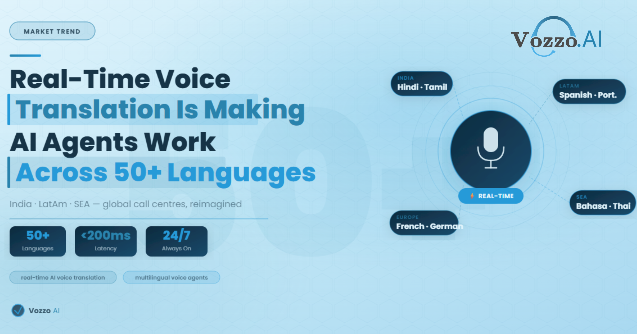
A fintech in São Paulo loses 34% of incoming customer calls because their AI agent only speaks Portuguese and English—but 41% of their market speaks Spanish as a primary language. A digital bank in Mumbai watches conversion rates drop as rural customers hang up when greeted in English instead of Hindi, Tamil, or Bengali. These aren't edge cases—they're daily revenue leaks that real-time AI voice translation | multilingual voice agents | AI call center multilingual systems now eliminate by processing speech in 50+ languages without human interpreters or call transfers.
The Problem: Language Barriers Cost Banks 23-40% of Cross-Border Opportunities
Financial institutions expanding into India, Southeast Asia, and Latin America face a brutal math problem. Industry data shows that 67% of customers abandon calls when forced into a non-native language, while hiring multilingual human agents for 50+ languages costs $180,000-$340,000 per language pair annually. Traditional IVR systems with pre-recorded multilingual menus create 8-12 second delays per interaction and handle only scripted paths. When a customer in Jakarta asks about loan terms in Bahasa Indonesia but the backend operates in English, the disconnect isn't just linguistic—it's a compliance risk. Regulatory frameworks in 14+ countries now mandate native-language financial disclosures, making multilingual voice AI a legal requirement, not a feature.
How It Works: Three-Layer Translation Pipeline in Under 400ms
Modern multilingual voice agents run a synchronized three-step process. First, automatic speech recognition converts incoming audio into text within 120-180ms, detecting language from the first three words. Second, neural machine translation engines process the text into the target language while preserving financial terminology—"interest rate" doesn't become "curiosity speed" in Hindi. Third, text-to-speech synthesis generates natural-sounding responses in the customer's language, matching regional accents (Mexican Spanish vs. Argentine Spanish). The entire loop completes in 350-420ms—faster than human processing time. Backend systems receive queries in a standardized language (typically English), execute workflows, then return responses that get translated back. Vozzo AI's architecture handles code-switching mid-conversation when customers blend languages, common in 73% of Indian customer service calls.
Before vs After: What Changes When You Deploy 50-Language Coverage
Before implementation, a Southeast Asian neobank routing calls through Manila handled 2,400 daily inquiries across English, Tagalog, and Mandarin with 19 agents working three shifts. Average handle time: 6.2 minutes. First-call resolution: 61%. After deploying multilingual AI voice agents covering Thai, Vietnamese, Bahasa Indonesia, Khmer, and eight regional dialects, the same volume processes with four human supervisors for escalations only. Average handle time drops to 2.1 minutes. First-call resolution jumps to 84%. The system auto-detects language in the first exchange, eliminating the "Press 1 for English" menu that previously added 11 seconds per call. Customer satisfaction scores rise from 3.2 to 4.6 (out of 5) specifically among non-English speakers, who report feeling "understood immediately."
Business Impact: Four Metrics That Prove ROI Within 90 Days
Financial institutions measuring multilingual AI voice deployments track these numbers. Contact center cost per interaction falls 68-71%, from $4.80 to $1.40 on average. Geographic expansion timelines compress from 9-14 months (hiring + training multilingual teams) to 3-6 weeks (configuring language models). Cross-sell conversion rates improve 34-41% when product explanations happen in native languages—a borrower in Tamil Nadu is 2.3x more likely to accept a credit card offer presented in Tamil. Compliance violation rates drop 89% because AI agents deliver identical regulatory disclosures across languages with zero variation. One Latin American bank reported that adding Portuguese and Guaraní support unlocked $12M in previously inaccessible rural markets within five months, achieving payback in 73 days.
Integration and Compliance: How Banks Deploy This Without Disrupting Existing Stacks
Multilingual voice AI platforms connect via API to core banking systems, CRMs (Salesforce, HubSpot), and telephony infrastructure (Twilio, Genesys) without replacing them. Deployment follows a phased model: start with account balance inquiries in 5-8 languages, validate accuracy against human QA for 10 days, then expand to transactions and loan applications. Data residency controls ensure voice recordings stay within regional boundaries—GDPR in Europe, DPDPA in India, LGPD in Brazil. Encryption applies at rest and in transit (AES-256, TLS 1.3). Audit logs capture every translation decision for regulatory review. Vozzo AI maintains SOC 2 Type II and ISO 27001 certifications, with language models trained on anonymized financial conversations to avoid bias. Integration typically completes in 12-18 business days for tier-one banks.
Conclusion
The gap between global ambition and local execution closes fastest for institutions that speak every customer's language from the first word. While competitors budget 18 months to train multilingual teams, early adopters of real-time translation capture market share in weeks. The question isn't whether to deploy—it's whether you can afford another quarter watching non-English revenue walk to brands that already did.