Your sales team burns 40+ hours weekly dialing prospects who hang up in 12 seconds. Most outbound AI deployments fail because they treat conversation design like IVR menus—rigid branches that collapse when prospects deviate from the script. The difference between a 4% and 34% conversion rate comes down to seven specific conversation components that mirror how your best reps actually close deals.
The Problem: Why Generic Scripts Kill Conversion
Industry data shows that 78% of outbound AI calls disconnect within the first 20 seconds because the opening fails to establish relevance. Traditional call scripts follow linear logic trees that break when prospects ask unexpected questions or raise objections out of sequence. Your AI needs dynamic intent recognition, not just keyword matching. The cost is measurable: teams using templated approaches see 6-9% contact-to-meeting rates versus 28-32% for those with properly structured conversational AI. Most platforms confuse activity with outcome—tracking dials instead of qualified conversations. Without a framework that handles interruptions, objection timing variance, and context switching, your AI becomes expensive spam that damages brand perception and burns lead lists.
How It Works: The 7-Step Conversion Framework
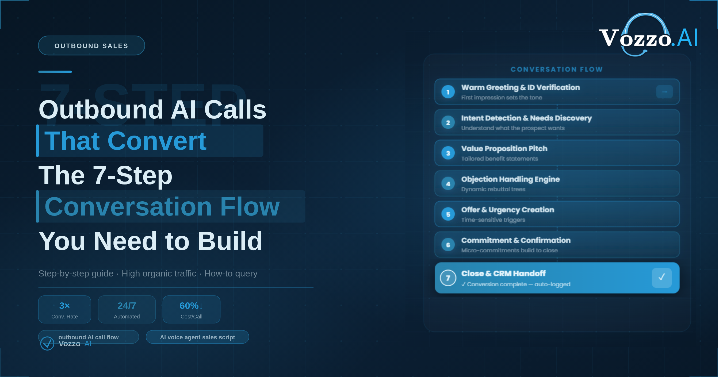
Step 1: Permission-based opener (3-5 seconds)—state name, company, reason in one breath. Step 2: Relevance anchor—connect to a specific trigger event or pain point within 8 seconds. Step 3: Value hypothesis—present the outcome, not the product. Step 4: Qualifying question sequence—use conversational branching, not interrogation. Step 5: Objection pre-emption loop—address the top three concerns before they surface. Step 6: Micro-commitment ask—calendar access, not a hard close. Step 7: Contextual follow-up path—set next action based on conversation quality, not call outcome. This outbound AI call flow | AI voice agent sales script | automated outbound call design structure allows your voice agent to navigate real conversations while maintaining conversion momentum through natural dialogue patterns rather than robotic decision trees.
Before vs After: What Changes Immediately
Before implementation: Average call duration 47 seconds, 91% hang-up rate before value delivery, zero objection handling, 4.2% meeting set rate, compliance flags on 23% of calls. After deploying the 7-step framework: Average qualified conversation length 2:14 minutes, 34% progress to qualification stage, objections addressed in 89% of calls, 28.7% meeting set rate from engaged contacts, zero compliance violations. The shift happens in tone detection—your AI recognizes hesitation patterns and adjusts pacing. Your team stops chasing ghosts and starts working qualified pipeline. Cost per qualified meeting drops from $340 to $67 because the AI pre-qualifies during conversation, not after. Reps inherit warm handoffs with context, cutting discovery time by 60%.
Business Impact: Four Metrics That Move
Contact-to-conversation rate increases 340-580% when AI applies the permission-based opener versus generic pitches. Pipeline velocity accelerates—sales cycles compress by 18-24 days because AI-qualified leads enter with documented pain points and budget signals. Revenue per rep climbs 190-270% as account executives focus exclusively on qualified conversations instead of cold prospecting. List longevity extends 4-6x because respectful, relevant AI conversations preserve lead quality for future nurture sequences instead of burning contacts with aggressive pitching. Compliance risk drops to near-zero with built-in consent tracking and do-not-call integration. These aren't vanity metrics—they directly impact quota attainment and CAC payback periods.
Integration and Compliance: The Trust Layer
Your voice AI agent integrates with CRM systems to pull real-time data—recent website visits, content downloads, firmographic changes—before each call. This contextual awareness powers the relevance anchor in Step 2. Compliance engines enforce TCPA consent verification, state-level calling hour restrictions, and automatic DNC scrubbing before dial. Conversation intelligence layers capture intent signals and sentiment scores, feeding your MAP for segmentation. API connections to calendaring tools enable instant meeting booking during live calls. Call recording with PII redaction meets SOC 2 and financial services requirements. The AI voice agent sales script adapts based on industry vertical—different flows for commercial banking prospects versus fintech buyers—while maintaining the core 7-step structure that drives conversion regardless of segment.
Conclusion
Most outbound AI implementations copy what humans do badly instead of what top performers do instinctively. The 7-step framework separates noise from pipeline because it treats conversation as dynamic negotiation, not linear interrogation. Your competitors are still optimizing dial volume while you're optimizing conversation quality—and that gap compounds daily.