Maharashtra Vidhan Sabha. 288 constituencies. 6 languages spoken across the state — Marathi, Hindi, Urdu, Gujarati, Konkani, and English. A political research agency needs statistically significant voter sentiment data from every constituency in 72 hours, and a human caller panel would need 2,000 people minimum — they have 3 days and a budget for 200.
Why Traditional Voter Survey Methods Break Down at State Scale
A state-level voter survey requires simultaneous data collection across hundreds of constituencies. Sequential calling misses the point because voter sentiment shifts daily during campaign season — data collected in week one is stale by the time fieldwork reaches week two.
Language fragmentation is the hardest operational problem. Maharashtra alone requires Marathi, Hindi, and Urdu fluency across different districts, and a single caller panel cannot cover all three authentically without stretching thin or outsourcing to multiple vendors.
Human caller panels introduce interviewer bias. Callers with political affiliations, regional accents, or fatigue affect response patterns in ways that are impossible to control at scale, and no amount of training fully removes this variance across a 200-person panel.
Data lag kills the insight. If fieldwork takes 10 days and data entry takes 3 more, the sentiment data is 2 weeks old before the client sees it — and political campaigns move in 48-hour cycles. This is exactly the gap that voice AI voter survey India deployments are built to close: collection and structuring happen in the same window a campaign actually needs the numbers.
How Voice AI Runs a Multilingual Voter Survey Across an Entire State
Step 1 — Upload constituency-wise voter sample lists with phone numbers and language tags: Marathi for Pune districts, Hindi-Urdu mix for Aurangabad, Konkani for the Konkan belt.
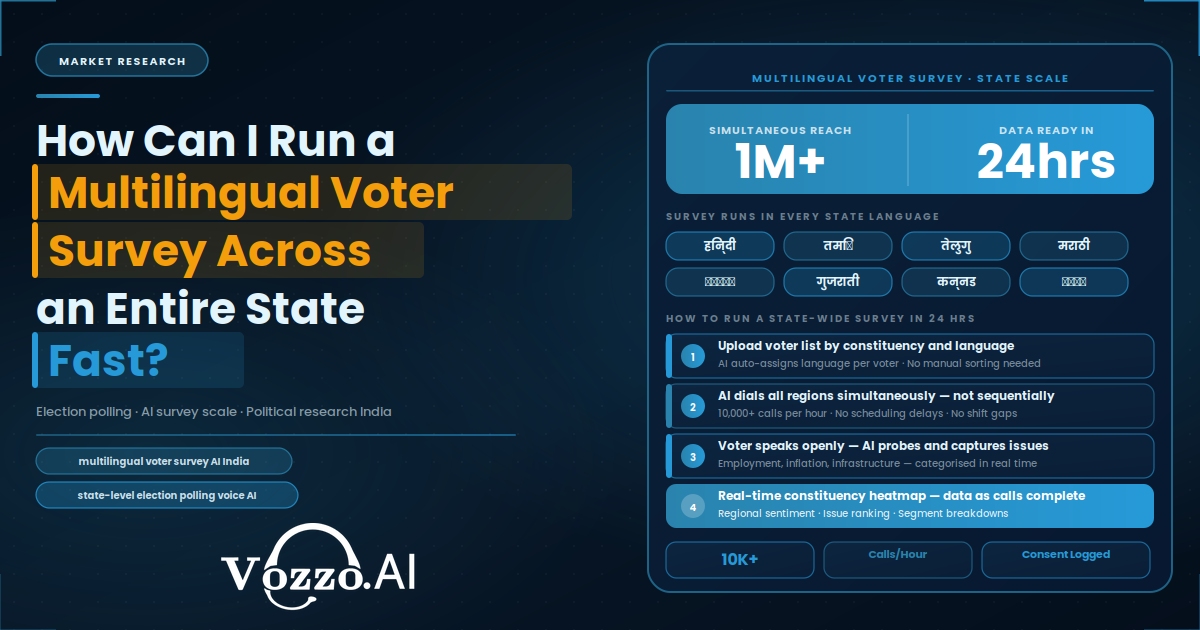
Step 2 — AI launches simultaneous outbound calls across all 288 constituencies. Not sequential — all constituencies run in parallel from hour one, which is what makes a multilingual voter survey across entire state fast rather than a multi-week rollout.
Step 3 — Each voter receives a call in their tagged language. The AI greets naturally, introduces the survey as an independent opinion study, and begins questions.
Step 4 — Survey questions are delivered conversationally, not as robotic IVR press-1-press-2 prompts, but as natural language questions with open response capture.
Step 5 — Dynamic branching kicks in. If a voter mentions a specific issue like water scarcity or unemployment, the AI probes deeper on that issue automatically.
Step 6 — Responses are transcribed, classified, and structured in real time: party preference, top issue, satisfaction with current representative, and swing likelihood captured as structured fields per respondent.
Step 7 — A live constituency dashboard updates continuously. The research team sees response rates, early preference data, and issue rankings per constituency as calls complete.
What Makes AI Voter Surveys More Reliable Than Human Caller Panels
Interviewer effect is eliminated. The AI asks every question in exactly the same tone and sequence regardless of constituency, language, or time of day — a consistency that human callers cannot replicate across 2,000 people.
Language authenticity holds up. Native language AI in Marathi sounds like a Marathi speaker, not a Hindi speaker attempting Marathi, and voters respond more honestly when they do not sense an outsider accent on the line.
Scale comes without fatigue degradation. Call quality on respondent 50,000 is identical to respondent number 1, while human caller panels deteriorate in quality as volume and shift length increase. This is the core mechanism behind constituency survey automation: consistency doesn't decay as the sample grows.
Data arrives in real time. There is no fieldwork lag, no data entry queue, and no cleaning delay — structured data is available within hours of survey launch, not days after fieldwork closes.
Before vs After Voice AI for a State-Wide Voter Survey
Before: 200 human callers, 5 languages attempted, 12,000 responses in 10 days, data entry takes 3 more days, interviewer bias uncontrolled, cost Rs 25–40 lakhs for the panel, results delivered 2 weeks after fieldwork begins.
After: AI calling platform, 6 languages natively, 2,00,000 responses possible in 72 hours, structured data available in real time, zero interviewer effect, cost a fraction of a human panel, constituency-level dashboards live during fieldwork.
Beyond Elections — Where This Same Infrastructure Serves Research Agencies
The same voice AI platform that runs constituency voter surveys handles post-budget citizen sentiment studies across 500 districts, government scheme awareness surveys across rural blocks, brand perception tracking across tier 2 and tier 3 cities, and public health behavior studies for state health departments. Any research question requiring fast, multilingual, geographically distributed data collection at scale uses the same infrastructure. Election polling is the most time-compressed version — but the capability serves every large-scale survey need a research agency has, from Lok Sabha pre-polls to exit polls to routine tracking studies between election cycles.
What Research Agencies Need From a Voice AI Survey Platform
- Language accuracy, not just coverage. Claiming to support 10 languages means nothing if Marathi accuracy drops to 70% in rural Vidarbha dialects. Ask for accuracy benchmarks on your specific language mix before committing.
- Configurable survey logic. Political surveys need dynamic branching based on voter responses. A platform with fixed linear survey flows cannot capture the nuance that makes constituency-level data actionable.
- Real-time dashboard with constituency-level drill-down. The client needs to see Nashik urban vs Nashik rural separately, not aggregated. Constituency granularity is the entire value of a state-level survey.
- TRAI compliance for survey calls. Opinion research calls in India must comply with DND scrubbing, CLI registration, and commercial communication regulations. Non-compliant survey calls get blocked and invalidate your sample.
Conclusion
A state-wide voter survey used to require months of planning, thousands of callers, and weeks of fieldwork. Voice AI compresses that into 72 hours without sacrificing statistical reliability or linguistic authenticity. The research agencies and political consultancies building this capability now are operating in a different category from those still running human caller panels.