
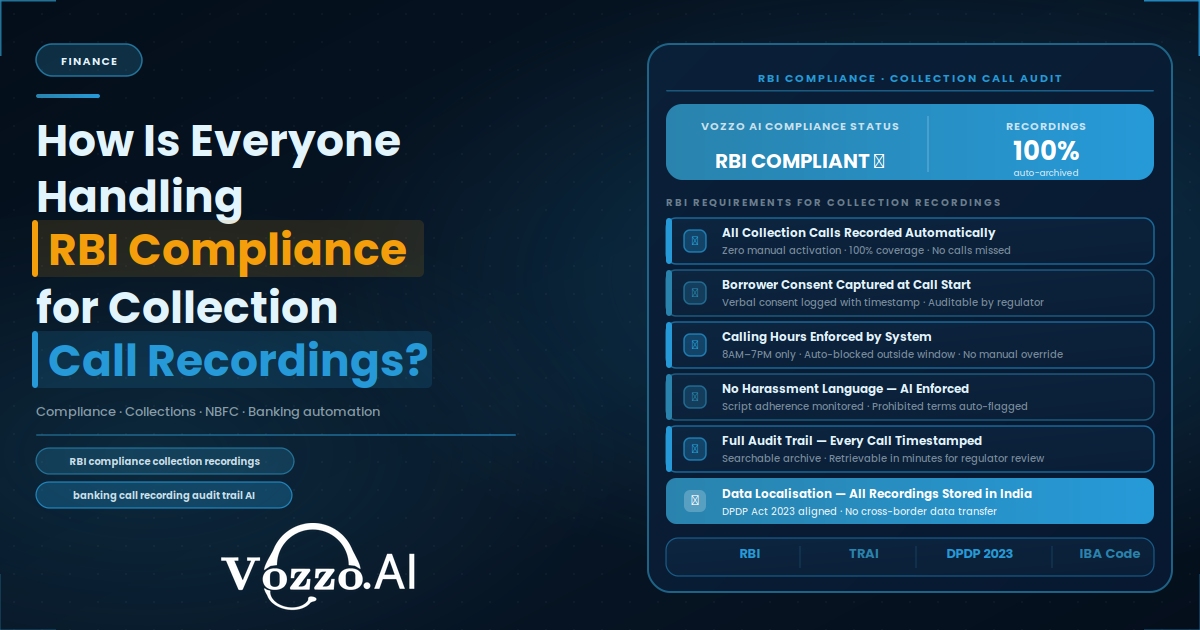
This question comes up in every BFSI operations forum right now. RBI's Fair Practices Code for collections is clear on paper. The operational reality of 500 agents making 8,000 calls a day is where compliance breaks down — and where the regulatory risk actually lives.
What RBI Actually Requires for Collection Call Recordings — The Non-Negotiables
The regulatory requirements themselves aren't ambiguous:
- Every collection call must be recorded and stored for a minimum period — current RBI and IBA guidelines require recordings retained for at least 3 years and retrievable within 24 hours of a regulator or ombudsman request.
- Calls must not be made before 8am or after 7pm — AI or IVR systems making automated collection calls are held to the same time restriction as human agents.
- Agents must identify themselves and their organization at the start of every call — this disclosure must be present in the recording and verifiable on demand.
- Prohibited language and intimidation: any call recording containing coercive language, threats, or harassment is a direct regulatory liability, and RBI can impose penalties or revoke lending licenses for pattern violations.
None of this is new. What's changing is how seriously it's being enforced, and that's exactly why the RBI Fair Practices Code voice AI conversation has moved from a compliance footnote to a boardroom topic.
Where the Compliance Gap Actually Lives — It Is Not the Policy, It Is the Audit
Here's the part nobody wants to say out loud: most NBFCs and banks have a collections call recording policy. Very few have a collections call recording compliance audit process that covers more than 2-3% of calls.
The policy says calls must be recorded, time-compliant, and disclosure-complete. The audit covers 200 calls out of 8,000 per day. The other 7,800 are an unaudited compliance liability sitting quietly in storage until something forces a closer look.
That something is usually an ombudsman complaint. When one arrives citing a specific date, time, and agent, the compliance team has 24 hours to produce the recording, verify the disclosure was given, confirm the call was within permitted hours, and check that no prohibited language was used. Doing this manually under time pressure — searching call logs, matching timestamps, listening to audio in real time — is where organizations fail, not because the underlying call was non-compliant, but because they can't prove it fast enough.
This isn't a hypothetical risk anymore. RBI's increasing focus on collections practices post-2023 has moved NBFC collections call compliance India from a theoretical exposure to an active examination priority, and the audits are only getting deeper from here.
How Leading BFSI Collections Teams Are Handling This in Practice
The organizations getting ahead of this aren't hiring bigger QA teams. They're restructuring how compliance gets verified in the first place.
- Every collection call routed through a centralized recorded telephony platform — no agent calling from a personal mobile, no unrecorded channel of any kind.
- AI call monitoring runs on 100% of recordings, not a QA sample. Every call is checked for time of call, opening disclosure, prohibited language, and whether a promise to pay was captured — this is where RBI compliance collection call recordings stops being a manual bottleneck and becomes a continuous process.
- Automated compliance flags raised same day — calls made outside permitted hours, calls missing an opening disclosure, calls with high-risk language, all surfaced before end of business rather than weeks later.
- Structured data extracted from every call — borrower ID, DPD bucket, call outcome, promise-to-pay amount and date, agent ID — pushed to the collections CRM automatically.
- Ombudsman-ready retrieval, where any call can be pulled by borrower ID, date, agent ID, or phone number within 60 seconds, not a 24-hour manual search through call logs.
- A monthly compliance report generated automatically, covering percentage of calls within the time window, disclosure completion rate, prohibited language incident rate, and promise-to-pay capture rate — audit-ready without manual compilation.
- Agent coaching triggered directly from compliance data, so agents with disclosure completion below threshold get flagged for training before the regulator sees the pattern, not after.
Before vs After AI-Powered Compliance Monitoring for Collections
Before: 500 agents, 8,000 calls daily, a QA team reviewing 240 calls a week, compliance gaps invisible until an ombudsman complaint or RBI examination surfaces them, manual call retrieval taking hours, a monthly compliance report requiring 3 days of analyst time, and prohibited language incidents caught weeks after they occurred.
After: 100% of 8,000 daily calls monitored automatically, compliance flags raised the same day, any call retrieved in 60 seconds, the monthly report generated overnight, prohibited language incidents caught and escalated before end of business, and agent coaching driven by complete data instead of sampled guesses.
The Specific RBI Examination Questions Your Call Data Must Answer
Examiners don't ask about your policy. They ask about your data.
- "Provide recordings of all collection calls made to borrower X between these dates" — you need instant retrieval by borrower ID across your entire call archive, not a manual search.
- "What percentage of your collection calls were made outside permitted hours in the last quarter" — you need an automated time-compliance report, not a sampling exercise.
- "Show us your process for identifying and addressing prohibited language in collection calls" — you need documented AI monitoring with flagging and escalation logs, not a policy document.
- "How many ombudsman complaints related to collections were preceded by compliance-flagged calls" — you need call compliance data linked to complaint records, which requires structured data extraction from recordings in the first place.
What to Look for in a Collections Call Compliance Platform
- 100% call coverage, not sampling. RBI examinations do not accept "we review a representative sample." Every call must be monitored, and the monitoring must be documented.
- Indian language compliance monitoring. Hindi, Marathi, Tamil, Telugu, and Bengali collections calls must be monitored with the same accuracy as English calls. Language coverage gaps are compliance gaps.
- Tamper-evident storage with timestamp integrity. Recordings must be stored in a format where modification is detectable and timestamp authenticity is verifiable — chain of custody matters in ombudsman proceedings.
- Configurable compliance rules aligned to current RBI guidelines. The platform must let you update prohibited language lists, time window rules, and disclosure requirements as RBI guidance evolves. Static rules become stale rules.
The honest answer to how everyone is handling RBI compliance for collection call recordings is: most organizations are complying with the policy and hoping the audit never goes deep. The ones building genuine compliance infrastructure are monitoring every call, not every hundredth one — because that's what the regulation actually requires, and what the examination will eventually test.