Every sales and collections head in India hits the same wall at the same point: the only way to reach more customers is to hire more agents. More agents means more salary, more training, more attrition, more management overhead, and a three-month ramp before the new hire is productive. By then, the campaign window has closed.
Why Hiring More Agents Is the Wrong Answer to an Outbound Scale Problem
Agent headcount scales linearly with call volume. To double your outbound reach, you double your team. Voice AI does not work this way: it runs as many parallel calls as your campaign requires.
Attrition makes it worse. Indian call centers average 35-45% annual attrition, so you are constantly recruiting, onboarding and training just to hold the same capacity. Meanwhile, a human agent tops out at 80-120 calls per day depending on call duration and complexity.
The cost structure is also fundamentally different. A human agent costs Rs 18,000-35,000 per month in salary plus infrastructure. An AI voice call costs Rs 3-8. At 5,000 calls per day, the math is not close. This is why outbound call automation India-wide is moving from pilot project to core infrastructure.
What Outbound Call Automation With Voice AI Actually Looks Like
Here is a realistic deployment for an Indian business, step by step.
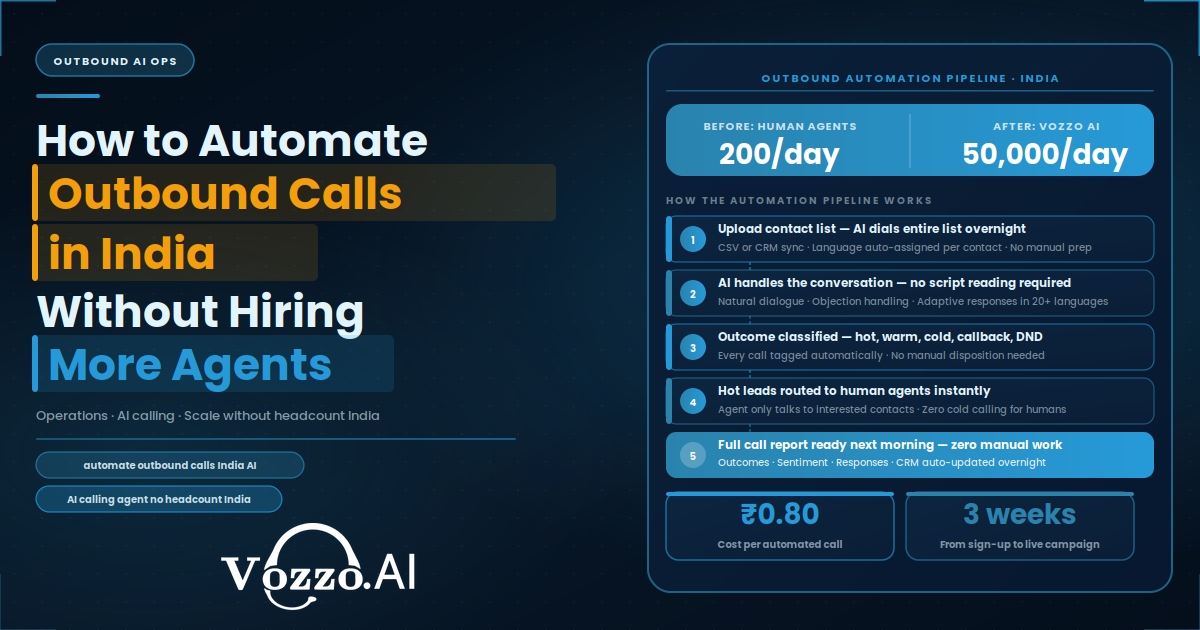
Step 1: Upload your contact list. Include names, phone numbers and a language tag per contact (Hindi, Tamil, Telugu, Marathi, Kannada, Bengali or Punjabi), based on geography or profile.
Step 2: Configure your campaign. Define the call objective, conversation script, qualification criteria, escalation triggers and CTA: book an appointment, confirm an order, collect a payment commitment or schedule a site visit.
Step 3: Set your calling window. Use TRAI-compliant hours, a DND-scrubbed list and a registered CLI number. Compliance is built into the campaign before launch.
Step 4: Launch. The AI places calls across your entire list simultaneously, not sequentially. This is how teams automate outbound calls India without hiring agents: 10,000 calls in a morning, not over three weeks.
Step 5: Every call runs in the contact's language. The AI greets by name, delivers the call objective, and handles responses and objections naturally.
Step 6: Outcomes are captured in real time. Confirmed, not interested, callback requested, wrong number or no answer: each result is pushed to your CRM as structured data automatically.
Step 7: Hot leads reach humans instantly. Escalations are routed to your agents with full call context, so they only speak to people worth speaking to.
The Outbound Use Cases Where AI Automation Delivers the Highest ROI in India
Voice AI outbound automation works best where call volume is high, the script is structured and speed matters. These five use cases show it most clearly.
Collections and payment reminders. NBFC and bank collections teams using AI outbound calling cover 100% of their DPD portfolio daily instead of the 20-30% human agents can reach. Promise-to-pay capture improves when calls are made in the borrower's native language. RBI-permitted calling hours are enforced automatically.
Agri input and seed sales. Seasonal outreach to 50,000-1,00,000 farmers before kharif or rabi sowing is only achievable with AI. Field reps cover 4,000 farmers in the window AI covers 80,000. The companies that reach farmers first win the season.
Insurance renewal and cross-sell. Life and general insurers running renewal campaigns across the Hindi belt and southern states need multilingual outbound at scale. AI handles the reminder and qualification call; human agents handle the conversion conversation.
E-commerce order and delivery. Proactive calls for COD confirmation, failed delivery rescheduling and post-delivery feedback run without support agent involvement. RTO rates drop when AI calls the customer before the return is initiated.
Healthcare appointment confirmation. Hospitals can call every patient 24 hours before their appointment. No-show rates drop 25-35% without any reception staff involved in the reminder process.
Before vs After Outbound Call Automation for a 200-Agent Call Center
The difference is easiest to see in a 200-agent operation running collections or sales outreach.
Before: 200 agents, 18,000 calls per day at most, 40% attrition (80 agents replaced annually), a 6-8 week ramp for new agents, Rs 55,00,000 per month in salaries, and no multilingual capability beyond Hindi and English.
After: An AI voice platform running 50,000+ calls per day, no attrition, campaigns live in 48 hours, a cost of Rs 3-8 per call, 10+ Indian languages natively, and human agents handling only escalations and high-value conversations.
What Indian Businesses Need to Set Up Outbound Call Automation
Before launching your first campaign, get these four things right.
TRAI compliance infrastructure. Commercial outbound calls in India require DND-scrubbed lists, registered CLI numbers and permitted calling hours. Compliance must be built into the platform, not bolted on.
CRM integration for contact data and outcome sync. Contact lists must flow in automatically and call outcomes must flow back. Manual export-import defeats the purpose of automation.
Indian language training on your specific use case. A collections AI needs different language training than an agri sales AI. Generic multilingual is not enough; domain vocabulary matters.
Escalation routing to human agents. AI handles volume, humans handle complexity. The handoff must be instant and carry context, not a cold transfer after the customer has already explained everything to the AI.
The outbound calling capacity problem in India is not a hiring problem. It is a technology adoption problem. The businesses that automate outbound calls in 2026 are not replacing their agents; they are giving them a more valuable job while AI handles the volume that was previously impossible to reach. If your outbound targets are growing faster than your hiring plan, the fastest fix is not another job posting. It is a campaign that goes live in 48 hours.