Election results announced in 6 days. A polling agency needs opinion data from 300 constituencies across 4 states in 48 hours. Each constituency speaks a different language. Human callers would need 3,000 people. They have 40.
The Scale Problem That Makes Traditional Polling Unworkable in India
India has 543 Lok Sabha and 4,000+ Vidhan Sabha constituencies, and each one requires a statistically significant sample size before the data can be called reliable. That is not a rounding-error problem — it is a structural one, because no caller panel scales linearly with a country this large.
Language diversity makes centralized calling impossible. A caller sitting in Delhi cannot conduct a reliable survey in Madurai or Imphal — not because they lack effort, but because tone, phrasing, and colloquial nuance in a regional language change how a respondent answers. Translate the question wrong and you have not simplified the survey, you have corrupted the data.
Election windows are short, and they do not bend to your staffing constraints. Exit poll data is needed within hours of booths closing. Pre-poll data is needed before the campaign narrative shifts and the numbers you collected become stale. There is no "we'll get to it next week" in polling.
Human caller panels cannot scale from 50 to 5,000 in 48 hours — hiring, training, and language-matching that many callers in two days is not a staffing plan, it is a fantasy. AI voice calling can. This is exactly why voice AI political survey India deployments have moved from experimental to operationally necessary for agencies that need constituency-level coverage on election timelines.
How Modern Polling Agencies Are Running Constituency Surveys at Scale
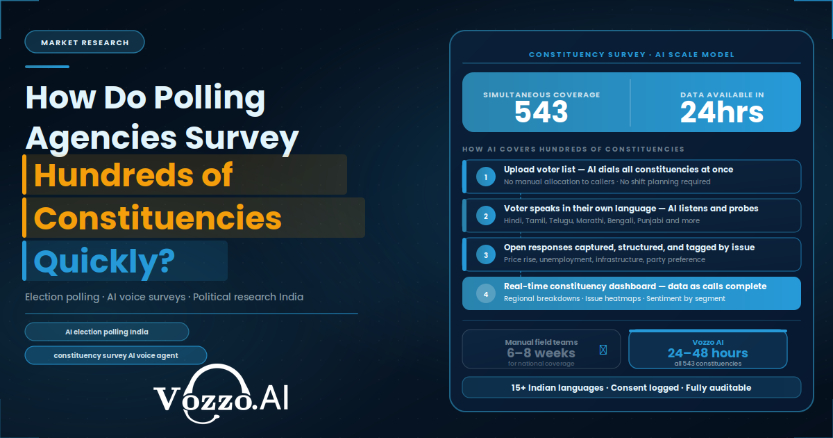
Step 1: The agency uploads constituency-wise respondent lists with phone numbers and language tags — Hindi, Tamil, Telugu, Marathi, Bengali, Odia, Punjabi tagged per respondent, so the system knows exactly which language to call in before it dials.
Step 2: The AI voice calling platform launches simultaneous outbound campaigns across all constituencies — not sequential, all at once. This is the core of what makes polling agency survey automation across constituencies actually work at election scale: 300 constituencies calling in parallel, not one after another.
Step 3: Each respondent receives a call in their tagged language, and the AI greets and conducts the survey in a natural conversational flow, not a robotic press-1-press-2 IVR sequence.
Step 4: Dynamic question branching handles real conversation. If a respondent says they are undecided, the AI asks follow-up probing questions. If they name a party, the AI records the response and moves to the next question — the same branching logic a trained human interviewer would use, applied consistently.
Step 5: Open-ended responses are transcribed and classified in real time — sentiment, party preference, and issue priority are extracted automatically, without a data entry team working through the night.
Step 6: Constituency-level data dashboards update in real time. Agency analysts see response rates, early preference data, and completion status live, constituency by constituency, rather than waiting for end-of-day compilation.
Step 7: A full structured dataset is delivered within hours of campaign completion — constituency-wise, demographic-wise, and issue-wise breakdowns ready for analysis, not a raw pile of call recordings someone still has to process.
What Makes AI-Powered Constituency Surveys More Reliable Than Human Caller Panels
Interviewer bias is eliminated. The AI asks every question in exactly the same tone, sequence, and phrasing across every respondent in every constituency — no interviewer subtly leading a respondent toward an answer, intentionally or not.
Language accuracy improves because native language AI removes the translation layer that distorts responses when a Hindi-speaking caller surveys a Tamil respondent. The question asked is the question intended, in the respondent's own language, every time.
Response consistency holds at scale in a way human panels cannot match. Human callers get tired, skip questions, and paraphrase under time pressure. AI never does — call number 40,000 gets the exact same script as call number one.
Scale without degradation is the real differentiator. Survey quality on call 50,000 is identical to call number 1. Human caller panels deteriorate as volume and fatigue increase, which is precisely when election-window pressure is highest. This is what makes a genuine bulk constituency survey tool different from a bigger call center — it is not more people making more calls, it is the same quality of interview repeated without decay.
Before vs After AI Voice Surveys for a 200-Constituency Poll
Before: 40 human callers, 5 languages, 4 days of fieldwork, a maximum of 12,000 responses, a data entry lag of 24-48 hours after fieldwork ends, measurable interviewer effect in the results, and a cost of Rs 15,00,000-plus for the panel.
After: an AI calling platform running 10 languages, a 48-hour turnaround, up to 2,00,000 responses possible, a real-time dashboard instead of a data entry queue, zero interviewer effect, and a cost that is a fraction of the human panel at the same scale.
Beyond Elections — Where Else Polling and Research Agencies Use This
The same infrastructure that runs election constituency surveys handles brand tracking studies across 50 cities, product feedback surveys across rural districts, government scheme awareness studies across 600-plus districts, and post-budget sentiment surveys within 24 hours of a Union Budget announcement. The use case is any research question that needs large-scale, multilingual, fast-turnaround data from geographically dispersed respondents. Election polling is simply the most time-pressured version of a problem that market research agencies face every week.
The polling agencies publishing reliable constituency-level data within hours of poll close are not doing it with bigger caller panels. They are doing it with AI voice infrastructure that reaches respondents in their own language, at scale, inside the time window that actually matters. That capability is now accessible to any research agency — not just the ones with 10,000-person caller networks.