It's 3:14 a.m. on a medical-surgical floor, and a nurse needs a patient's complete medication history before administering a new dose. The on-call pharmacist isn't answering, the chart is scattered across three different systems, and the patient is waiting in pain. In that moment, a voice AI that can retrieve accurate records instantly isn't a convenience feature , it's a patient-safety requirement wrapped in a compliance obligation.
The HIPAA Problem With Voice AI in Healthcare
Most consumer-grade voice assistants were never built to handle Protected Health Information. They route audio to third-party servers, retain recordings indefinitely, and offer no mechanism for a hospital to sign a Business Associate Agreement. When a nurse asks a general-purpose assistant about a patient's allergies or medication history, that query — and the PHI embedded in it , can leave the hospital's compliance boundary entirely, with no audit trail to prove otherwise.
This is not a hypothetical risk. Voice data is inherently identifiable: it captures tone, patient names, room numbers, and clinical detail in a single utterance. Once that audio is transmitted to a server outside the hospital's control, the covered entity has effectively lost the ability to guarantee the minimum necessary standard required under HIPAA's Privacy Rule.
The core issue is architectural, not accidental. A healthcare data privacy AI agent must be designed from the ground up to treat every voice interaction as PHI until proven otherwise: encrypting it, logging it, and restricting who can retrieve it. Retail and hospitality voice platforms were never engineered with these safeguards, which is why deploying HIPAA compliant voice AI requires purpose-built infrastructure rather than a generic assistant with a healthcare skin.
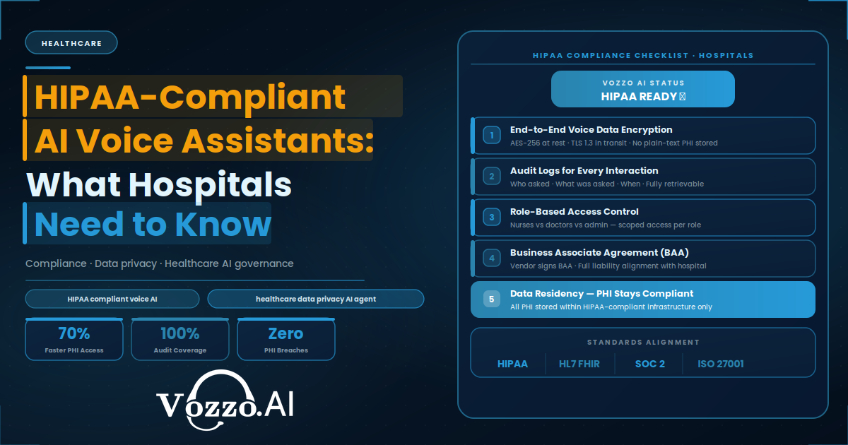
The 5 HIPAA Requirements Every Healthcare Voice AI Must Meet
Hospital IT and compliance teams should evaluate any voice AI vendor against five non-negotiable requirements before deployment. Failing any one of these turns a productivity tool into a liability.
- End-to-end encryption of all voice data. Audio and transcripts must be encrypted in transit and at rest, so no unauthorized party can intercept or access PHI at any stage of the interaction.
- Audit logs for every interaction. The system must record who asked, what was asked, and when, creating a defensible trail for compliance audits and incident investigations.
- Role-based access control. Nurses, physicians, and administrative staff need different levels of access; a voice AI must enforce these boundaries automatically rather than exposing the same data to every user regardless of role.
- A signed Business Associate Agreement (BAA) with the AI vendor. Without a BAA in place, no vendor handling PHI can legally operate within a covered entity's environment, regardless of how strong its technical safeguards are.
- Data residency within compliant infrastructure. PHI must remain on servers and networks that meet HIPAA's technical safeguards, with no uncontrolled replication to consumer cloud services or third-party analytics tools.
Vendors that cannot document all five in writing should be treated as non-compliant, not "compliant with exceptions."
Before vs After Voice AI in Hospital Workflows
Before voice AI, a nurse needing patient history places a call to the nursing station, waits on hold, and depends on whoever answers to locate the right chart in the right system. Each step adds minutes, and each handoff introduces a chance for miscommunication or transcription error. Night shifts compound the problem, when staffing is thinner, callbacks take longer, and fatigue increases the odds of a mistake going unnoticed.
After deploying HIPAA-compliant voice AI, the same nurse asks the question directly and receives a verified answer sourced straight from the EHR in seconds, with the exchange logged automatically for compliance review. There is no phone tag, no waiting on a colleague to free up, and no manual documentation step afterward. The workflow shifts from reactive and call-dependent to immediate and self-service, without sacrificing the audit trail that compliance officers require during review or investigation.
Compliance Outcomes and Clinical Impact
Hospitals piloting compliant voice AI report measurable gains across both efficiency and risk categories. Average time to retrieve patient information drops from roughly 4 to 6 minutes via phone call to under 15 seconds through a direct voice query. Medication history errors tied to miscommunication during verbal handoffs decline by up to 30% when voice AI pulls directly from structured EHR data instead of relying on a verbal relay between staff. Nursing staff report reclaiming 20 to 40 minutes per shift previously spent on hold or re-confirming information with pharmacy or another unit. Compliance teams also see faster audit preparation, since every interaction is already logged and timestamped, cutting manual log reconciliation during HIPAA audits by a significant margin , often the difference between days and hours of preparation work.
How Vozzo AI Meets HIPAA Standards
Vozzo AI encrypts every voice interaction end-to-end and stores transcripts within infrastructure that meets HIPAA's technical safeguard requirements. Every query generates a timestamped audit log capturing who asked, what was asked, and the response given, so compliance officers have a ready-made record for review rather than a reconstruction project. Vozzo AI offers a signed BAA to healthcare customers and maintains strict data residency controls, ensuring PHI never leaves compliant environments regardless of where a query originates.
Hospitals that adopt HIPAA-compliant voice AI now are setting the operational and compliance standard their peers will be measured against within the next two years. As regulators and patients scrutinize how healthcare systems handle PHI more closely, the gap between institutions with verifiable audit trails and those still relying on manual phone-based workflows will only widen. The question for hospital leadership is no longer whether to adopt voice AI, but whether the vendor they choose can prove compliance under audit.