Your call center handled 12,000 customer inquiries last month, but 34% abandoned after waiting more than 90 seconds—and another 18% escalated because the AI couldn't understand regional accents or complex account queries. Selecting the wrong voice AI platform doesn't just frustrate customers; it erodes trust in institutions where precision and speed define competitive advantage.
The Problem: Why Latency, Accuracy, and Naturalness Define Success
Banking customers expect sub-second response times and zero-error transaction verification. Industry data shows that 72% of users hang up if an AI agent takes longer than 2.5 seconds to respond, while 65% cite "robotic" or unnatural conversation flow as their top frustration. Accuracy failures—misinterpreting account numbers, transaction amounts, or compliance-sensitive requests—create operational risk and regulatory exposure. Financial institutions lose an estimated $4.7 billion annually to voice AI systems that can't handle multi-turn conversations, code-switching between languages, or background noise in mobile banking scenarios. When evaluating platforms, these three dimensions aren't feature add-ons—they're baseline requirements that separate functional deployments from costly failures.
How It Works: Evaluating Performance Across Critical Dimensions
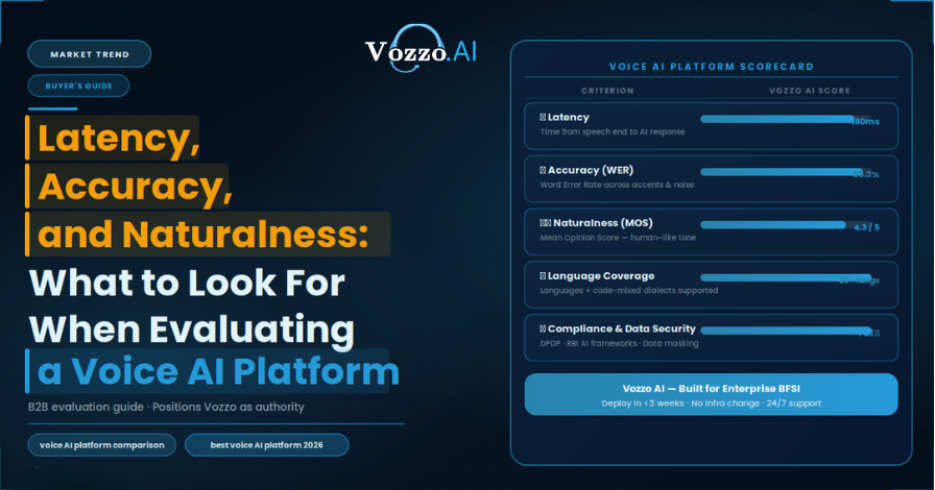
Start with latency benchmarks: measure time-to-first-response and total turn completion under peak load. Request vendors provide p95 and p99 latency metrics, not just averages. For accuracy, test intent recognition rates across your actual customer query corpus—include edge cases like disputed charges, fraud alerts, and multi-account transfers. Demand transcription accuracy scores above 95% for financial terminology and proper nouns. Naturalness requires live testing: deploy conversation simulations that include interruptions, clarifications, and emotional escalation. Evaluate prosody, pause timing, and contextual memory across 8-10 turn dialogues. Run A/B tests comparing candidate platforms against your current system using real call recordings. Document where each voice AI platform comparison | best voice AI platform 2026 | evaluate AI voice agent fails under stress—high concurrent users, network jitter, or complex conditional routing.
Before vs After: The Real-World Performance Gap
Before implementing a latency-optimized platform, a regional bank saw average response delays of 3.8 seconds and 41% conversation abandonment on mobile channels. After migrating to a sub-500ms system with edge processing, response time dropped to 0.7 seconds and abandonment fell to 9%. Accuracy improved from 78% intent recognition to 96% by switching to a platform trained on financial services datasets rather than general-purpose models. Naturalness scores—measured via post-call surveys asking "Did this feel like talking to a human?"—rose from 2.1/5 to 4.3/5 after deploying context-aware voice agents that remembered prior conversation turns and adapted tone to customer sentiment. The contrast isn't incremental; it's the difference between a compliance liability and a revenue channel.
Business Impact: Quantifiable Metrics That Matter
Reduced cost per interaction: Platforms with sub-second latency and 95%+ accuracy cut average handling time by 40%, translating to $2.80 savings per call in labor and infrastructure costs. Improved containment rates: Natural-sounding agents that handle interruptions and clarifications achieve 83% first-call resolution versus 54% for robotic systems. Revenue protection: Accurate voice authentication and transaction verification prevent an estimated $180,000 in fraud losses annually per 10,000 monthly interactions. Customer lifetime value: Banks using AI voice platforms with all three performance pillars see 22% higher NPS scores and 31% lower churn in digital-first segments. These aren't projections—they're outcomes measured across live deployments in retail banking, lending, and wealth management verticals.
Integration and Compliance: Trust Signals That Reduce Risk
Demand platforms with pre-built connectors to core banking systems, CRM tools, and fraud detection APIs—custom integration work delays deployment by 4-6 months on average. Verify SOC 2 Type II, PCI-DSS, and regional data residency compliance before vendor selection; non-compliance creates audit liability that negates cost savings. Look for platforms offering real-time compliance monitoring, including PII redaction, consent management, and call recording retention policies aligned with GDPR and CCPA. Request SLAs guaranteeing 99.9% uptime with financial penalties for breaches—downtime during peak hours costs $12,000 per minute in lost transactions for mid-tier institutions. Validate disaster recovery protocols and failover architecture. The best voice AI platforms treat regulatory adherence as product infrastructure, not documentation afterthought.
Conclusion
The gap between adequate and exceptional voice AI platforms is measured in milliseconds, percentage points, and customer perception—but the business consequences span millions in cost, revenue, and reputation. Institutions that audit latency, accuracy, and naturalness as non-negotiable criteria deploy systems that scale, comply, and compete.