Every voice AI vendor in 2026 claims to be enterprise grade — the sales deck, the pricing page, and the case study PDF all say it. The question that separates platforms that have actually run at scale from platforms that have run impressive pilots is simple: what happens on day 47 when your call volume spikes 3x at 2am and your largest client's contact center is live? The answer to that question is what enterprise grade actually means.
What Enterprise Grade Actually Means — The Six Real Requirements
1. Concurrency at production volume without degradation
An enterprise voice AI platform must handle thousands of simultaneous calls without latency increase, voice quality degradation, or transcription accuracy drop. The benchmark is not peak demo performance — it is consistent performance at 3x your average daily volume during an unexpected spike. Ask any vendor for their concurrency ceiling and the latency SLA they guarantee at that ceiling.
2. Uptime SLA with financial penalty
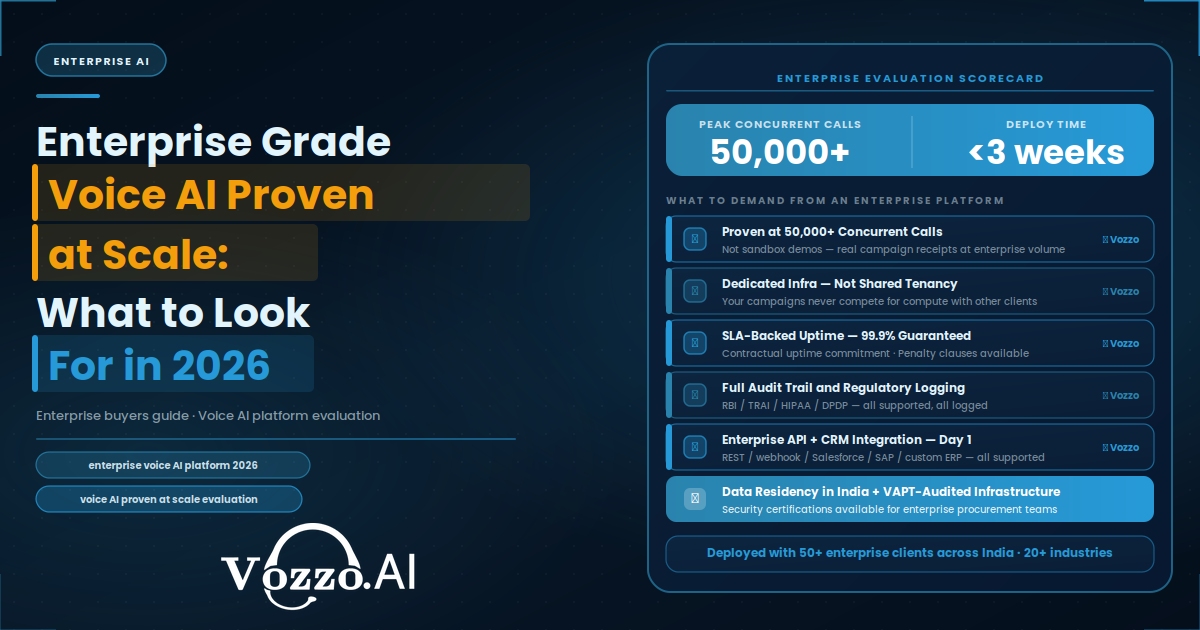
Enterprise grade means 99.9% uptime minimum — roughly 8.7 hours of downtime per year — with financial penalties for breach, not just a service credit. A voice AI platform running a bank's collections operation or a hospital's appointment system cannot go down for maintenance windows during business hours. Ask for the SLA document, not the marketing page.
3. Data residency and sovereignty compliance
For enterprises in India, the UK, the Netherlands, and Ireland, data residency is a regulatory requirement, not a preference. India's DPDP Act and GDPR in the EU and UK govern where call recordings, transcriptions, and customer data can be processed and stored, and how they move across borders. Platforms that route all data through US data centers create regulatory exposure for non-US deployments.
4. Integration depth with enterprise systems
Enterprise grade means native integration with the systems enterprises actually run — Salesforce, SAP, Oracle, Genesys, Avaya, Twilio, AWS Connect, Microsoft Teams, and core banking platforms. An API that works in a sandbox is not the same as a production-tested integration. The difference is how it handles authentication, rate limiting, error handling, and data mapping at scale.
5. Security certifications that match your industry
SOC 2 Type II, ISO 27001, PCI-DSS for financial services, HIPAA for healthcare, and Cyber Essentials for UK public sector. Not "in progress" — certified, with current audit documentation available for vendor review. Enterprise procurement teams in the UK, the Netherlands, and Ireland will ask for these before a contract is signed.
6. Proven client deployments at comparable scale
Reference clients in your industry, at comparable call volume, willing to speak to your procurement team. Not case study PDFs with anonymized metrics — actual client names with actual call volumes. A platform that cannot provide this has not been enterprise grade at scale, regardless of what the sales deck says.
Where Most Voice AI Platforms Fall Short at Enterprise Scale — The Honest Assessment
On any enterprise voice AI platform 2026 shortlist, the question is less about features and more about where the architecture breaks. Three failure points recur.
- Latency under load. Most voice AI platforms perform well at 100 concurrent calls. Performance degrades at 1,000 and breaks at 5,000 because the underlying architecture was not designed for concurrency at that level. Ask for latency benchmarks at 10x your expected peak, not your expected average.
- Multilingual accuracy at volume. Platforms demonstrate strong English accuracy in demos. Hindi, Dutch, Tamil, and Irish English accuracy at volume, on mobile network audio quality, is where most platforms reveal their limitations. Request a live accuracy test on your own call recordings in your target languages before signing.
- Support response at 2am. Enterprise deployments run 24/7. A support team available 9–5, Monday to Friday, in a US time zone is not enterprise support for a contact center in Dublin or Hyderabad. Ask what the SLA is for P1 incident response outside US business hours.
Vozzo AI — Enterprise Voice AI Already Live at Scale
Vozzo AI is already deployed at enterprise scale across India, with clients in BFSI, healthcare, agriculture, and government — handling millions of calls with consistent performance across 10+ Indian languages and English. For enterprises in the UK, the Netherlands, and Ireland, Vozzo AI offers GDPR-compliant infrastructure, multilingual capability including Dutch and British English, and integration with leading European enterprise telephony and CRM platforms. This is enterprise grade voice AI proven at scale: the platform is not in pilot phase for enterprise — it is in production, with reference clients across verticals and geographies available for procurement review. Enterprise SLAs, data residency options, and security certification documentation are available on request.
The Due Diligence Checklist — What to Demand From Any Enterprise Voice AI Vendor
- Uptime SLA with financial penalty terms — not a marketing claim.
- Concurrency ceiling and latency SLA at peak load — tested, not estimated.
- Data residency options for your jurisdiction — India DPDP and EU/UK GDPR compliant.
- Security certifications, current and audited — SOC 2 Type II and ISO 27001 minimum.
- Native integrations with your specific enterprise systems — production-tested integrations, not just API access.
- Multilingual accuracy benchmarks on your language mix — a live test on your own audio, not a demo.
- Reference clients at comparable scale in your industry — names and contacts, not anonymized PDFs.
- P1 support SLA outside US business hours — critical for UK, Netherlands, Ireland, and India deployments.
- Commercial model at scale — per call, per minute, or platform fee — and what happens at 3x volume.
- Exit and data portability terms — what happens to your data and conversation flows if you switch platforms.
Before vs After: Choosing an Enterprise Grade Platform vs a Scaling Startup
Before — the pilot-to-production failure pattern. The voice AI performs well in a 3-month pilot at 500 calls per day. The enterprise contract is signed and volume scales to 8,000 calls per day. Latency increases, accuracy drops on regional language calls, the integration with the core banking system fails under load, and support response during a 3am incident takes 6 hours. Rollback costs and reputational damage follow.
After — an enterprise grade deployment. The platform is demonstrated at 20,000 concurrent calls before the contract is signed. Data residency is confirmed for the jurisdiction. The integration is tested at production volume in staging, and the support SLA is confirmed for the local time zone. Go-live at 8,000 calls per day happens without incident.
The Bottom Line
Enterprise grade voice AI is not a feature list — it is a track record of production deployments at scale, in regulated industries, across multiple geographies, with the support infrastructure to match. The vendors who can demonstrate this in 2026 are a short list. Design your procurement process to find them, not to be impressed by demos.