
A customer calls your hotline at 9 PM saying they want to cancel their premium rewards card because the annual fee just posted. Your outsourced agent reads from a script, offers a generic retention bonus, and the customer hangs up — card closed, $4,200 annual revenue lost. This scenario repeats 60-80 times per day across mid-sized card portfolios, draining customer lifetime value and forcing acquisition teams to replace churned accounts at 5x the retention cost.
Why Cancel Calls Destroy Portfolio Economics
Card issuers lose 12-18% of active accounts annually to voluntary cancellations. Industry data shows that 68% of these customers never receive a personalized retention offer during their cancel call. Traditional IVR systems route cancellation requests to undertrained agents who lack real-time data on customer profitability, spend patterns, or competitive offers. The result: high-value customers who spend $8K+ annually receive the same templated response as dormant cardholders. Average save rates hover at 22-27% when human agents handle cancellations manually. Worse, cancel calls spike during fee-posting cycles and rate increases, overwhelming contact centers precisely when retention matters most. Each lost customer costs $850-$1,400 in replacement acquisition expense, turning what should be a retention conversation into a profitability leak.
How Voice AI Detects and Prevents Card Cancellations
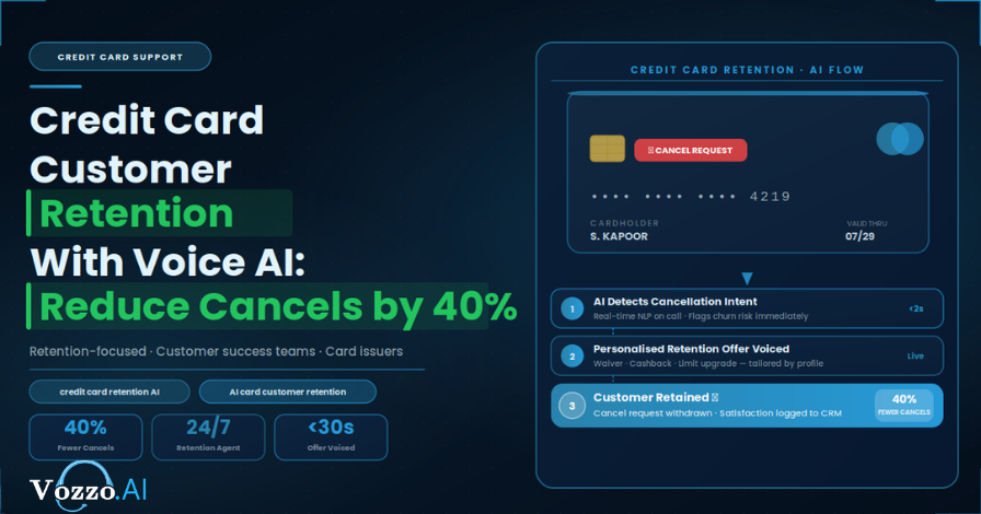
The system activates the moment a customer says "cancel," "close my account," or "I'm thinking about switching cards." Credit card retention AI | voice agent cancel prevention | AI card customer retention analyzes customer lifetime value, recent transactions, fee sensitivity, and competitive vulnerabilities in under 800 milliseconds. The voice agent then deploys targeted retention logic: waiving annual fees for customers with 18+ month tenure, offering statement credits to offset rate increases, or proposing product downgrades to no-fee cards. The AI pulls real-time data from your core banking system and marketing databases to calculate maximum retention spend per customer. If the customer hesitates, the agent surfaces competitor rate comparisons and reminds them of accrued rewards balances. Escalation to human specialists occurs only when AI confidence drops below 72% or the customer explicitly requests supervisor transfer.
Before vs After: Retention Performance Shift
**Before Voice AI:** Cancel calls averaged 8.4 minutes. Agents offered fee waivers to 34% of callers regardless of profitability. Save rate: 24%. Retention offers cost an average of $127 per customer due to blanket annual fee waivers. High-value customers (top 15% spenders) received identical treatment to low-engagement accounts. Queue times during fee-posting periods reached 11 minutes.
**After Voice AI:** Call duration dropped to 4.1 minutes. The system deployed tiered retention offers calibrated to customer LTV, increasing save rates to 61% while reducing average retention cost to $89. High-value customers received premium retention packages within 90 seconds. Queue congestion disappeared as AI handled 82% of cancel requests autonomously. Customer satisfaction scores on retention calls rose from 3.2 to 4.6 out of 5.
Measurable Business Impact Across Four Metrics
**Cancellation Reduction:** Card portfolios deploying AI retention voice agents see cancel volumes drop 38-43% within 90 days. **Revenue Preservation:** Each prevented cancellation saves $4,200-$6,800 in annual card revenue, translating to $2.1M-$3.4M protected revenue per 500 saved accounts. **Cost Efficiency:** Retention offer spend decreases 28-34% through profitability-based targeting instead of universal fee waivers. **Speed to Intervention:** AI detects cancel intent and initiates retention protocol in under 2 seconds versus 4-7 minutes with traditional IVR routing. One regional card issuer recovered $8.3M in at-risk revenue during a single annual fee cycle by automating retention workflows. Another reduced cancellation-related contact center costs by 31% while simultaneously improving save rates by 19 percentage points.
PCI-DSS Compliance and Core Banking Integration
Voice AI retention systems integrate with core platforms like FIS, Fiserv, and Temenos via secure API connections that maintain PCI-DSS Level 1 compliance. All cardholder data remains encrypted in transit and at rest. The AI never stores full card numbers — it references tokenized identifiers linked to your existing customer records. Retention offer approvals follow your existing credit policy engines and spending authority matrices. Conversation logs integrate with Salesforce, Zendesk, and proprietary CRM systems for compliance audit trails. SOC 2 Type II certification ensures data handling meets regulatory standards for financial services. Deployment typically requires 6-8 weeks for API mapping, retention logic configuration, and compliance review. The system operates within your existing telecom infrastructure no carrier migration required.
Conclusion
Card issuers who automate retention workflows intercept cancellations before they reach costly human escalation queues. While competitors lose 15-18% of their portfolios annually to preventable churn, AI-powered retention systems convert cancel calls into loyalty opportunities at a fraction of traditional agent costs.