
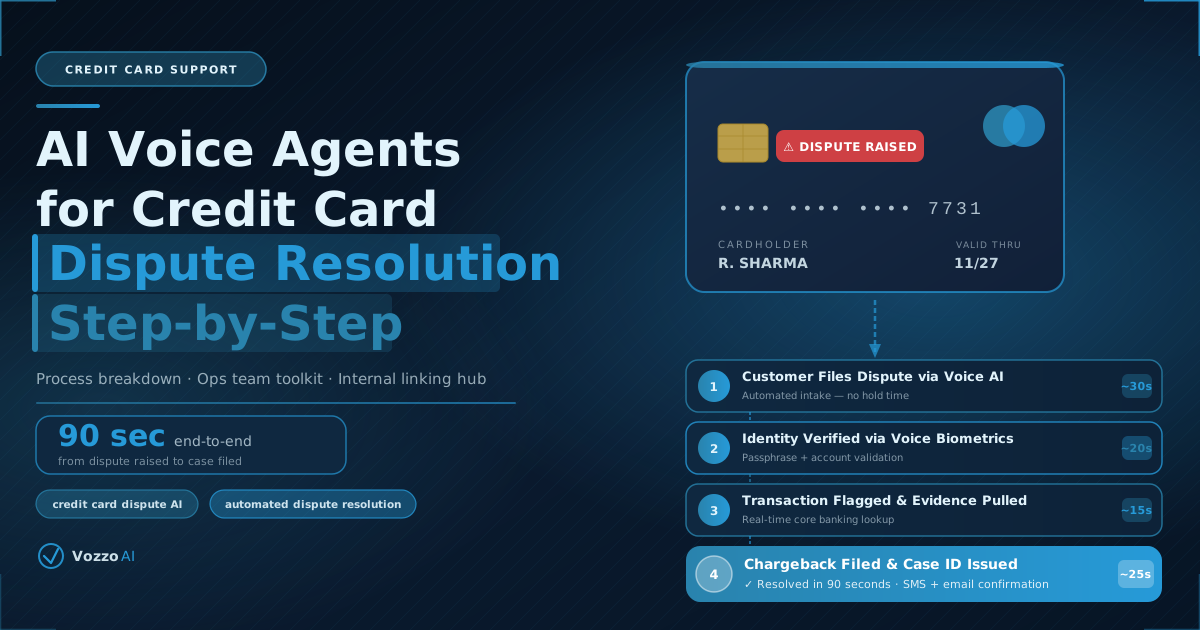
A cardholder calls at 9 PM claiming fraud on three transactions totaling $847. Your contact center has 16 agents handling 200+ simultaneous calls, and dispute intake alone consumes 8-12 minutes per case. Manual documentation errors lead to 18-22% of disputes being reopened due to incomplete initial information, costing your institution an average of $43 per rework cycle.
The Problem: Dispute Volume Overwhelms Manual Processes
Credit card dispute volume increased 31% year-over-year as digital payments expanded. Traditional phone systems require agents to toggle between CRM, case management, and card platforms while gathering merchant details, transaction dates, and dispute reasons. Industry data shows the average dispute intake call lasts 11.4 minutes, with 40% of that time spent on data entry rather than resolution. Compliance requirements demand specific questions be asked in sequence, but agent turnover averaging 38% annually means constant retraining. After-hours disputes queue until morning, creating customer friction and increasing abandonment rates to 23% during peak periods. Manual processes also struggle with inconsistent documentation quality, leading to regulatory gaps and delayed provisional credit decisions.
How It Works: The AI Voice Agent Dispute Workflow
Step 1: Cardholder initiates contact via phone or callback request. The AI voice agent authenticates using last four digits, ZIP code, and security questions. Step 2: Agent extracts transaction details through conversational prompts , merchant name, amount, date, dispute reason (unauthorized, not received, defective). Step 3: System cross-references transaction data in real-time against card platform APIs to verify details and flag patterns. Step 4: credit card dispute AI | AI voice agent chargeback | automated card dispute resolution systems generate case tickets with pre-filled fields, attaching call transcripts and tagging urgency levels. Step 5: Conditional logic routes cases—fraud goes immediately to investigations, billing errors to merchant outreach queues. Step 6: Cardholder receives confirmation via SMS with case number and estimated resolution timeline. Entire intake averages 3.2 minutes.
Before vs After: Dispute Handling Transformation
Before implementation: 11-minute average handle time, 22% documentation error rate, 18-hour average queue time for after-hours disputes, 6.4 touches per case resolution, $78 cost per dispute. After deploying automated card dispute resolution: 3.2-minute intake time (72% reduction), 4% documentation error rate, zero queue time with 24/7 availability, 3.1 touches per case, $31 cost per dispute. Agent capacity reallocated from intake to complex investigations increased first-call resolution for escalated disputes by 41%. Cardholder satisfaction scores improved from 6.8 to 8.9 out of 10. Provisional credit decisions accelerated from 48 hours to 6 hours due to complete initial data capture. Compliance audit scores increased 27% with mandatory question adherence at 99.7%.
Business Impact: Four Metrics That Matter
Operational cost per dispute dropped 60% by eliminating redundant data entry and reducing average handle time. Contact center capacity expanded by 340 hours monthly without hiring, reallocating agents to revenue-generating activities like retention and upsell. Chargeback win rates improved 19% because AI voice agent chargeback systems capture granular evidence during initial contact timestamps, merchant communication attempts, product condition details. Regulatory risk decreased measurably with 100% audit trail coverage and automatic escalation triggers for amounts exceeding thresholds. Customer lifetime value retained increased $1.2M annually as dispute resolution speed reduced attrition by 8%. False positive fraud blocks decreased 34% through better intent classification, preserving legitimate transaction approvals while maintaining security.
Integration and Compliance: Trust Architecture
AI voice agents integrate via REST APIs with core banking platforms, card networks (Visa, Mastercard), and case management systems. PCI-DSS Level 1 compliance ensures tokenization of card data with zero storage of full PANs. SSAE 18 SOC 2 Type II certification covers data handling protocols. Regional compliance modules adapt questioning for FCBA (US), Payment Services Regulations (UK), and PSD2 (EU) requirements. Voice biometrics layer adds authentication without friction, meeting FFIEC guidance on multi-factor verification. Audit logs capture every interaction with immutable timestamps for dispute litigation support. Encryption standards (AES-256) protect data in transit and at rest. System uptime SLAs guarantee 99.95% availability with failover routing to human agents during outages, ensuring zero dispute intake disruption.
Conclusion
Banks deploying voice AI for dispute intake gain a 72% efficiency advantage while competitors still manually process cases. The workflow transformation isn't theoretical, institutions handling 50,000+ monthly disputes now resolve them faster, cheaper, and with better outcomes. Operational teams that integrate these systems in Q1 will set the performance benchmark others spend years trying to match.