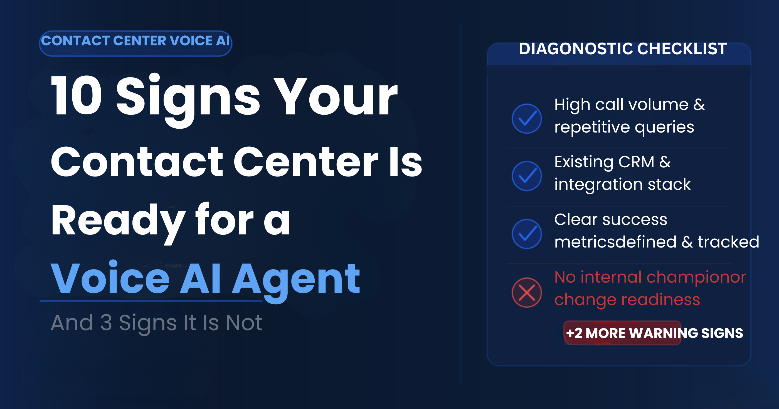
Most contact center leaders ask the wrong question. The question is not 'Should we use voice AI?' in 2026, the answer is almost always yes. The real question is: 'Are we ready to deploy it effectively?' Here are 10 signs you are and 3 honest signs you are not yet.
Why Readiness Matters More Than Technology
Voice AI deployment failure is almost never a technology problem — it's a readiness problem. Contact centers that rush deployment without the right call volume, data, or internal buy-in see poor results and blame the technology. The businesses seeing 3–5x ROI are the ones who assessed readiness first. contact center AI automation is not a technology problem — it's a readiness assessment problem. Master the readiness checklist first and the technology deploys itself.
10 Signs Your Contact Center Is Ready
Sign 1: You receive 500+ inbound calls per day
At this volume, the ROI of voice AI becomes immediately measurable. Each automated call saves 4–8 minutes of agent time. Below 500 calls/day, the economics work but take longer to show. This is the entry threshold where contact center AI automation starts paying back within weeks.
Sign 2: More than 40% of your calls are repetitive queries
Balance checks, order status, appointment confirmations, FAQs — if your agents are answering the same 10 questions on repeat, voice AI can handle these instantly. This is the single fastest win in contact center AI automation. When over 40% of your volume is predictable, you have an automation goldmine.
Sign 3: Your average handle time (AHT) is above 5 minutes
Voice AI resolves routine queries in under 90 seconds. If your AHT is high due to repetitive tasks, there's significant time — and cost — to recover. A contact center averaging 7-minute calls on balance inquiries is losing thousands of agent-hours monthly that a voice AI agent could eliminate instantly.
Sign 4: You have measurable CSAT or NPS data
AI deployment without a baseline is flying blind. If you already track customer satisfaction, you can quantify the improvement post-deployment and prove ROI to leadership. A clear CSAT score before deployment becomes your strongest business case after deployment.
Sign 5: You operate across multiple languages or regions
This is where voice AI dramatically outperforms human agents. A single voice AI deployment can handle Hindi, English, Tamil, and Telugu simultaneously — 24/7. Understanding when to use voice AI starts with recognising your multilingual coverage gaps. One deployment, zero language premium.
Sign 6: Your contact center runs 24/7 or needs to
Human agents cost 3x more on night shifts. Voice AI has no shift premium, no overtime, and no absenteeism. If you need round-the-clock coverage, voice AI is the obvious solution. The economics alone justify deployment — even before you count the quality and consistency gains.
Sign 7: You have a CRM or ticketing system already in place
Voice AI needs a data source to be useful. If you already use Salesforce, HubSpot, Zoho, Freshworks, or Zendesk, Vozzo AI can connect in hours and pull live customer context on every call. Your CRM becomes the intelligence layer that turns every voice interaction into a personalised, data-driven conversation.
High attrition in contact centers is almost always caused by repetitive, low-complexity calls burning out agents. Automating these calls retains your best agents for complex, high-value interactions. Reducing agent churn by even 10% saves more than most voice AI deployments cost in their first year.
Whether it's RBI fair practices violations in collections or HIPAA gaps in healthcare — voice AI follows scripts with 100% consistency, every call, every time. Zero deviation, zero compliance risk. Every interaction is logged, auditable, and provably compliant.
Sign 9: You’ve had compliance incidents on calls
Sign 10: Your leadership has approved an AI pilot budgetThis is
the mo
st practical sign of all. If budget exists and leadership is aligned, the only remaining step is finding the right platform. Voice agent readiness isn't just about technology — it's about organisational will. Budget approval signals that will exists.
3 Signs You Are Not Ready Yet — And What to Do About It
Sign 1: You don't have clean call data or call transcripts
Voice AI learns fastest from historical call data. If you don't have 3–6 months of call transcripts or categorised query logs, spend 60 days building that dataset first. It will dramatically improve your AI's accuracy from day one. The fix is simple — start recording and categorising calls today.
Sign 2: Your internal processes are not documented
If your agents resolve queries based on tribal knowledge rather than documented SOPs, voice AI will struggle. Before deploying, map your top 20 call types into structured call flows. This work benefits your human agents too — and lays the groundwork for a successful voice AI pilot.
Sign 3: You expect voice AI to replace all human agents immediately
The most successful deployments use voice AI to handle tier-1 queries while humans handle escalations. If leadership expects a 100% replacement overnight, reset expectations first — the ROI is still massive with a hybrid model. Voice agent readiness includes readying your leadership's mindset for an augmentation strategy, not a replacement one.
Your Next Step — A Free Voice Agent Readiness Assessment
If you scored 7 or more from the 10 signs above, your contact center is ready for a voice AI pilot. Vozzo AI offers a free readiness assessment where we analyse your call volume, query mix, and CRM setup — and give you a deployment roadmap in 48 hours. There's no commitment, no lengthy RFP, and no guesswork.
Contact center AI automation is not a future consideration — it is a 2026 imperative. The contact centers winning today are not the largest or best-funded. They are the most prepared. If you recognise your operation in the 10 signs above, the next step is a conversation. Book your free Voice Agent Readiness Assessment at vozzo.ai/voice-ai-agents