
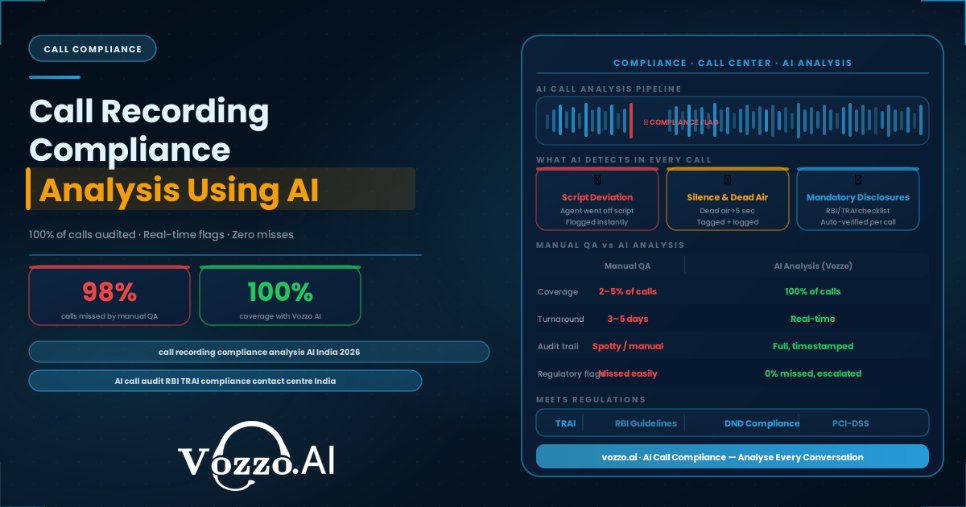
An NBFC receives a regulatory notice following an ombudsman complaint alleging that a collections agent used threatening language and called outside permitted hours — and the compliance team has 72 hours to produce the recording, verify the agent, confirm the call time, transcribe the relevant section, and respond in writing. They have 47,000 recordings from that month; their QA team reviewed 940 of them, or 2%, and the call in question sits in the other 98%. This is not a failure of compliance policy. It is a failure of compliance infrastructure.
Why Manual Call Compliance Review Is Structurally Inadequate for BFSI and BPOs
BFSI contact centers generate 5,000 to 50,000 calls per day. QA teams reviewing 2–5% of those calls is the industry norm — which means 95–98% of agent behaviour is unreviewed and, from a compliance perspective, unknown.
At the same time, regulatory scrutiny of call center practices has increased materially through 2025–2026. RBI's focus on recovery and collections conduct, IRDAI's attention to insurance mis-selling, and SEBI's interest in investment advisory calls have moved from periodic review to ongoing examination priority.
The fundamental problem is not the size of the QA team — it is the sampling model. A compliance function that reviews 2% of calls cannot detect systematic patterns, cannot find the specific call a regulator asks for, and cannot demonstrate proactive monitoring to an examiner. AI compliance analysis of call recordings in BFSI replaces the sample with the full population: every call, every agent, every day.
What AI Call Recording Compliance Analysis Does — The Technical Reality
- Step 1 — Automatic ingestion. All call recordings are ingested via API or SFTP from your telephony platform — no manual uploads, no daily batch selection.
- Step 2 — Transcription with speaker diarization. Every call is transcribed with agent and customer voices labelled separately and timestamps attached to every utterance.
- Step 3 — Compliance rule engine. Your specific rules run on every transcript: permitted calling hours, mandatory disclosures, prohibited language lists, script adherence, and identity verification completion. This rule layer is the core of call recording compliance analysis using AI — it encodes your policy, not a generic template.
- Step 4 — Automated scoring. Each call is scored against the same rubric your QA team uses, applied consistently to 100% of calls rather than a sampled subset.
- Step 5 — Same-day flags. Calls outside permitted hours, missing mandatory disclosures, or containing flagged language are surfaced before end of business on the day they occur.
- Step 6 — Structured compliance data. Agent ID, call time, compliance score, specific flags, and escalation status are written per call and pushed to your compliance dashboard and CRM automatically.
- Step 7 — Audit-ready reporting. Daily compliance summaries, weekly agent performance reports, and monthly regulatory reports are generated on schedule from complete call data, not sampled estimates.
The Specific Compliance Requirements AI Analysis Monitors — By Regulation
RBI Fair Practices Code — Collections and Lending
Recovery calls must be made between 8 am and 7 pm, and AI flags every call outside this window automatically. Agent identification at the start of the call is mandatory — AI verifies the disclosure is present in the first 30 seconds. Coercive, threatening, or abusive language is monitored on 100% of collections transcripts with same-day flagging, and promise-to-pay commitments are extracted and pushed to the collections CRM without manual data entry.
IRDAI Insurance Sales Compliance
Insurance sales calls must include specific product disclosures before a sale is confirmed, and AI verifies disclosure completion on every sales call. Mis-selling risk is flagged at source — calls where the product was described inaccurately or exclusions were not communicated are identified before the policy is issued. IRDAI audit preparation shifts from a manual sampling exercise to an automated complete-call report.
SEBI Investment Advisory Compliance
Advisory calls must carry required risk disclosures and must not make guaranteed-return claims; AI flags both omissions and prohibited claims on every call. Structured evidence for SEBI examination comes from complete call records rather than a sample. Agent-level reports identify advisors making non-compliant claims before client complaints arrive.
GDPR and UK FCA Compliance for International Operations
For BPOs serving European clients, AI monitors GDPR consent confirmation, data subject rights disclosures, and FCA-required product disclosures on every call. Complete coverage provides the documentation that GDPR's accountability principle requires — not a 2% sample. For European client deployments, recordings and transcripts can be held within the EEA or UK to meet data residency requirements.
Before vs After AI Compliance Analysis for a 300-Agent BFSI Contact Center
Before — manual sampling:
- 300 agents, 15,000 calls daily; QA team of 11 reviewing 330 calls per week — 2.2% coverage
- Compliance gaps invisible until a regulatory notice or ombudsman complaint arrives
- Specific call retrieval taking hours under time pressure
- Monthly compliance report requiring 4 days of analyst time
- Prohibited language incidents caught weeks after they occur
After — AI compliance analysis:
- 100% of 15,000 daily calls analysed, with compliance flags raised the same day
- Any call retrieved in under 60 seconds by agent ID or customer ID
- Monthly compliance report generated overnight
- Prohibited language incidents escalated before end of business
- The same QA team of 11 managing by exception and coaching — not listening to calls
What to Demand From an AI Call Compliance Analysis Platform
- Configurable rules aligned to your regulatory framework. RBI collections rules differ from IRDAI sales rules, which differ from SEBI advisory rules. The platform must support your specific rule set — not a generic global template — and rules must be updatable when regulatory guidance changes.
- Indian language monitoring at production accuracy. Hindi, Marathi, Tamil, Telugu, and Bengali calls must be monitored with the same accuracy as English. A platform that monitors English at 95% accuracy and Hindi at 72% creates a compliance gap worse than no monitoring at all for your Hindi-language volume.
- Tamper-evident storage with timestamp integrity. Recordings and transcripts must be stored so that any modification is detectable and timestamp authenticity is demonstrable. Chain of custody matters in regulatory proceedings and ombudsman disputes.
- Sub-60-second retrieval by any identifier. When a regulator or ombudsman requests a specific call, you need it in seconds, not hours. Retrieval must work by customer ID, agent ID, phone number, date range, and compliance flag type — in combination.
Conclusion
The BFSI and BPO organisations that build genuine compliance infrastructure in 2026 — 100% call coverage, same-day flagging, sub-60-second retrieval — are not just managing regulatory risk; they are building a defensible posture that turns the next examination from a crisis into a 24-hour report delivery. The organisations still running 2% manual QA when that examination arrives will spend the following six months explaining why they were not monitoring the other 98%.
Want to see 100% call coverage on your own recordings? Explore Vozzo AI Call Intelligence.