Your BPO just signed a 500-seat contract with a 14-day ramp requirement. Traditional classroom training takes 21 days, and your attrition rate during onboarding sits at 38%. Voice AI platforms are now compressing induction cycles to 10 days while improving first-call resolution scores by 22% in the first week.
The Problem: Training Bottlenecks Cost BPOs Revenue and Talent
Industry data shows the average call center loses $6,200 per agent who quits during training. BPOs face three compounding issues: trainer bandwidth caps at 15-20 agents per cohort, knowledge retention from slide decks averages 31% after one week, and clients demand faster deployment without quality sacrifice. When a fintech client needs 200 trained agents for a product launch in three weeks, traditional methods force you to decline the contract or staff under-trained agents who generate compliance risks. The gap between client urgency and training capacity directly limits growth. Most BPOs run 4-6 week programs that blend classroom theory, shadowing, and live monitoring—a model unchanged since 2008 despite technology shifts everywhere else in operations.
How AI-Powered Voice Induction Works: The Four-Stage Workflow
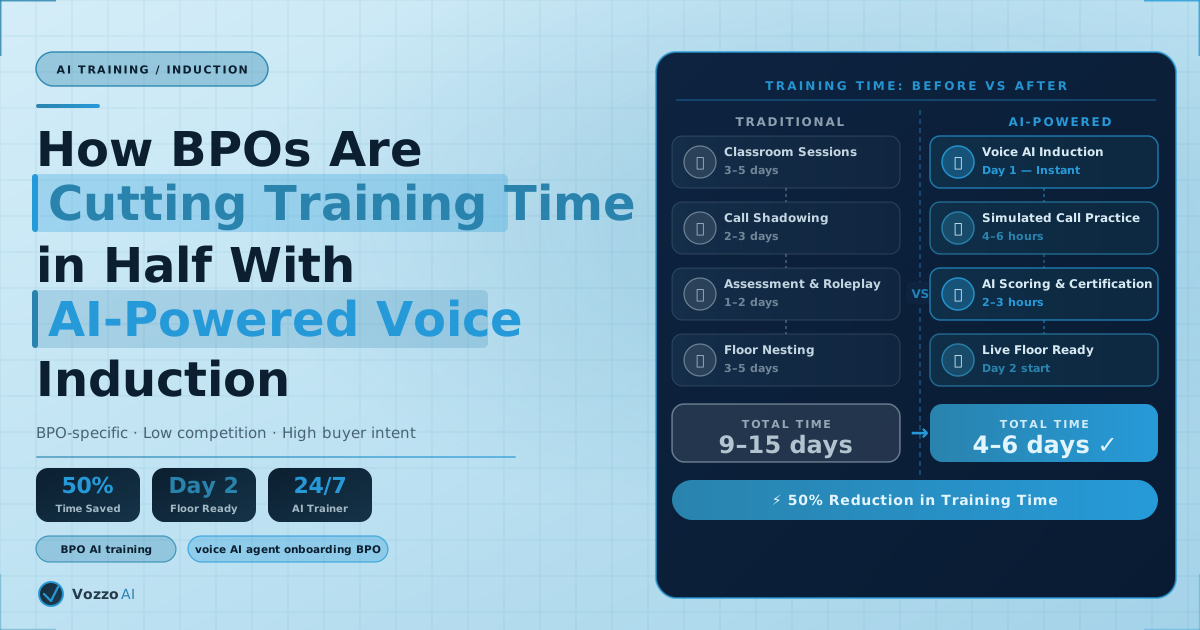
Voice AI platforms replace static modules with conversational simulations. Stage one: agents complete profile assessments that adapt difficulty based on role complexity—credit card disputes versus mortgage origination. Stage two: AI voices simulate customer scenarios with dynamic objections, requiring agents to apply policy knowledge in real-time dialogue. The system flags gaps instantly—if an agent mishandles a fraud escalation path, the AI replays that exact scenario with coaching hints. Stage three involves team-based exercises where BPO AI training | voice AI agent onboarding BPO | AI call center training systems analyze tone, pacing, and compliance adherence across mock calls. Stage four certifies agents through randomized assessments that mirror actual call distributions—30% billing inquiries, 25% technical support, 20% retention saves.
Before vs After: Induction Cycle Comparison
Before AI implementation, a mid-sized BPO in Manila ran 28-day training cycles with 12 trainers handling 180 agents quarterly. Post-implementation, the same headcount processes 340 agents in 14-day cycles. Before: agents required 47 live call observations before solo queue time; after: 18 AI simulation hours replace 35 observation hours. Trainer-to-agent ratios shifted from 1:15 to 1:28 because AI handles repetitive scenario practice while trainers focus on edge cases and soft skills. Quality assurance scores in week one improved from 68% to 84% average. Attrition during training dropped from 34% to 19%—agents report higher confidence from hands-on practice versus passive listening. The cost per trained agent fell from $1,840 to $920 when amortizing platform fees across volume.
Business Impact: Four Metrics That Move Your P&L
Time-to-productivity: agents reach 90% of target handle time 11 days faster. Revenue capacity: the same training infrastructure now supports 89% more seat fills per quarter, directly enabling larger contract bids. Compliance risk: AI call center training systems log every simulation for audit trails—zero gaps in documentation versus partial shadowing records. Trainer efficiency: senior staff reallocate 60% of their hours from script repetition to coaching high-complexity scenarios like de-escalation and empathy modeling. One logistics BPO calculated $340K annual savings from reduced re-training alone—agents who complete AI-based induction show 40% fewer knowledge gaps in month two. Client SLA attainment in the first 30 days post-training improved by 27 percentage points across five accounts.
Integration and Compliance: Trust Signals for Procurement Teams
Voice AI platforms integrate via API with existing LMS, CRM, and workforce management systems—no rip-and-replace required. Data residency options meet GDPR, SOC 2, and PCI-DSS requirements, critical when training agents on banking workflows with simulated customer data. Call recordings and AI-generated transcripts provide auditable proof of training completion for client reporting and regulatory review. Role-based access controls ensure only authorized personnel view performance analytics. Most platforms offer white-label customization so your branding remains consistent across client-facing materials. Implementation timelines average 3-4 weeks from kickoff to first cohort, including script migration and trainer certification on the AI interface. Ongoing support includes scenario library updates when clients launch new products or regulatory changes require workflow adjustments.
Conclusion
BPOs that adopt voice AI for agent onboarding gain a structural advantage in competitive bids, you can credibly promise faster ramps and higher day-one quality. The firms still running 2015-era classroom models will lose contracts to competitors who can deliver trained capacity in half the time. Your training infrastructure is now a revenue driver, not a cost center.