
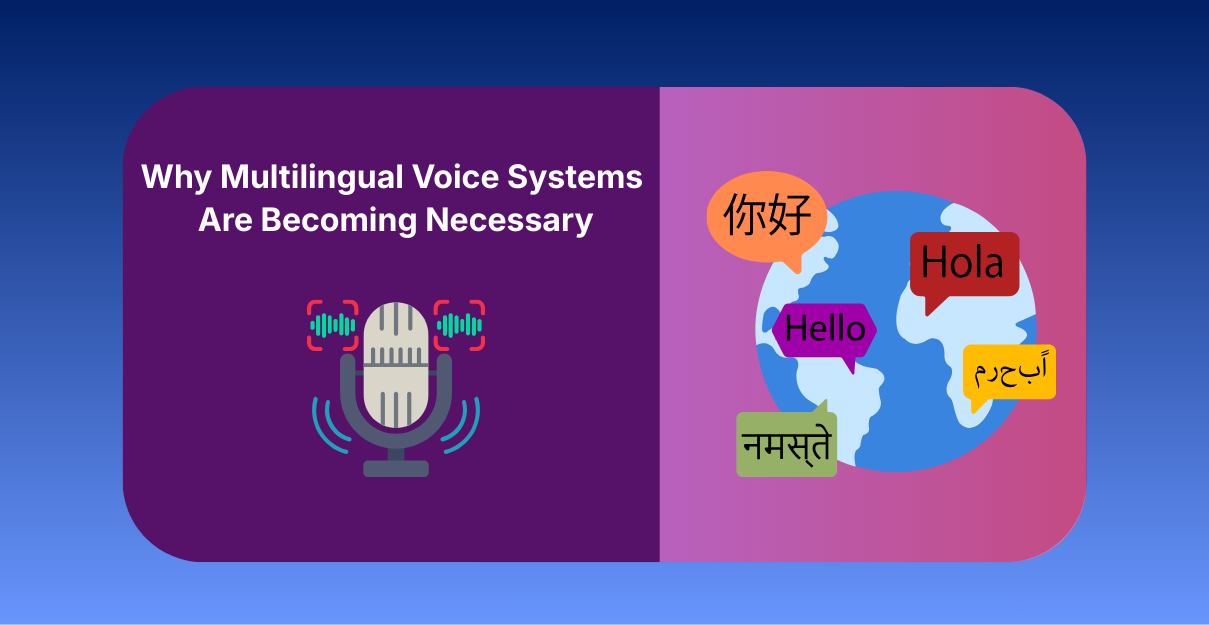
A customer in Madrid asks a banking app a question in Spanish. A traveler in Tokyo uses voice to reschedule a flight in English. A shopper in Dubai switches between Arabic and Hindi while tracking an order. All expect instant, accurate responses in their preferred language.
This shift in behavior is not a trend, it is a structural change in how people interact with technology. Businesses are serving audiences that are geographically scattered and linguistically diverse. To meet those expectations, companies are investing in smarter digital communication tools powered by Conversational AI Solutions. At the same time, Multilingual Voice AI is emerging as a critical layer that ensures those conversations happen without language barriers.
Voice is no longer just a feature. It is becoming the most natural way users connect with digital platforms.
The Rise of Voice as a Primary Interface
Voice interaction feels effortless. Instead of typing, navigating menus, or tapping through screens, users simply speak. Smart assistants developed by companies like Amazon and Google have made voice commands part of everyday life.
This behavior is now extending into banking apps, healthcare portals, retail platforms, and enterprise systems. People expect quick answers without friction. They want systems that understand intent, context, and natural speech patterns.
Conversational AI Solutions enable this shift by combining speech recognition, natural language understanding, and intelligent response generation. However, as adoption grows globally, language diversity becomes impossible to ignore.
Why Multilingual Capability Is No Longer Optional
Global Markets Demand Local Communication
Digital businesses operate across borders by default. An e commerce store in the United States can easily serve customers in Europe, Asia, and the Middle East. Yet language remains one of the biggest barriers to trust.
Multilingual Voice AI allows users to interact in their native language without switching platforms or struggling with translation tools. Research consistently shows that customers prefer to engage and purchase in their first language. Clear communication increases confidence and improves conversion rates.
Better Customer Experience Through Language Flexibility
Nothing frustrates users faster than being misunderstood. If a voice system misinterprets accents or forces users into one language, the experience deteriorates quickly.
Modern systems detect language automatically and adjust responses in real time. A user might begin speaking in English and continue in French. A well designed system maintains context and responds appropriately, creating a seamless interaction.
This fluidity transforms digital touchpoints into natural conversations rather than rigid transactions.
Inclusion and Accessibility
Language inclusivity is also about accessibility. In multicultural societies, not everyone is equally comfortable with a dominant language. Voice driven systems that support multiple languages empower broader user groups, including elderly individuals and those with limited literacy.
By integrating Multilingual Voice AI into customer service and support channels, organizations demonstrate cultural awareness and social responsibility.
How the Technology Works Behind the Scenes
Delivering multilingual voice experiences requires advanced infrastructure and carefully trained models.
Speech Recognition Across Accents and Dialects
Speech recognition systems must process diverse accents, tones, and speaking speeds. A model trained only on standard pronunciation will struggle in real world scenarios.
Developers train models on region specific datasets to improve accuracy. Continuous learning mechanisms refine performance over time as the system encounters new speech patterns.
Natural Language Understanding and Context Retention
Understanding speech is only the first step. Systems must interpret meaning within context. For example, the word “charge” can refer to a payment, a battery level, or an accusation. Context determines the correct response.
Conversational AI Solutions use contextual modeling to track dialogue history and intent, ensuring responses remain accurate throughout the interaction.
Real Time Translation and Response Generation
Some platforms incorporate translation engines that allow cross language communication between customers and human agents. While not flawless, real time translation has improved dramatically, making global customer support more scalable.
When paired with voice output, translation layers create a smooth communication bridge across languages.
Industry Applications Driving Growth
Multilingual voice systems are gaining momentum across multiple sectors.
Banking and Financial Services
Financial institutions serve diverse populations. Voice enabled apps allow customers to check balances, transfer funds, and receive fraud alerts in their preferred language. This reduces dependency on physical branches and enhances convenience.
Travel and Hospitality
Airlines and hotel chains operate internationally. Multilingual voice support simplifies bookings, itinerary changes, and cancellation processes for travelers worldwide.
Healthcare and Telemedicine
Clear communication can affect patient safety. Voice systems help patients schedule appointments, access medical records, and receive care instructions accurately in multiple languages.
Retail and E Commerce
Retailers use voice technology to support product searches, returns, and order tracking. Personalized interactions in the customer’s language improve engagement and boost sales.
Across these sectors, the combination of intelligent automation and language adaptability delivers measurable business value.
Key Challenges to Consider
Despite strong advantages, implementing multilingual systems requires thoughtful planning.
Dialect Variations and Cultural Nuances
Languages vary by region. Spanish spoken in Argentina differs from Spanish in Spain. Cultural expressions and tone also influence user perception.
Localization must go beyond translation. It should reflect cultural context and brand identity.
Data Security and Compliance
Serving customers in multiple countries involves complying with diverse data protection regulations. Secure infrastructure and transparent data handling practices are essential components of any deployment strategy.
Maintaining Consistent Brand Voice
Responses generated in different languages should reflect the same tone and professionalism. Careful design and human review help maintain consistency across markets.
Strategic Advantages for Forward Thinking Businesses
Organizations that invest in multilingual voice systems gain a competitive edge. They expand reach without proportionally increasing support staff. They shorten response times and reduce operational costs. Most importantly, they strengthen relationships with customers who feel heard and understood.
Multilingual Voice AI is not just a technical upgrade. It is a strategic move toward inclusive digital engagement.
As markets become more interconnected, businesses that fail to adapt may struggle to retain diverse audiences. Language flexibility is quickly becoming a baseline expectation rather than a differentiator.
The Road Ahead for Voice Driven Communication
The future of voice technology points toward deeper personalization. Systems may recognize returning users by voice signature and automatically apply language preferences. Emotion detection could enable more empathetic responses based on tone and sentiment.
Integration with customer relationship management platforms will allow even more contextual interactions. Companies leveraging advanced Conversational AI Solutions will be able to deliver consistent, intelligent communication across channels and languages.
Conclusion: Speak Globally, Connect Personally
The digital economy has erased geographic boundaries, but language barriers still exist. Customers expect fast, natural communication in the language they know best. Businesses that cannot provide it risk losing engagement and trust.
By embracing Multilingual Voice AI and integrating it within broader Conversational AI Solutions, organizations can create inclusive, scalable, and future ready communication strategies.
Now is the time to evaluate your current customer interaction channels. If your audience spans multiple languages, investing in multilingual voice systems is not just an enhancement, it is a necessity for sustainable global growth.
➡ Start Your Journey Today, simply hit the free trial button above.