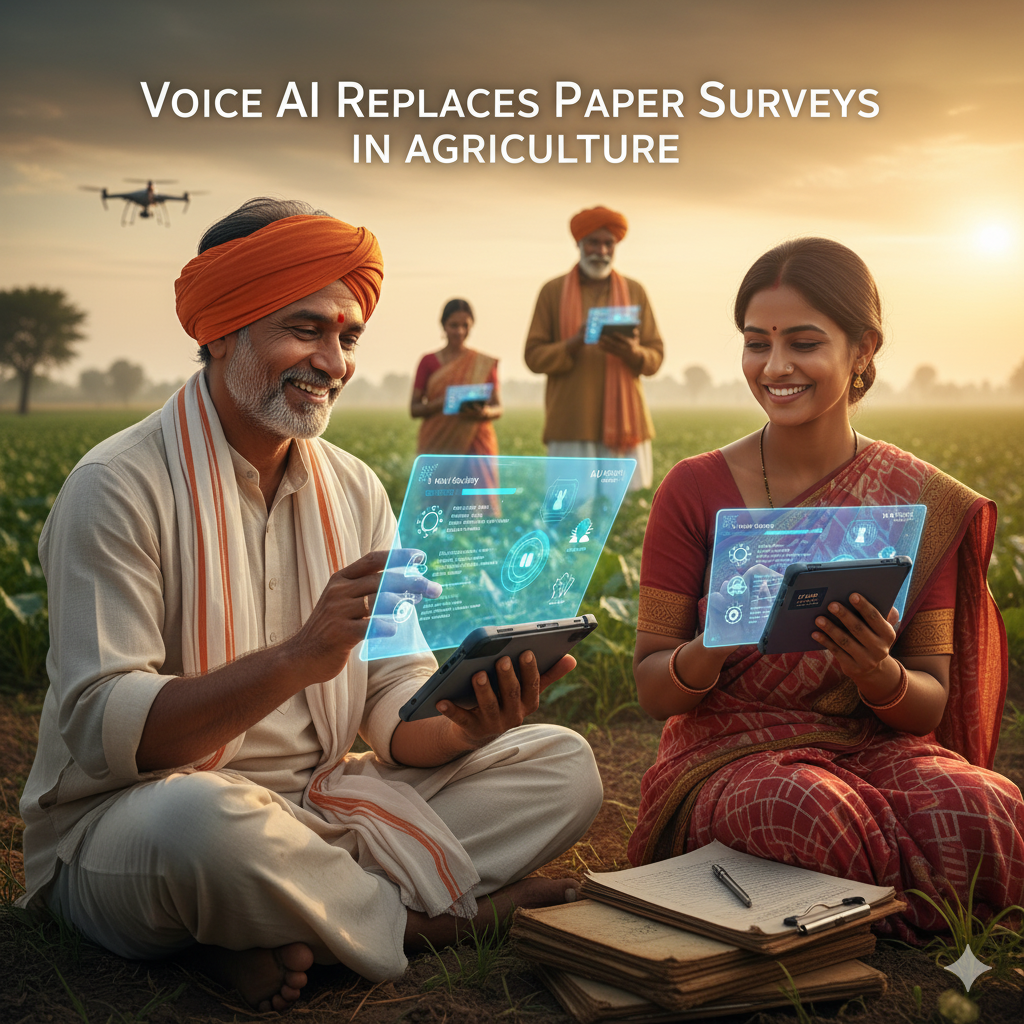
In the fast-changing world of agriculture, organizations constantly seek faster, smarter ways to understand farmers’ needs and measure their impact. Traditional data collection methods often fall short they’re time-consuming, expensive, and limited in scale. Now, Voice AI is emerging as a game-changer, enabling organizations to gather real-time insights directly from farmers in their own language, using just a simple phone call.
The Problem with Traditional Surveys
For decades, field surveys have been the backbone of agricultural programs. NGOs and agri-input companies rely on them to measure impact understanding how farmers adopt new seeds, fertilizers, or practices. But traditional methods like paper forms or in-person interviews are slow, costly, and error-prone.
Enumerators must travel to remote areas, conduct interviews, then manually enter responses into databases. This process can take weeks or months, and by the time the data is analyzed, the season may already have changed, making insights obsolete.
Moreover, many farmers face language, literacy, and connectivity barriers, making digital or text-based forms inaccessible.
Enter Voice AI: The Digital Field Assistant
Voice AI is transforming agricultural data collection. Imagine farmers receiving a call in their local language, where a friendly voice asks simple questions:
“Did you use the new fertilizer this season?”
“How was your crop yield compared to last year?”
They respond verbally and the AI instantly records, translates, and categorizes their answers.
These AI-powered voice agents work 24/7, can reach thousands of farmers simultaneously, and automatically generate structured data dashboards. NGOs and companies get real-time insights into adoption rates, challenges, and farmer satisfaction — all without deploying a single field enumerator.
Key advantages include:
- Speed: Feedback cycles shrink from months to days.
- Scale: Reach 10,000+ farmers across regions instantly.
- Accessibility: Works on basic mobile phones — no internet or literacy required.
- Cost Efficiency: Cuts survey costs by up to 70%.
Real-World Impact
NGOs using Voice AI to monitor agricultural projects report dramatic improvements in responsiveness. One NGO replaced its seasonal field surveys with automated voice check-ins and collected 20x more farmer responses in just a week.
Similarly, an agri-input company launched a product feedback line via voice AI gathering continuous farmer insights that informed its marketing and R&D strategies. Instead of relying on once-a-year feedback, the company now tracks weekly sentiment and usage trends.
Voice AI doesn’t just digitize surveys it redefines engagement. It enables farmers to be heard in their own language, on their own time, closing the gap between field realities and organizational decisions.
FAQs
1. How accurate is voice-based data collection compared to manual surveys?
Voice AI can achieve 95%+ accuracy when trained in local dialects. It also reduces human bias and transcription errors common in manual data entry.
2. Does it require smartphones or internet?
No. Voice agents work on any feature phone using standard voice calls, making them ideal for rural areas with limited connectivity.
3. Can NGOs integrate Voice AI with their existing monitoring systems?
Yes. Voice AI platforms can export data in formats compatible with Excel, Power BI, KoboToolbox, and other MIS dashboards, allowing seamless integration with existing workflows.