
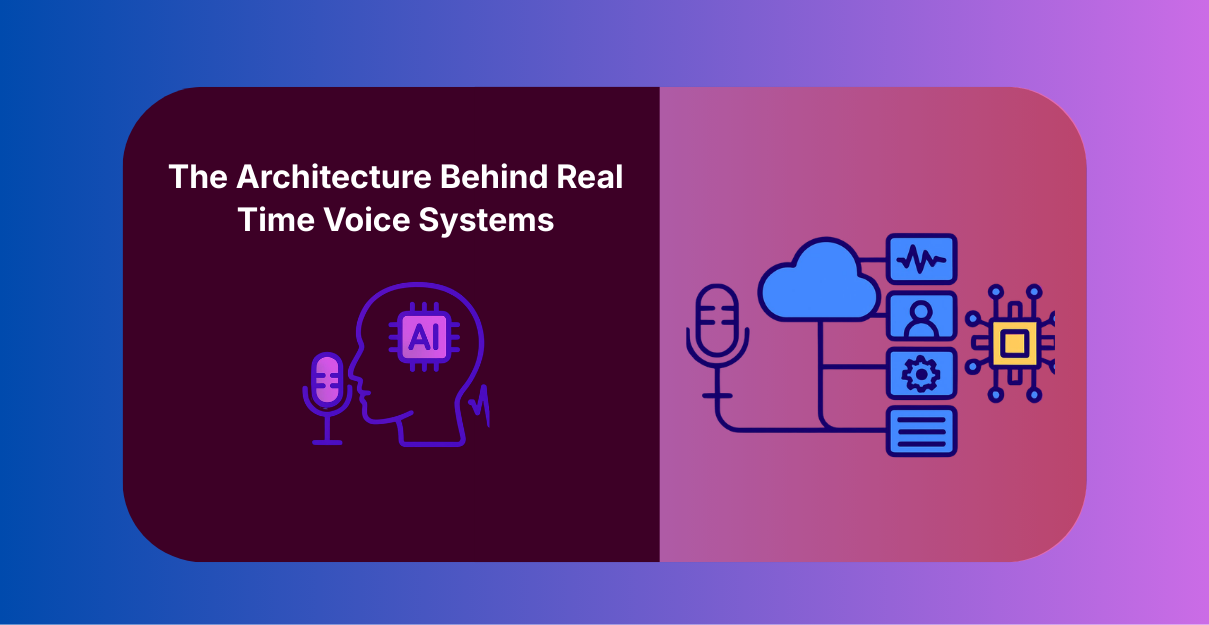
Voice is becoming the most natural interface in digital experiences. From booking a flight to resolving a banking query, users increasingly expect to speak instead of type. Behind these seamless conversations lies a sophisticated technical foundation that makes real-time interaction possible.
Modern Voice AI systems are not just speech tools, they are carefully orchestrated pipelines that convert human language into structured intent, trigger business logic, and respond instantly with natural-sounding audio. At the center of this transformation are intelligent Voice AI Agents designed to handle conversations at scale while maintaining context, accuracy, and speed.
Let’s explore the architecture that powers these real-time voice systems and understand how businesses can leverage them effectively.
Why Real-Time Matters in Voice Systems
When a customer speaks, even a delay of one or two seconds feels unnatural. Human conversations operate in milliseconds. Any lag reduces trust and engagement.
Real-time performance is critical in sectors such as:
- Banking and financial services, where customers check balances or report fraud
- E-commerce, where shoppers need quick product guidance
- Travel and hospitality, where bookings and cancellations happen instantly
- Healthcare, where appointment confirmations must be precise
A robust Voice AI architecture ensures low latency, contextual understanding, and reliable execution of tasks without making users repeat themselves.
The Core Architecture of Modern Voice Systems
At a high level, real-time voice systems operate through a multi-layered pipeline. Each layer plays a distinct role in converting speech into meaningful outcomes.
1. Speech Recognition Layer, Converting Audio to Text
The first step is Automatic Speech Recognition, often called ASR. This component listens to raw audio input and transcribes it into text in real time.
High-quality ASR models are trained on diverse accents, dialects, and background noise patterns. For markets like India, this includes handling code-mixed speech, such as Hindi blended with English.
Key priorities in this layer include:
- Low latency processing
- High word accuracy rate
- Noise robustness
- Support for multiple languages
Without accurate transcription, every downstream system suffers.
2. Natural Language Understanding, Identifying Intent
Once speech becomes text, the next step is understanding meaning. This is where Natural Language Understanding, or NLU, comes in.
The system identifies:
- User intent, such as booking a ticket or checking order status
- Entities, such as dates, names, amounts, or locations
- Context from previous turns in the conversation
Advanced architectures use large language models to interpret ambiguous queries. For example, if a user says, “I need it tomorrow,” the system must connect “it” to the previous request.
In real-world deployments, this layer often determines the difference between a frustrating experience and a helpful one.
3. Dialogue Management, Driving the Conversation
Dialogue management is the control center of a voice system. It decides what happens next.
This layer:
- Maintains conversation context
- Applies business rules
- Determines responses
- Handles fallbacks when confidence is low
For instance, if a user provides incomplete information, the system prompts for clarification instead of failing. If the user changes direction mid-conversation, the dialogue engine adapts dynamically.
Well-designed Voice AI Agents rely heavily on this layer to ensure conversations feel human rather than scripted.
4. Business Logic and System Integration
A voice system is only as useful as its ability to act.
Once intent is identified, the platform connects to backend systems such as:
- CRM databases
- Payment gateways
- Order management systems
- Booking engines
- Support ticket platforms
This integration allows the system to complete real tasks. For example, it can retrieve account details, initiate refunds, update delivery addresses, or schedule callbacks.
Real-time APIs and secure data pipelines are essential here. Any delay in backend response directly impacts user experience.
5. Text to Speech, Delivering Natural Responses
After generating a response, the system converts text back into speech using Text to Speech, or TTS.
Modern TTS engines aim for:
- Natural tone and rhythm
- Emotional nuance
- Minimal robotic artifacts
- Language adaptability
The goal is to replicate human-like delivery while maintaining clarity. In high-performing systems, users often struggle to distinguish between automated and human responses.
Latency Optimization, The Invisible Advantage
Achieving real-time performance requires more than good models. It requires architectural optimization.
Some common strategies include:
- Streaming audio processing instead of waiting for full sentences
- Parallel processing of ASR and NLU tasks
- Edge deployment for reduced network delays
- Intelligent caching of frequent responses
Reducing latency from two seconds to under one second significantly improves conversation flow and user satisfaction.
In competitive markets, speed becomes a strategic advantage.
Context Retention and Memory
Human conversations rely on memory. If a customer says, “Yes, that one,” the system must know what “that one” refers to.
Modern voice systems use short-term session memory and sometimes long-term contextual memory to personalize interactions. For example:
- Recognizing returning customers
- Remembering preferred languages
- Tracking ongoing service requests
This capability turns simple automation into intelligent assistance.
Security and Compliance in Voice Systems
In industries like BFSI and healthcare, security is non-negotiable.
Real-time voice systems must ensure:
- Encrypted audio streams
- Secure API integrations
- Role-based access controls
- Compliance with data regulations
Voice biometrics can also be layered into the architecture for authentication. Instead of asking security questions, the system verifies identity through vocal patterns.
This adds convenience while maintaining safety.
Scalability, Handling Thousands of Conversations
One of the biggest advantages of digital voice infrastructure is scalability.
Unlike traditional call centers, automated systems can handle thousands of concurrent interactions. Cloud-native architecture enables dynamic scaling based on call volume.
For example, during a festival sale or financial quarter closing, conversation spikes can increase dramatically. A well-designed architecture automatically allocates additional computing resources without downtime.
This scalability reduces operational costs and improves service availability.
Real-World Impact Across Industries
Businesses are already seeing measurable results:
- Financial institutions reduce call handling time and improve entity capture accuracy
- E-commerce platforms increase conversions by assisting users in real time
- Travel companies prevent missed bookings by offering 24/7 automated support
- Insurance providers streamline claims registration through conversational workflows
In each case, properly designed Voice AI systems act as revenue enablers rather than simple support tools.
The Future of Conversational Infrastructure
The next evolution involves deeper personalization, multilingual adaptability, and better emotional intelligence.
Emerging systems will:
- Detect user sentiment and adjust tone accordingly
- Handle complex multi-step workflows without escalation
- Operate seamlessly across voice, chat, and messaging channels
- Integrate predictive analytics for proactive engagement
As large language models continue improving, Voice AI Agents will move from reactive assistants to proactive business partners.
Conclusion, Building the Right Foundation
Real-time voice systems are not powered by a single model or tool. They are built on a layered architecture that combines speech recognition, language understanding, dialogue orchestration, backend integration, and natural speech synthesis.
For businesses exploring automation, success depends on choosing scalable infrastructure, optimizing latency, and ensuring seamless system integration. When implemented correctly, voice technology does more than answer calls, it transforms customer experience, reduces operational costs, and drives measurable growth.
If you are planning to implement intelligent voice solutions, now is the time to invest in a robust architecture that supports real-time performance and enterprise scalability. The future of digital interaction is conversational, and those who build the right foundation today will lead tomorrow’s customer experience.
➡ Start Your Journey Today, simply hit the Free Trial button above.