
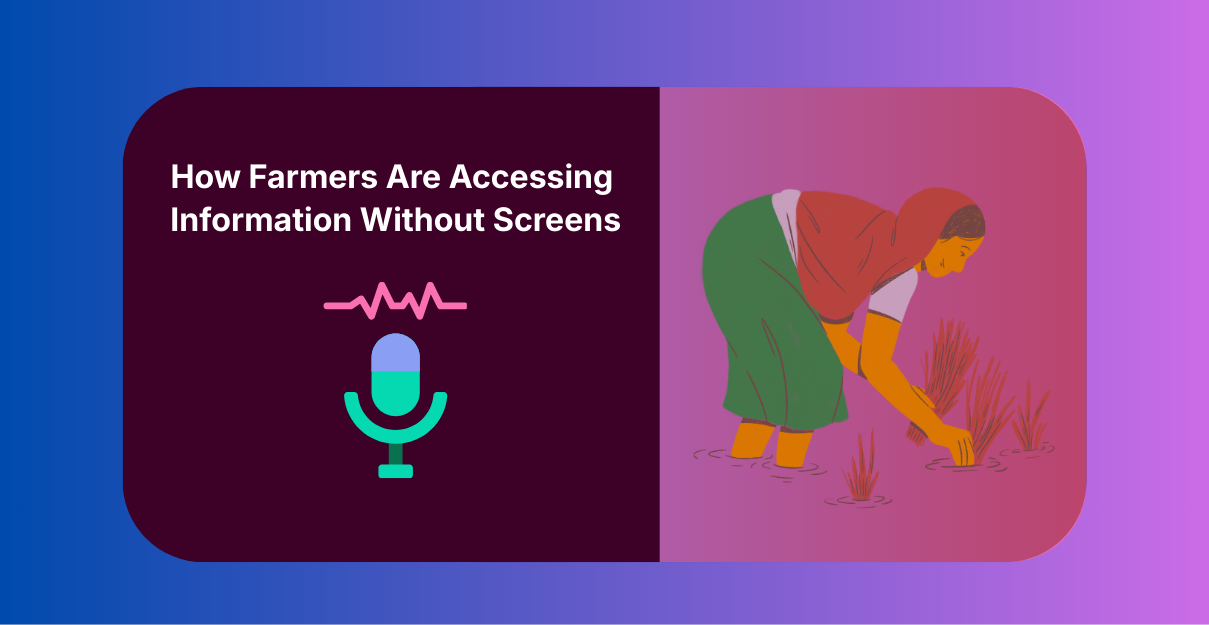
At sunrise, a farmer walks through the field, hands busy checking soil moisture and crop health. There is no time to scroll through dashboards or tap through mobile apps. Yet questions arise constantly. What is the weather forecast for the next six hours, when should irrigation begin, how are market prices trending today?
Instead of pulling out a device, the farmer simply asks.
This is where Voice AI in Agriculture is quietly reshaping how information flows on farms. By enabling hands-free, real-time access to data, voice-driven systems are helping farmers make faster decisions without interrupting their work. In an industry where timing can determine profit or loss, that shift matters.
Let us explore how this technology works, why adoption is increasing, and what it means for the future of farming.
Why Screen-Free Access Matters on the Farm
Agriculture is physically demanding and time-sensitive. Farmers operate machinery, manage livestock, monitor crops, and respond to sudden weather changes. Stopping to interact with a screen is often inconvenient and sometimes unsafe.
Traditional digital agriculture tools rely heavily on smartphones, tablets, and desktop dashboards. While useful, they require visual attention and manual input. In contrast, Voice AI in Agriculture allows farmers to retrieve information while keeping their hands and eyes focused on tasks.
For example, a grower harvesting corn can ask for real-time commodity prices without leaving the tractor. A dairy farmer can request herd health data while inspecting livestock. The technology fits naturally into the rhythm of farm work.
What Is Voice AI in Agriculture
Voice AI in Agriculture refers to the use of speech recognition, natural language processing, and machine learning systems tailored to agricultural needs. These systems understand spoken commands and deliver relevant, context-aware responses.
Unlike generic voice assistants, agricultural voice systems are trained on domain-specific vocabulary such as crop diseases, irrigation cycles, soil nutrients, and equipment diagnostics. This specialization improves accuracy and usability in rural environments.
Major technology companies have already demonstrated the power of voice systems. Devices powered by Amazon Alexa and Google Assistant show how voice interfaces can handle everyday tasks. Agricultural platforms are adapting similar capabilities, but fine-tuned for farm operations.
Now, specialized solutions like Vozzo Voice AI Agents are taking this a step further building purpose-driven voice systems designed specifically for farmers. Instead of generic commands, Vozzo enables real-time crop advisory, weather updates, mandi price information, loan assistance, and government scheme guidance through natural, multilingual voice conversations. This makes advanced agricultural intelligence accessible even to farmers without smartphones or digital literacy, bringing screenless technology directly to the fields.
Key Applications Transforming Daily Operations
Voice technology is not just a novelty feature. It supports practical, high-impact use cases that directly affect productivity and profitability.
Real-Time Weather and Climate Updates
Weather remains one of the biggest variables in farming. A sudden frost, heavy rainfall, or unexpected heatwave can damage crops within hours.
With voice-enabled systems, farmers can request hyperlocal forecasts, rainfall predictions, and wind speed updates instantly. Some advanced platforms integrate satellite and IoT sensor data, offering field-specific insights rather than general regional forecasts.
This quick access helps farmers adjust irrigation schedules, protect crops, and optimize planting decisions.
Equipment Monitoring and Maintenance
Modern farms rely on sophisticated machinery equipped with sensors. Tractors, combines, and irrigation systems generate continuous performance data.
Through Voice AI in Agriculture, operators can ask about fuel levels, engine diagnostics, or maintenance schedules while working. Instead of checking a dashboard, they receive spoken alerts or summaries.
This reduces downtime and prevents costly mechanical failures.
Market Prices and Financial Insights
Commodity markets fluctuate daily. Crop prices can shift based on global supply chains, weather patterns, and geopolitical events.
Voice systems allow farmers to check live market prices and compare them with historical trends. Immediate access supports better selling decisions and improved negotiation strategies.
When margins are tight, timing a sale correctly can significantly impact revenue.
Pest and Disease Identification
Crop health monitoring is critical. Farmers often need quick answers when they notice unusual leaf discoloration or pest activity.
Voice-enabled tools can connect to databases that provide guidance on symptoms, treatment options, and recommended pesticides. Combined with mobile image recognition tools, voice interaction simplifies the process of identifying and responding to threats.
Bridging the Digital Divide in Rural Areas
One of the less discussed advantages of Voice AI in Agriculture is its potential to improve digital inclusion. In many rural regions, literacy levels vary, and navigating complex apps can be challenging.
Voice interaction reduces barriers. Farmers who are less comfortable with text-based interfaces can still access advanced agricultural insights simply by speaking in their local language.
In countries where mobile connectivity is expanding but technical training is limited, voice-first solutions may accelerate digital adoption across farming communities.
Integration with IoT and Smart Farming Systems
Agriculture is becoming increasingly data-driven. Soil sensors, drones, satellite imagery, and connected irrigation systems generate vast amounts of information.
The challenge is not collecting data, but making it usable.
Voice AI in Agriculture acts as an accessible interface layer on top of these systems. Instead of logging into multiple dashboards, farmers can ask direct questions such as:
What is the soil moisture level in Field Three
When was the last nitrogen application
How many liters of water were used yesterday
The system pulls data from connected devices and responds instantly. This conversational layer transforms complex datasets into actionable insights.
Challenges and Considerations
Despite its promise, implementing voice technology in farming environments presents challenges.
Connectivity Constraints
Reliable internet access remains limited in some rural areas. While offline voice recognition models are improving, many advanced systems still depend on cloud processing.
Expanding rural broadband infrastructure is essential for widespread adoption.
Language and Accent Recognition
Agricultural communities often speak regional dialects. Voice systems must be trained to recognize diverse accents and terminology to ensure accurate responses.
Continuous learning models help improve performance over time, but initial setup and customization are crucial.
Data Privacy and Ownership
Farm data is sensitive. Yield reports, financial information, and operational metrics represent competitive advantages.
Farmers must understand how their data is stored, processed, and protected. Transparent policies and secure systems are key to building trust.
The Economic Impact of Smarter Conversations
Efficiency gains translate directly into financial benefits. By reducing time spent searching for information and minimizing errors, voice-enabled systems contribute to better decision-making.
Consider irrigation management. Overwatering wastes resources and increases costs, while underwatering reduces yield. Quick access to moisture data and weather forecasts helps optimize water usage, lowering expenses and supporting sustainability goals.
Similarly, proactive equipment maintenance reduces unexpected breakdowns during critical harvest periods.
Over time, these incremental improvements add up to measurable gains in productivity and profitability.
The Future of Voice-Driven Farming
The next phase of Voice AI in Agriculture will likely include deeper personalization and predictive insights. Systems may anticipate questions based on seasonal patterns and historical data.
For instance, during planting season, a farmer might automatically receive spoken reminders about seed spacing recommendations or fertilizer schedules based on soil analysis.
Integration with augmented reality tools could further enhance field operations, combining visual overlays with voice instructions for complex tasks.
As technology becomes more affordable and accessible, adoption rates are expected to rise across both large-scale agribusinesses and smallholder farms.
Conclusion:
Farming has always required quick thinking, adaptability, and resilience. Today, digital tools are becoming as essential as tractors and irrigation systems. Yet technology must fit the realities of fieldwork, not complicate them.
Voice AI in Agriculture offers a practical solution, delivering real-time insights without demanding screen time. It empowers farmers to access weather updates, market prices, equipment diagnostics, and crop guidance while staying focused on the land.
For agricultural businesses, cooperatives, and technology providers, the message is clear. Investing in voice-enabled solutions can improve efficiency, expand accessibility, and support smarter decision-making across the industry.
➡ Start Your Journey Today, simply hit the free trial button above.