Education technology has come a long way from static PDFs and recorded lectures. For years, digital learning meant one thing, access to content. Watch the video. Read the module. Take the quiz. Repeat.
But today, something much more dynamic is happening.
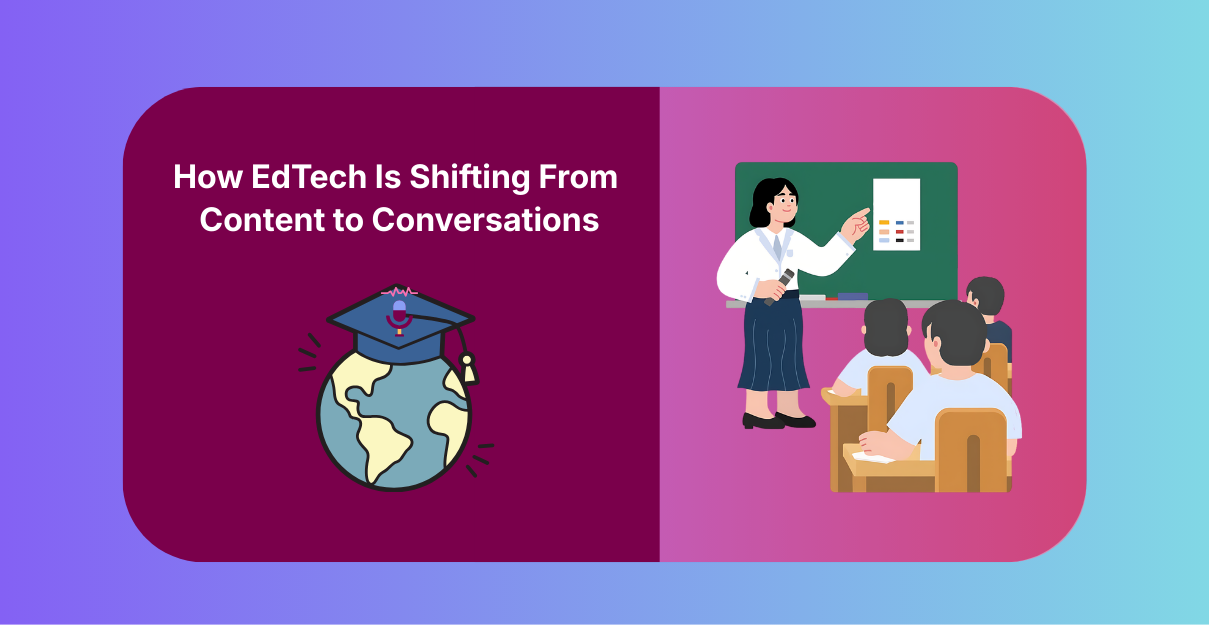
Instead of simply delivering information, modern platforms are starting to hold conversations. They listen, respond, adapt, and guide. At the center of this shift is Voice AI for Education, a rapidly evolving innovation that is redefining how students learn and how teachers teach.
The classroom is no longer just digital. It is interactive, responsive, and increasingly voice driven.
From Passive Learning to Interactive Dialogue
Traditional e-learning systems were designed to scale content distribution. They did that well. Massive open online courses from institutions like Coursera and edX made world-class education accessible to millions. Yet, despite their reach, many learners struggled with engagement and completion.
Why?
Because learning is not just about consuming information. It is about asking questions, clarifying doubts, and receiving feedback in real time. Human classrooms thrive on dialogue. Digital classrooms, until recently, did not.
That is where conversational systems step in.
Instead of clicking through slides, students can now speak naturally, ask follow-up questions, and receive tailored explanations. This shift transforms technology from a content library into a learning companion.
What Is Voice AI in Modern Classrooms?
At its core, Voice AI for Education refers to systems that use speech recognition, natural language processing, and adaptive learning algorithms to interact with learners through voice.
Think beyond simple voice assistants. While tools like Amazon Alexa and Google Assistant introduced consumers to voice interaction, educational applications go much deeper. They can:
- Answer subject-specific questions in context
- Provide instant feedback on spoken responses
- Adjust difficulty based on student performance
- Support language pronunciation practice
- Enable accessibility for learners with visual or motor impairments
In essence, these systems replicate some elements of one-on-one tutoring, but at scale.
Why Conversation Enhances Learning
Research in cognitive science consistently shows that active engagement improves retention. When students explain concepts aloud, ask questions, and receive immediate clarification, they process information more deeply.
Conversation creates three powerful learning advantages:
1. Immediate Feedback
Delayed feedback weakens learning outcomes. A conversational interface can correct misunderstandings in real time. If a student mispronounces a word in a language lesson or struggles with a math explanation, the system can respond instantly.
2. Personalized Pacing
Every learner moves at a different speed. Voice-enabled platforms can detect hesitation, confusion, or confidence in speech patterns and adapt accordingly. That kind of personalization was once possible only in small classroom settings.
3. Reduced Cognitive Load
Typing can interrupt the learning flow, especially for younger students. Speaking is more natural. By allowing learners to interact verbally, Voice AI for Education reduces friction and keeps attention focused on the subject matter.
Real-World Applications Across Educational Levels
This technology is not limited to higher education or tech-savvy environments. Its applications span the entire educational spectrum.
K-12 Classrooms
In primary schools, voice-driven tools help students practice reading aloud and improve pronunciation. They can also guide children through step-by-step problem solving in subjects like mathematics.
For students with learning differences, speech-based interaction offers an inclusive alternative to text-heavy interfaces.
Higher Education
University students use conversational systems to clarify complex topics in real time. Instead of searching through discussion boards, they can ask direct questions and receive structured answers immediately.
Institutions such as Arizona State University have explored AI-powered assistants to support student services and academic queries, reducing administrative burden while improving responsiveness.
Corporate and Professional Training
In workplace learning environments, conversational systems simulate real-life scenarios. Sales trainees can practice customer interactions. Healthcare professionals can rehearse patient communication. The experience becomes immersive rather than theoretical.
Accessibility and Inclusion
One of the most promising aspects of Voice AI for Education is its impact on accessibility.
Students with visual impairments benefit from fully voice-based navigation. Learners with dyslexia can engage through speech rather than text. Multilingual students can practice conversational skills without fear of classroom embarrassment.
By lowering barriers, voice technology makes education more equitable.
This is not just about convenience. It is about participation.
Challenges and Considerations
Despite its potential, implementing conversational systems in education comes with challenges.
Data Privacy and Security
Educational institutions must ensure that student voice data is stored and processed securely. Compliance with regulations and transparent data practices are essential for building trust.
Teacher Integration
Technology works best when it complements educators rather than replaces them. Teachers need training and clear frameworks for integrating conversational tools into lesson plans.
Accuracy and Context
While voice systems have improved dramatically, misunderstandings can still occur, especially in specialized academic subjects. Continuous refinement and subject-specific training are necessary for reliable performance.
Addressing these concerns thoughtfully will determine how successfully this shift unfolds.
The Future of Learning Is Conversational
The broader trend in technology is moving toward natural interaction. We talk to our devices. We expect immediate responses. Education is catching up to that reality.
Forward-thinking institutions and edtech companies are investing heavily in speech recognition, multilingual support, and emotionally aware systems that can detect frustration or confusion.
As hardware improves and cloud infrastructure becomes more robust, conversational learning experiences will feel increasingly seamless.
What we are witnessing is not just a feature upgrade. It is a fundamental transformation in how knowledge is delivered and absorbed.
Instead of logging in to watch a lesson, students will log in to have a conversation.
Why Institutions Should Pay Attention Now
Adopting Voice AI for Education is not about chasing trends. It is about aligning with how people naturally learn.
Schools and universities that embrace conversational systems can:
- Increase student engagement
- Improve retention and course completion rates
- Offer scalable personalized support
- Strengthen accessibility initiatives
- Differentiate themselves in a competitive education landscape
In a world where learners expect interactivity, static platforms risk becoming obsolete.
Conclusion: From Content Platforms to Learning Partners
Education technology is no longer just a distribution channel for lectures and PDFs. It is evolving into something far more human.
By enabling dialogue instead of one-way delivery, Voice AI for Education transforms digital platforms into active learning partners. It empowers students to ask, explore, and refine their understanding in real time.
The shift from content to conversation is not a distant future scenario. It is already happening.
If you are an educator, administrator, or edtech innovator, now is the time to explore how conversational tools can enhance your learning ecosystem. Start small, pilot thoughtfully, and focus on outcomes that truly support students.
The classrooms of tomorrow will not just deliver knowledge. They will talk back, listen closely, and grow alongside every learner.
➡ Start Your Journey Today, simply hit the free trial button above.