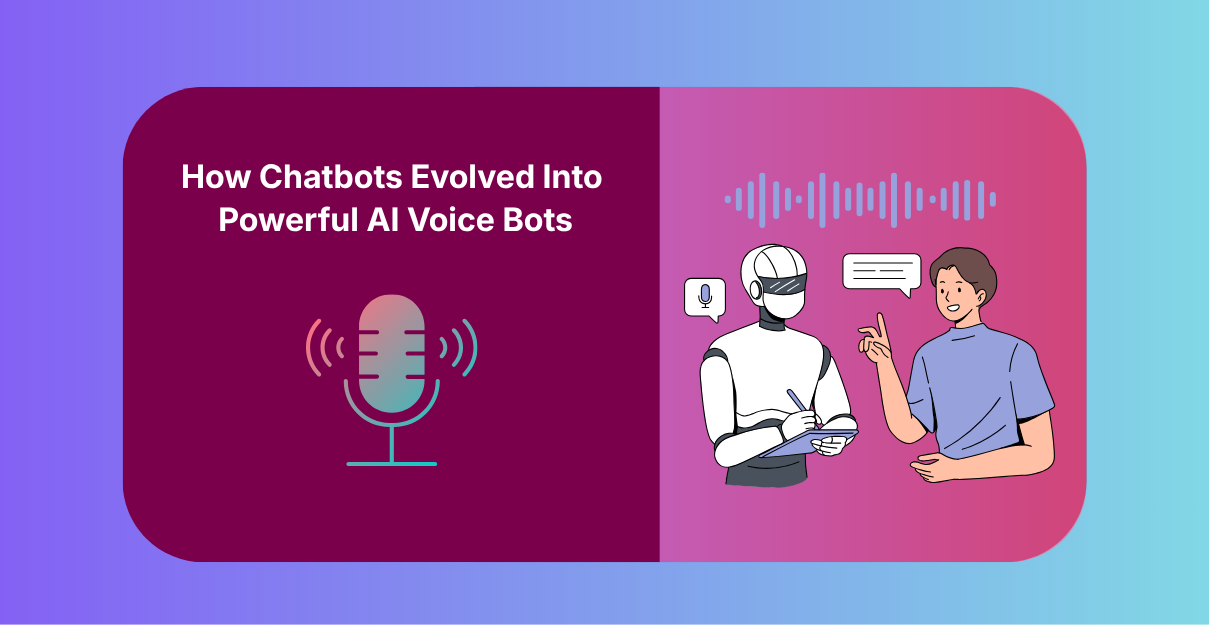
Chatbots evolved into voice AI systems to deliver more natural, real time, and human like conversations, enabling businesses to handle complex interactions, understand intent better, and provide faster, more personalized customer experiences.
Introduction
Customer communication has changed significantly over the past decade.
Earlier, businesses relied on chatbots to automate conversations. These systems helped reduce workload but often failed to deliver a smooth user experience.
Today, customer expectations are different. People want:
- Instant responses
- Natural conversations
- Personalized interactions
This shift has led to the evolution from simple chatbots to Voice AI that can understand, respond, and adapt in real time.
In this article, you will learn how this transformation happened, what makes voice AI different, and why businesses are moving toward voice first communication.
What Were Chatbots and Their Limitations
Chatbots were designed to handle text based interactions using predefined rules or limited AI models.
They could:
- Answer basic questions
- Guide users through simple workflows
- Provide scripted responses
However, they had major limitations. Most chatbots:
- Could only handle specific queries
- Failed when users asked unexpected questions
- Lacked context awareness
These systems were often rigid and unable to manage real human conversation patterns. This led to frustration and poor user experience.
Why Businesses Moved Beyond Chatbots
As customer expectations increased, businesses realized that chat based systems were not enough.
Key challenges included:
- Slow and unnatural interactions
- Limited personalization
- Inability to handle complex conversations
At the same time, demand for faster and more intuitive communication grew rapidly. Modern users prefer speaking over typing, especially on mobile devices.
This created the need for voice AI that can:
- Understand natural language
- Respond instantly
- Handle real conversations at scale
What Is Voice AI and How It Is Different
Voice AI is an advanced form of conversational technology that allows users to interact using speech instead of text.
Unlike chatbots, voice AI focuses on:
- Understanding intent behind spoken words
- Managing multi step conversations naturally
- Responding in real time without delays
Voice AI can maintain conversation context, ask follow up questions, and adapt to user behavior. It is designed to handle the natural variation in human communication that traditional chatbots consistently struggle with.
➡ How Startups Using Voice AI in Crowded Markets
➡ Voice AI Agents for High-Converting Sales Calls
Key Differences Between Chatbots and Voice AI
1. Interaction Style
Chatbots rely on text input, while voice AI enables natural spoken conversations. Voice interaction feels more intuitive and reduces effort for users. In fact, over 70% of customers prefer voice interaction over text based chat for complex queries.
2. Context Awareness
Older chatbot systems often forget previous inputs within the same conversation. Voice AI retains full context across multiple interactions, making conversations significantly smoother and more meaningful for the customer.
3. Real Time Communication
Voice AI responds instantly without requiring typing or navigation. This improves speed and user satisfaction considerably. Businesses using voice AI report response times up to 60% faster than traditional chatbot workflows.
4. Ability to Handle Complexity
Chatbots are limited to predefined conversation flows and break down when users deviate from the script. Voice AI handles dynamic conversations, interruptions, and unexpected inputs naturally — managing up to 80% of customer interactions without any human intervention.
5. User Experience
Voice AI interaction feels more human and engaging compared to static text interfaces. This leads to better customer experience and higher engagement. Businesses using voice AI report up to 35% higher customer satisfaction scores compared to chatbot only systems.
How Voice AI Is Transforming Customer Experience
Businesses are using voice AI to improve communication across multiple customer touchpoints.
Voice AI can:
- Answer customer calls instantly without hold times
- Handle support queries at any hour
- Schedule appointments automatically
- Qualify leads in real time
Voice AI provides real time, human like responses that improve customer satisfaction and reduce wait times significantly across every industry.
Latest Trends in 2026
1. Shift to Conversational Intelligence
Voice AI is no longer just reactive. It can now predict user intent, guide conversations proactively, and personalize responses based on past behavior. Over 65% of businesses plan to increase investment in voice AI driven customer communication by the end of 2026.
2. From Support Tool to Business Driver
Voice AI is now used directly for sales conversations, lead generation, and customer engagement not just support. Businesses using voice AI as a revenue tool report up to 30% increase in qualified lead conversion compared to chatbot driven workflows.
3. Real Time Context Handling
Voice AI can now handle interruptions, continue conversations naturally after pauses, and maintain long conversation context across multiple sessions. This makes voice AI significantly more human like and effective than any previous generation of chatbot technology.
4. Always On Availability
Businesses are moving toward 24/7 communication models. Voice AI enables continuous availability without increasing operational costs a capability that chatbots could never deliver at the same level of conversational quality.
Real World Impact
Companies that have transitioned from chatbots to voice AI have reported up to 35% higher customer satisfaction scores, 60% faster response times, and significant reductions in operational costs.
Voice AI handles up to 80% of routine customer interactions without human intervention, allowing teams to focus on complex, high value conversations that directly impact revenue.
Organizations across BFSI, healthcare, real estate, and retail are using voice AI to manage increasing customer demand without proportionally increasing team size or costs.
When Should Businesses Shift to Voice AI
You should consider transitioning from chatbots to voice AI if:
- Your chatbot cannot handle complex or unexpected queries
- Customer experience feels limited or frustrating
- You receive high volumes of calls or messages daily
- Response time is directly affecting your conversion rates
These are clear signs that chatbots are no longer sufficient and voice AI is the logical next step for your business.
Challenges to Consider
Accuracy and Understanding Voice AI must accurately interpret different accents, speaking styles, and background noise conditions to perform consistently across all customer interactions.
System Integration Integration of voice AI with CRM and backend systems is essential for delivering accurate, context aware responses in real time.
User Trust Customers must feel comfortable and confident interacting with voice AI. Clear communication about what the system can and cannot handle helps build that trust over time.
FAQ's
- Is voice AI better than chatbots?
For complex, real time interactions, voice AI significantly outperforms chatbots by understanding natural language, maintaining conversation context, and responding instantly without scripted flows. - Can voice AI replace chatbots completely?
Not entirely. Voice AI and chatbots can work together effectively depending on the use case. - Is voice AI suitable for all businesses?
Voice AI is especially valuable for businesses with high customer interaction volumes, frequent inbound calls, or complex support needs. - How difficult is it to transition from chatbots to voice AI?
The transition from chatbots to voice AI requires integration with existing CRM and backend systems, but most modern voice AI platforms are designed for straightforward deployment.
Conclusion
The shift from chatbots to voice AI represents a fundamental change in how businesses communicate with customers. Where chatbots offered scripted, limited responses, voice AI delivers dynamic, real time conversations that feel natural, responsive, and deeply personalized.
Businesses that make this transition now will be better positioned to meet rising customer expectations, reduce operational costs, and drive stronger engagement in 2026 and beyond.
The question is no longer whether to move from chatbots to voice AI it is how quickly you can make the shift.
➡ Start your free trial today and experience how voice AI can transform your customer communication.