Every admissions office has the same story. A prospective student fills out a form on a Tuesday night at 11 PM, eager and curious. By the time someone from the enrollment team calls back on Thursday morning, that student has already committed to another school. The window was small, and the team missed it, not because they didn't care, but because they were buried in a backlog of follow-ups, voicemails, and scheduling chaos.
This is where the conversation around AI voice agents gets genuinely interesting, and surprisingly urgent, for higher education institutions.
What Are AI Voice Agents, and Why Do Enrollment Teams Need Them Now?
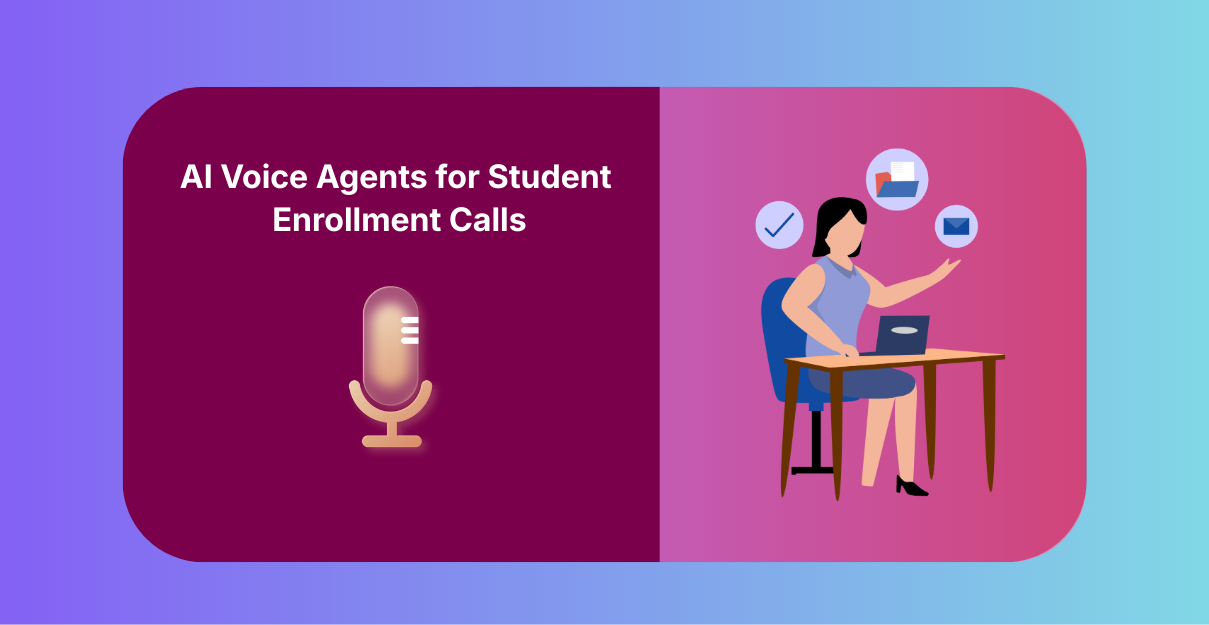
Unlike chatbots that respond to typed messages, AI voice agents conduct live, spoken conversations with prospective students over the phone. They can answer questions, collect information, schedule campus visits, and pass qualified leads directly to human counselors, all without a staff member lifting a finger for the initial interaction.
For enrollment teams managing thousands of inquiries per semester, this isn't a luxury. It's rapidly becoming a necessity.
Research consistently shows that speed-to-contact is one of the single biggest factors in enrollment conversion. One widely cited study from Lead Connect found that 78% of customers end up buying from the company that responds first. In higher education, the same principle applies: the first school to have a meaningful conversation with a prospective student usually wins.
The Enrollment Call Problem Nobody Talks About
Most admissions offices are chronically understaffed relative to their inquiry volume. A mid-sized university might receive 10,000 to 40,000 inquiries per enrollment cycle. Even with a team of 15 counselors, connecting with every student in a timely, personalized way is mathematically difficult.
What typically happens instead is a triage approach: counselors prioritize high-intent applicants and let thousands of warm leads go cold. Students who never hear back don't just enroll elsewhere. They often walk away with a negative impression of the institution, and they tell others.
Automated voice technology addresses this at the root level. Instead of choosing who to call, teams can engage everyone, immediately, and let the technology handle the initial qualification before routing the right conversations to the right people.
How AI Voice Agents Actually Work in a Student Enrollment Context
When a student submits an inquiry form, an intelligent voice system can trigger an outbound call within seconds, not hours. The conversation might go something like this:
The agent introduces itself clearly (the best implementations are transparent about being automated), asks about the student's program of interest, confirms their contact preferences, and answers common questions about application deadlines, financial aid timelines, or campus visit availability.
If the student is ready to schedule a campus tour, the agent books it directly into the counselor's calendar. If they have a complex question about transfer credits or scholarship eligibility, the agent flags the call for human follow-up and makes sure that counselor has full context before they dial.
What makes this different from older interactive voice response (IVR) systems is the conversational quality. Modern voice automation built on large language models can handle follow-up questions, adjust based on what the student says, and speak naturally without the robotic cadence that used to define phone automation.
The Real Benefits: Beyond Just Faster Call-Backs
Speed is the obvious win, but institutions deploying this technology are seeing broader improvements across their enrollment funnel.
Consistency at scale. Human counselors, no matter how skilled, have off days. They forget to ask certain questions or pitch programs inconsistently. A well-configured voice system delivers the same quality interaction every single time, whether it's handling the first call of the day or the two-hundredth.
Better data collection. Every conversation is logged, transcribed, and tagged. Enrollment teams gain visibility into what questions prospects are asking most, which programs generate the most interest, and where students are dropping off in the funnel. That's intelligence that's nearly impossible to gather at scale from human-only calls.
Staff relief and retention. Counselor burnout is a real issue in enrollment management. Repetitive, low-complexity calls, confirming email addresses, answering "when is the deadline?" for the hundredth time, consume hours that could be spent on meaningful advising. Offloading that volume lets counselors focus on conversations that actually require human judgment and empathy.
Addressing the Obvious Concern: Will Students Feel Tricked?
This is the most common pushback, and it's a fair one. Students, especially Gen Z applicants who are sharply attuned to inauthenticity, don't want to feel like they're being processed.
The answer isn't to pretend the agent is human. It's to design interactions that are genuinely helpful, clear about their nature, and quick to connect students with real people when the conversation calls for it.
Schools that are getting this right are transparent upfront ("Hi, I'm an automated assistant calling on behalf of Westfield University"), they keep conversations short and purposeful, and they make the handoff to a human counselor feel seamless rather than like a consolation prize.
When the automation is actually useful, students respond well. Being called back within 60 seconds at any hour of the day is impressive, not off-putting.
What to Look for When Evaluating Voice Automation for Your Enrollment Team
Not all platforms are built equally. Before a college invests, there are a few things worth evaluating carefully.
Natural language capability matters enormously. Can the system handle a student who goes off-script? Can it understand regional accents, or manage a conversation where the student asks something unexpected mid-call?
CRM integration is non-negotiable. The value of every conversation is lost if it doesn't sync cleanly with your existing enrollment management system, whether that's Slate, Salesforce, or another platform.
Compliance is also a real consideration. Any outbound calling program needs to align with TCPA regulations and institutional policies around student communication. The platform you choose should make compliance easy, not an afterthought.
The Institutions Already Seeing Results
Early adopters in the enrollment space, particularly community colleges and online-first universities that deal with high inquiry volume and limited staff, have reported meaningful improvements in contact rates and counselor productivity after deploying AI voice agents.
One online university reportedly increased its first-contact rate from under 40% to over 75% after implementing automated outreach, simply by ensuring no inquiry went uncontacted for longer than a few minutes.
Those aren't marginal gains. In an industry where a single enrolled student represents tens of thousands of dollars in tuition revenue, improving contact rates even modestly can translate to significant institutional outcomes.
Final Thoughts: The Human Touch Isn't Gone, It's Repositioned
The institutions winning at enrollment in the next five years won't be the ones that automate everything. They'll be the ones that automate smartly, using technology to handle speed, scale, and consistency, while preserving genuine human connection for the moments that actually shape a student's decision.
AI Voice Agents for Education don't replace enrollment counselors. They give those counselors a fighting chance to do their best work, by making sure no student falls through the cracks before the conversation even begins.
➡ Start Your Journey Today, simply hit the free trial button above.