A BPO with 800 agents, clients in financial services, healthcare, and retail, and a contract renewal six months out — and the client now requires AI voice automation capability. The options are to build voice AI from scratch (18 months and Rs 3–5 crore minimum), white label a voice AI vendor's platform under the BPO's own brand, or lose the contract to a BPO that already has the capability. For most BPOs in India, the UK, the Netherlands, and Ireland, the answer is obvious — but the white label platform choice is not.
Why BPOs Are the Fastest-Growing Segment of Voice AI Platform Buyers in 2026
BPOs are under simultaneous pressure from two directions: clients demanding AI automation as a service component, and competitors already offering it. The window to add voice AI to your service portfolio without losing existing clients is narrowing.
Building proprietary voice AI is not realistic for most BPOs. It requires AI research talent, speech model training infrastructure, and ongoing maintenance investment — none of it a BPO's core competency.
White labelling an enterprise voice AI platform allows a BPO to launch AI-powered services under its own brand within weeks, not months, with the platform provider handling model training, infrastructure, updates, and compliance. That is why demand for white label voice AI BPO India UK capability is now a renewal requirement.
The margin structure is commercially attractive: the BPO buys platform access at wholesale and bills clients at retail, with voice AI services commanding 30–60% higher contract value than agent-only equivalents.
What a White Label Voice AI Platform Must Provide for a BPO
1. Full brand customisation — your name, not theirs
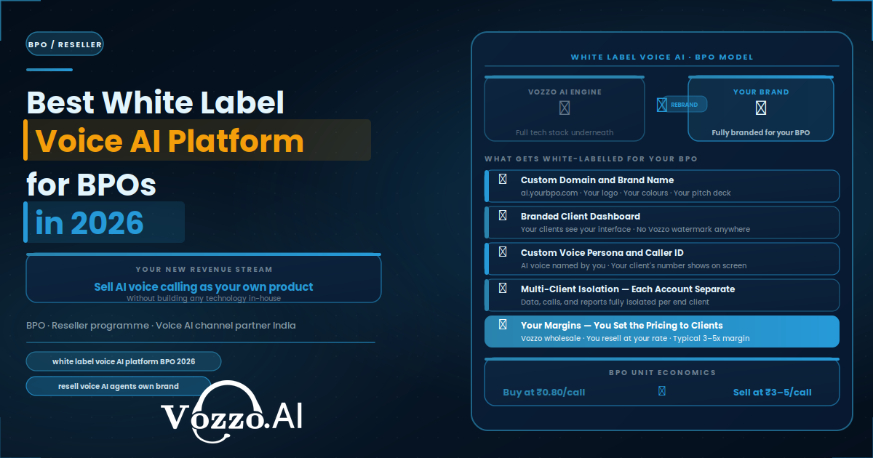
The platform must be deployable under your BPO's brand name, domain, and visual identity, with client-facing dashboards, call analytics, and reporting all showing your brand. Clients should not be able to identify the underlying platform without your disclosure. White label means white label — not co-branded, and not "powered by X" in the footer.
2. Multi-client architecture with data isolation
The platform must support separate client environments with complete data isolation. A financial services client's call data must be structurally separated from a healthcare client's data at the database level, not just access-controlled. Cross-client data leakage is a contract-ending event.
3. Multilingual capability matching your client base
For BPOs serving Indian enterprises: Hindi, Tamil, Telugu, Marathi, Kannada, and Bengali at minimum. For BPOs serving UK, Irish, or Dutch clients: British English, Irish English, and Dutch with the regional accent accuracy their end customers expect. English-only platforms cannot serve a multilingual portfolio.
4. Configurable conversation flows without vendor dependency
The BPO must be able to build, modify, and deploy new conversation flows for each client without going back to the platform vendor for every change. A no-code flow builder that operations staff — not just developers — can use is the difference between a scalable white label business and permanent dependency on vendor professional services.
5. Analytics and reporting you can present to clients as your own
Client-facing dashboards should show call volume, resolution rates, sentiment analysis, agent handoff rates, and campaign performance, branded as your BPO's intelligence product. The underlying platform's name should not appear anywhere in the reporting stack your clients see.
6. Commercial model that supports BPO margin requirements
Wholesale platform pricing must let the BPO apply a margin and bill clients per call, per minute, or as a monthly platform fee, with minimum volume commitments that align with realistic client contract sizes. Revenue share models where the vendor participates in client growth are not white label. They are partnerships with margin drag.
The Revenue Opportunity for BPOs That White Label Voice AI
Take a BPO with 5 enterprise clients, each running 3,000 calls per day. At Rs 12 per AI call billed to clients and Rs 5 per call in platform cost, the margin is Rs 7 per call. At 15,000 calls per day across 5 clients, that is Rs 1,05,000 per day — Rs 31,50,000 per month — in margin from AI call volume alone, before any professional services or implementation fees. This is additional revenue on top of existing agent contract value, not a replacement for it, which is why choosing the right white label voice AI platform for BPOs is a P&L decision, not an IT one. BPOs that position AI voice as a managed service add-on to existing contracts are seeing 25–40% contract value increases on renewal.
White Label Voice AI for BPOs Across India, UK, Netherlands, and Ireland — Market Context
India — The largest BPO market globally by headcount, where clients increasingly make AI automation a condition of renewal. Indian BPOs serving BFSI, healthcare, e-commerce, and government clients need white label platforms with Indian language depth and RBI/DPDP compliance built in.
United Kingdom — UK BPOs face FCA requirements for financial services clients and NHS data standards for healthcare. White label platforms must demonstrate UK GDPR compliance, data residency within the UK or EEA, and Cyber Essentials certification for public sector clients. British English accent accuracy is a baseline requirement that many global platforms still underperform on.
Netherlands — Dutch-language capability is non-negotiable for BPOs serving Dutch enterprise clients. Netherlands-based BPOs also serve multilingual international clients, requiring Dutch, English, and often French or German in the same platform. AVG (the Dutch name for GDPR) compliance and data residency within the EEA are standard procurement requirements.
Ireland — Ireland's BPO sector serves domestic clients and acts as the European hub for US multinationals with EU operations. Irish English accent handling, EU GDPR compliance, and the ability to serve pan-European client bases from an Irish-domiciled operation are the key requirements. Irish BPOs evaluating white label voice AI are often making the decision on behalf of a US parent company's European strategy.
What to Evaluate When Choosing a White Label Voice AI Platform as a BPO
- Is this genuinely white label or co-branded? Ask to see the client-facing dashboard and reports in white label mode before signing anything.
- What is the multi-client data architecture? Ask for a technical architecture diagram showing how client data is isolated at the infrastructure level.
- Which languages are natively supported versus handled by a translation layer? Request accuracy benchmarks for your clients' languages on real audio samples.
- What is the platform uptime SLA, and what are the financial penalties? Your client contracts carry SLAs that depend on the platform being available.
- What does the commercial model look like at 10x our current volume? Understand the pricing curve before pricing a service that turns unprofitable at scale.
The Bottom Line
For BPOs in India, the UK, the Netherlands, and Ireland, white labelling an enterprise voice AI platform is the fastest route to competing in an AI-first market without the capital and timeline risk of building proprietary technology. The BPOs making this move in 2026 are not just defending existing contracts — they are building a new revenue line that scales independently of agent headcount. The platform choice determines whether that line is profitable and defensible.