The most common reason Indian enterprises abandon voice AI IVR pilots is not price, integration complexity, or vendor reliability — it is that the system does not understand what their customers are saying. A caller in Coimbatore saying "balance" in Tamil-accented English gets misrouted, a caller in Lucknow saying "EMI" gets an error response, and a caller in Kolkata saying "complaint" lands in the wrong queue. The platform understood American English beautifully; it was never designed for the 1.4 billion people who speak every other variety.
Why Indian Accent Understanding Is the Core Technical Requirement for IVR in India
- India has 22 scheduled languages and hundreds of regional dialects, but the more immediate IVR challenge is Indian English — spoken by 125 million+ people with accent patterns that differ significantly from the American and British English most global speech recognition models are trained on.
- Tamil-, Bengali-, Marathi-, and Hindi-accented English each have distinct vowel sounds, consonant pronunciations, stress patterns, and intonation that global STT models consistently misrecognise.
- The consequence is a broken customer experience. When an IVR misunderstands a caller twice, they press 0 for an agent — and every escalation costs Rs 35-80 in handle time. Across 10,000 daily calls at a 30% misrecognition rate, that is Rs 1,05,000 a day in avoidable agent cost.
- This is why Indian accent speech recognition IVR capability is the first thing to evaluate, not a feature to check at the end.
The Accent Landscape an Indian Enterprise IVR Must Handle
Hindi-belt Indian English (UP, Bihar, Rajasthan, MP, Delhi NCR). Retroflex consonants, a syllable-timed rhythm distinct from stress-timed English, and specific vowel substitutions — "sheet" sounds closer to "sit", and "bill" and "bell" are often indistinguishable. For banking, insurance, and telecom IVRs serving north India, this is the primary English variant to support.
South Indian English (Tamil, Telugu, Kannada, Malayalam accented). Geminate consonants, different vowel-length distinctions, and distinct syllable stress — "problem" becomes "pra-blem", and digit sequences are pronounced differently from US norms. South Indian callers are among the highest-volume IVR users in Indian banking and telecom, so getting this right is not optional.
Bengali and Eastern Indian English. Specific vowel-to-consonant transitions, distinct "v" and "w" pronunciations, and characteristic intonation. For e-commerce and retail IVRs with large eastern India customer bases, this is a significant share of inbound volume.
Marathi and Gujarati accented English. Prevalent across India's commercial heartland, with distinct "a" sounds and aspirated consonants. Mumbai contact centers serving pan-India customers encounter it constantly.
Pure regional languages — Hindi, Tamil, Telugu, Marathi, Bengali, Kannada. Millions of callers will only interact with an IVR in their mother tongue. An IVR that requires English input excludes them — and in rural and semi-urban markets, they are the majority.
What Separates a Genuinely Indian-Accent-Ready Platform From One That Is Not
Training data origin. A model trained mainly on American call center audio will underperform on Indian accents whatever the marketing says. Ask what share of training data is Indian English and which accent varieties are represented — vendors with production deployments in Indian call centers have real-world data that benchmark-dataset vendors lack.
Live accuracy testing on your own audio. Send 50 real calls from your customer base across your target geographies, not the vendor's curated demo audio. The gap between demo accuracy and real-call accuracy reveals true capability.
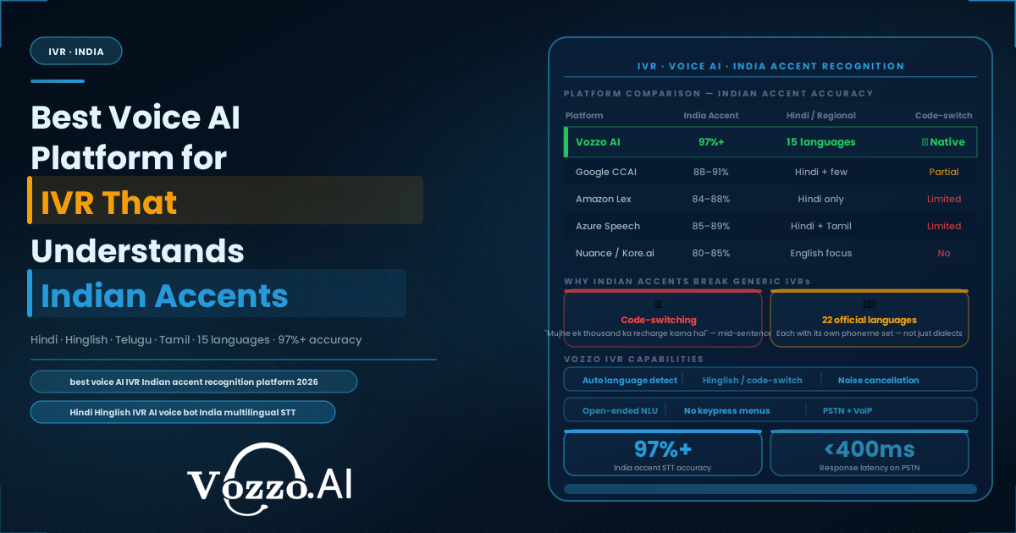
Code-switching and Hinglish handling. Callers mix languages mid-sentence — "mera account ka balance kya hai" or "delivery kab aayega". A platform that handles pure Hindi and pure English but breaks on mixed input will fail on a large share of real calls.
Noise robustness on mobile audio. Most Indian IVR calls arrive over mobile networks with compressed codecs, background noise, and degradation. Ask for accuracy benchmarks on mobile audio at your telephony codec quality — clean studio benchmarks are irrelevant.
Regional number and entity recognition. Customers read out account, Aadhaar, and mobile numbers with regional patterns, mix "paanch" and "five" in one response, and state amounts in lakhs and crores. Entity recognition must handle Indian formats, not just global ones.
Platform Comparison — How Major Voice AI Platforms Handle Indian Accents in 2026
Google Cloud Speech-to-Text. Strong Indian English support with multiple India-specific models and a large Indian data corpus; best-in-class for Hindi and major South Indian languages. Volume pricing needs careful modelling. A strong choice for enterprises already in the Google ecosystem.
Microsoft Azure Cognitive Services. Indian English accuracy improved significantly through 2025-2026, with strong Hindi support. Tamil and Telugu are improving but still behind Google. Excellent for enterprises on Microsoft infrastructure.
AWS Transcribe. Reliable for Indian English with reasonable Hindi accuracy, but less comprehensive regional language coverage than Google or Azure. Best for AWS-native architectures where integration simplicity outweighs language breadth.
Deepgram. Strong general accent robustness, improving Indian English accuracy, and competitive volume pricing, with less extensive regional language support. Worth evaluating for English-primary deployments.
Vozzo AI. Built on Indian production call data from enterprise BFSI, e-commerce, and healthcare deployments, with native handling of Hindi, Tamil, Telugu, Marathi, Bengali, Kannada, Punjabi, and Gujarati alongside Indian English accent variants. Code-switching and Hinglish are handled natively. For enterprises looking for a voice AI platform IVR understands Indian accents as a design requirement, Vozzo replaces menu-driven IVR with conversational AI that understands natural Indian speech instead of structured commands.
Before vs After Replacing a Standard IVR With Indian-Accent-Ready Voice AI
Before — global STT platform:
- 28% misrecognition rate on Indian English callers
- 34% IVR abandonment rate
- 40% of calls escalating to agents due to recognition failures
- IVR CSAT of 5.8/10
- Rs 1,26,000 per day in avoidable agent handle time
After — Indian-accent-trained voice AI:
- Misrecognition drops to 6%
- IVR abandonment drops to 11%
- Recognition-driven escalations drop to 8% of calls
- IVR CSAT rises to 7.9/10
- Rs 28,000 per day in recognition-driven escalations — a saving of Rs 98,000 per day
The Evaluation Checklist Before Selecting a Voice AI IVR Platform for India
- Request accuracy benchmarks on Indian English — not global English.
- Test on your own call recordings across your actual customer geographies.
- Confirm code-switching and Hinglish handling with a live test.
- Verify regional language coverage matches your customer demographic.
- Check accuracy on mobile network audio, not clean audio benchmarks.
- Confirm Indian number and entity recognition — lakhs, Aadhaar format, mobile sequences.
- Ask for reference clients in your industry running at your call volume in India.
The Bottom Line
An IVR that understands Indian accents is not a niche requirement — it is the baseline for any voice AI deployment serving Indian customers at scale. Platforms built on Indian production training data and real Indian call center deployments deliver accuracy that models trained on American English cannot match, whatever their marketing claims. Test on your own audio, in your customers' accents, before you commit to any platform.