Indian banks and NBFCs handle over 2 billion customer interactions a year — account queries, EMI reminders, fraud alerts, loan updates, KYC follow-ups, and collections calls — across 22 languages and a customer base that runs from English-speaking urban professionals to first-generation account holders in rural Maharashtra who speak only Marathi. The contact center infrastructure serving that volume is stretched beyond capacity. Voice AI is not a future consideration for Indian banking; it is a current operational necessity for any institution running at scale.
The Seven High-Value Use Cases for Voice AI in Indian Banks
EMI and Loan Repayment Reminders
A voice AI agent for Indian banks calls every borrower 7 days, 3 days, and 1 day before the EMI due date — in their registered language, with loan details pulled from the core banking system in real time. For a bank with 5,00,000 active loan accounts, that is 15,00,000 automated calls per repayment cycle with no agent involved in routine reminders. Early reminder automation reduces NPA formation in the 0–30 DPD bucket by 18–25% across deployments, because borrowers reminded in their own language pay on time at significantly higher rates.
Collections Calls for Overdue Accounts
AI voice agents handle outbound collections for DPD 1–60 accounts — the high-volume, lower-complexity segment where the objective is capturing a payment commitment and confirming a payment arrangement. RBI Fair Practices Code compliance is built into every call: permitted calling hours enforced, mandatory identification given, and prohibited language monitoring active. Human collections officers are reserved for DPD 90+ accounts, disputed balances, and hardship cases that need negotiation and judgment.
Fraud Alert and Card Block Notifications
When fraud detection flags a suspicious transaction, the AI voice agent calls the cardholder within seconds — often before the customer has noticed — to confirm or deny it. If fraud is confirmed, the agent triggers a card block via the core banking API and initiates the replacement card workflow, completing the interaction in under 90 seconds without a human agent. Round-the-clock availability means a 3 am alert is handled as effectively as a 3 pm one, at the moment customer trust is most at stake.
Account Service and Balance Queries
Routine inbound queries — balance, last five transactions, branch timings, IFSC code, cheque status — are resolved in real time without agent involvement. For PSBs handling 50,000+ inbound calls a day, automating the 40–50% that are routine frees human agents for complex service requests and relationship conversations. Multilingual capability gives rural and semi-urban account holders the same service quality as urban customers calling in English.
KYC and Document Follow-Up
KYC renewal and record updates require contacting millions of customers to confirm document submission or update contact details. AI voice agents run the outbound campaign — confirming receipt, flagging pending submissions, and giving branch visit instructions. They do it at a scale and speed human teams cannot match against RBI's KYC completion deadlines.
Fixed Deposit and Investment Renewal
FD maturity reminders go out automatically 30 days and 7 days before maturity; the AI presents renewal options, captures the customer's preference, and routes renewal intent to the relationship manager or branch. For private sector banks with large FD books, automated renewal outreach improves FD retention by 15–22% compared with no outreach or SMS-only outreach.
Cross-Sell and Product Campaigns
Pre-approved personal loan, credit card upgrade, and insurance cross-sell campaigns are delivered by voice AI to eligible segments, targeted by product eligibility, credit score, and relationship depth. AI handles the product introduction and interest qualification; the relationship manager handles application and closure. Campaign economics improve significantly when AI pre-qualifies interest before human time is spent.
RBI Compliance Requirements Every Bank Voice AI Deployment Must Meet
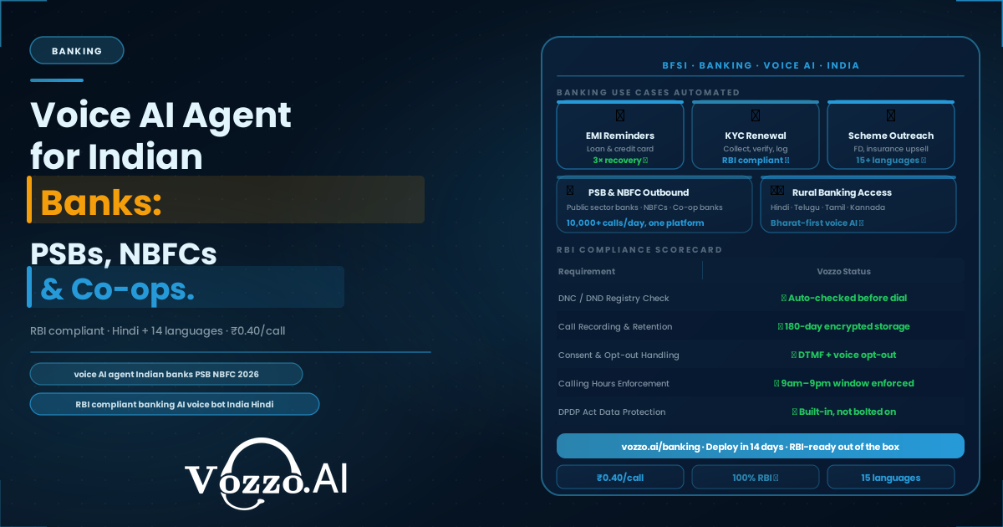
- Permitted calling hours. All outbound AI calls must be made between 8 am and 7 pm. RBI guidelines apply to automated calls exactly as they do to human agent calls — there is no exemption for automated systems.
- Mandatory identification. Every AI-initiated call must identify the institution and the purpose of the call within the first 30 seconds. A call that proceeds before identification is given is non-compliant regardless of its outcome.
- Fair Practices Code for collections. Collections AI must never use coercive, threatening, or humiliating language. Every collections call must be recorded, and compliance monitoring must confirm prohibited language is absent from every one.
- Data localisation. Call recordings and customer data processed by the voice AI platform must be stored within India. Offshore processing of Indian banking customer data requires RBI approval that most bank procurement processes cannot accommodate.
- Audit trail completeness. Every AI-initiated interaction must produce a complete log: institution identification, call time, customer ID, call outcome, and agent identification. That log is what you hand an RBI examiner or the Banking Ombudsman.
Before vs After Voice AI for a Mid-Size Private Sector Bank — Monthly Operations
Before:
- 2,00,000 EMI reminders per month requiring 45 agents
- 40% NPA formation in the 0–30 DPD bucket
- Fraud alerts dependent on the customer discovering the transaction
- KYC follow-up covering 30% of pending cases; FD renewal outreach to 20% of maturing FDs
- 35,000 routine balance queries per month with a 12-minute average wait
After:
- 2,00,000 EMI reminders completed automatically in 4 days
- NPA formation in the 0–30 DPD bucket reduced by 22%
- Fraud alerts placed within seconds of detection
- KYC follow-up covering 95% of pending cases in 7 days; FD renewal outreach to 100% of maturing FDs
- 70% of routine balance queries handled by AI with zero wait time
What Indian Banks Need From a Voice AI Platform
- Core banking system integration. The voice agent must connect to your CBS in real time for account data, loan details, EMI schedules, and FD maturity dates. A voice agent quoting outdated account information is worse than no voice agent at all.
- Indian language depth across your customer geography. A PSB with branches in all 28 states needs 10+ languages natively; a private bank concentrated in Maharashtra and Gujarat needs Marathi, Gujarati, and Hindi at minimum. Coverage must match your actual customer demographics.
- RBI compliance built into the platform. Calling-hours enforcement, mandatory identification, prohibited language monitoring, and audit log generation must be native features, not manual process controls. Compliance that depends on human process discipline fails at scale.
- Proven banking sector deployment. Banking voice AI handles sensitive financial data and makes calls that carry regulatory and reputational risk. Ask for reference deployments in Indian banking or NBFC operations before evaluating platform capability.
Conclusion
Indian banks deploying voice AI in 2026 are not experimenting with automation — they are solving a scale problem that manual contact centers cannot address while meeting regulatory and customer experience standards at the same time. Institutions that deploy RBI-compliant voice AI across their highest-volume interactions will cut operating costs, improve NPA management, and communicate with customers at a consistency their current infrastructure cannot match. The window for first-mover advantage in AI-powered banking communication is open now, and closing as the technology becomes standard.
Evaluating voice AI for your bank or NBFC? See how Vozzo AI supports BFSI teams.