India has 22 scheduled languages, 121 languages spoken by more than 10,000 people, and a population where 90% of first-preference communication happens in a language that is not English. Every enterprise deploying a voice AI agent in India is making the same mistake — they are buying a technology built for English speakers and hoping it works in Bharat. It does not.
Why Multilingual Is Not a Feature in India — It Is the Foundation
- An AI voice agent that handles English only reaches approximately 12% of India's population in their first-preference language. The other 88% tolerate it, misunderstand it, or hang up.
- The business cost of language mismatch is not abstract — conversion rates on voice calls drop 40-60% when the interaction is in the customer's second language versus their first. In collections, compliance rates drop. In sales, close rates drop. In healthcare, treatment adherence drops.
- Global voice AI platforms — built on English-first architectures — treat Indian languages as an add-on layer. The accuracy degrades, the natural language understanding misses cultural context, and the conversation sounds unnatural to native speakers.
- Indian language voice AI built natively — not translated from English — trains on actual regional speech data from the first line of code. India-built multilingual voice AI trains on Indian language data natively, and the difference in conversation quality is audible in the first 10 seconds of a call.
What True Multilingual Voice AI Capability Means — And What It Does Not
What it means:
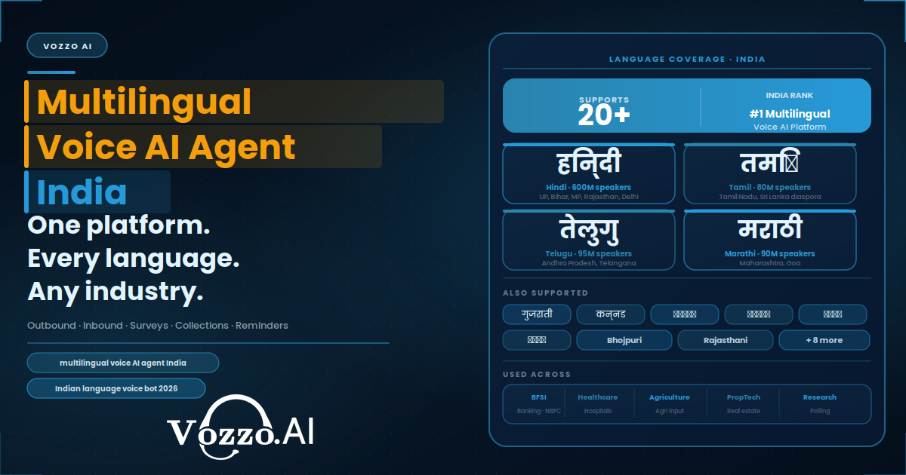
- Native language model training — the AI was trained on actual Hindi, Tamil, Telugu, Marathi, Bengali, Kannada, Punjabi, Odia, Gujarati, and Malayalam speech data — not translated from English.
- Domain-specific vocabulary in regional languages — a voice AI that handles "EMI" in Hindi, a crop name in Tamil, or "davakhana" in Urdu is genuinely multilingual. One that only handles textbook vocabulary is not.
- Code-switching fluency — Indian callers naturally mix languages mid-sentence. Hinglish, Tanglish, Manglish. A genuine multilingual AI handles this without breaking conversation flow.
- Dialect recognition — Marathi spoken in Vidarbha differs from Marathi in Konkan. Tamil in Chennai differs from Coimbatore. Genuine multilingual AI handles dialect variation without accuracy degradation.
What it does not mean:
- Translation layer AI — some platforms translate input to English, process in English, and translate output back. The latency is high, the accuracy is poor, and the conversation feels robotic. This is not multilingual AI — it is multilingual I/O with English intelligence.
- Language selection menus — press 1 for Hindi, press 2 for Tamil is not multilingual AI. It is language-segmented IVR.
Industries Where Multilingual Voice AI Has the Highest Impact in India
BFSI and collections — loan collections, insurance renewals, and banking service calls across India's tier 2 and tier 3 markets require Hindi and regional language fluency. A collections call in the borrower's native language has significantly higher promise-to-pay rates than one in English. For NBFCs and MFIs serving rural and semi-urban markets, multilingual collections AI is not optional.
Agriculture and agri input — seed companies, fertilizer brands, and agri input distributors reaching farmers across Maharashtra, Andhra Pradesh, Punjab, and Rajasthan need Telugu, Marathi, Punjabi, and Rajasthani dialect capability. Farmers make purchase decisions based on trust, and the right multilingual voice AI agent India brands deploy is what earns that trust, call after call.
Healthcare — patient communication across India's public and private hospital network spans 15+ languages. Appointment reminders, discharge follow-ups, and medication adherence calls must reach patients in their language to be effective. A Tamil patient in a Chennai hospital who receives a Hindi reminder call has a measurably lower response rate.
E-commerce and D2C — India's next 400 million e-commerce buyers are coming from tier 2, tier 3, and rural markets. Customer support, order tracking, and delivery coordination in regional languages is the difference between a completed order and a return.
Government and public services — grievance helplines, scheme awareness campaigns, and citizen communication across India's states require the linguistic range that only a genuinely multilingual voice AI platform can deliver at scale.
How to Evaluate a Multilingual Voice AI Platform for India — The Right Questions
- Which languages are natively trained versus translation-layer — ask for a live demonstration in your specific language mix on your own call scripts, not a curated demo.
- What is your accuracy benchmark on code-switched speech — Hinglish, Tanglish, and mixed-language calls are the norm in Indian call centers. Accuracy on clean language is irrelevant if the platform fails on real calls.
- How do you handle low-bandwidth mobile audio — most of India's rural and semi-urban calls come through mobile networks with variable audio quality. The AI must perform on compressed audio, not just studio-quality recordings.
- What is your latency on regional language processing — response delay above 1.5 seconds in a voice conversation breaks the interaction. Ask for latency benchmarks on your specific languages.
- Do you have domain-specific vocabulary for my industry — a platform that handles Hindi financial terms accurately but fails on Hindi agricultural terms is partially multilingual. Domain vocabulary coverage matters as much as language coverage.
Before vs After Multilingual Voice AI — Enterprise Results in India
Before: English-only or Hindi-only voice AI, 40% of customer base unreachable in first-preference language, conversion and compliance rates significantly lower in regional language markets, customer experience inconsistent across geographies, tier 2 and tier 3 market penetration limited by language.
After: 10+ Indian languages covered natively, every customer interaction in first-preference language, conversion rates consistent across geographies, tier 2 and tier 3 markets accessible at scale, single platform managing multilingual customer communication across all regions.
Building a voice AI strategy for India without genuine multilingual capability is building for 12% of the market and hoping the other 88% figures it out. The enterprises that deploy natively multilingual voice AI in 2026 are not just reaching more customers — they are reaching them in the language that makes every interaction more trusted, more effective, and more likely to convert.