
An NBFC's legal team receives a customer dispute. The call recording exists, but finding the exact moment where the agent made the verbal commitment takes a paralegal four hours of listening. Multiply that by two hundred disputes a month, and the true cost of manual review becomes impossible to ignore.
Why Call Transcripts Alone Are Not Enough And What Bulk Analysis Changes
- A transcript is a document. Analysis is the intelligence extracted from it.
- BFSI and BPO operations need to know what was promised, what was disputed, and what was missed — across thousands of calls, not just the ones flagged manually.
- Bulk transcript analysis turns call data into a searchable, queryable intelligence layer across your entire call history, not a handful of spot-checked recordings.
- This is the shift that call transcript AI BFSI teams are now investing in — moving from reactive documentation to proactive, decision-grade intelligence.
- For collections teams specifically, this means tracing exactly what was said as an account crosses each DPD bucket, right up to the point it risks turning into an NPA.
The 5 Things a Bulk Call Transcript Analysis Tool Must Do for BFSI and BPOs
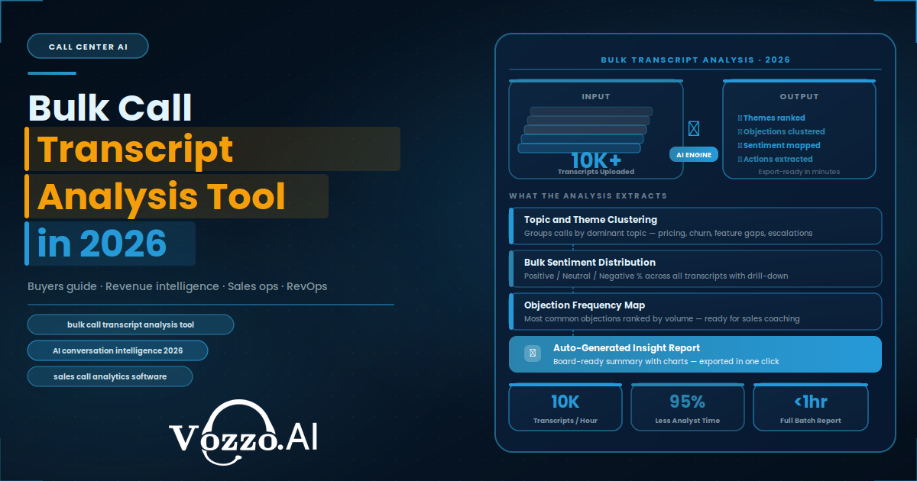
- Process at scale overnight. Five thousand calls uploaded at 6pm should have structured analysis ready by 8am. Batch processing at this speed is non-negotiable for call centers with high daily volumes, and it is exactly what a genuine bulk call transcript analysis tool delivers instead of a slow, manual review queue.
- Extract structured data, not keyword lists. For every call: customer intent, agent response, commitment made, outcome, sentiment arc, and compliance flags — organized as data fields, not a word cloud of frequently used terms.
- Make transcripts searchable by meaning, not just keyword. Search “calls where customer mentioned foreclosure” and retrieve every call where that intent appeared, even if the customer actually said “band karwa do” instead of the English term.
- Enable dispute-ready call retrieval. When a customer dispute arrives, the exact call, the exact timestamp, and the exact agent statement should be retrievable in under sixty seconds, not after a day of searching through recordings.
- Handle multilingual transcript analysis natively. Hindi, English, Hinglish, Tamil, Telugu — BFSI calls in India are heavily code-switched, and the analysis tool has to be built for that reality, not bolted on as an afterthought.
Specific Use Cases Where Bulk Transcript Analysis Pays for Itself
Collections and recovery. AI scans every collection call transcript for promise-to-pay commitments and flags the ones that were never followed up on. The legal team gets a searchable archive of every verbal commitment made during the collections cycle, and dispute resolution time drops from days to minutes. DPD-wise call segmentation also makes it possible to prioritize outreach on accounts nearing the NPA threshold instead of treating every overdue account the same way.
Insurance and bancassurance sales. Every sales call transcript gets analyzed for mandatory disclosure compliance before the policy is issued. Mis-selling gets caught at the source, not in an ombudsman complaint months later, and IRDA audit preparation turns into a report instead of a manual, call-by-call exercise. Bancassurance teams in particular benefit, since cross-sell scripts and mandatory disclosures can be checked call by call rather than sampled once a quarter.
BPO quality assurance. The QA team moves from listening to individual calls to reviewing AI-generated analysis of every single call. Weekly QA reports get generated automatically, and client SLA reporting gets built from 100% of call data instead of a 2% manual sample. First-call resolution rates and agent coaching needs also become visible at a portfolio level instead of being inferred from a handful of monitored calls per agent per month.
Before vs After Bulk Transcript Analysis for a 300-Agent BFSI Call Center
Before: the legal team manually searches recordings for evidence, QA samples 3% of calls, compliance gaps surface in audits weeks after the calls actually happened, and agent disputes take two to three days to investigate. Legal and compliance teams operate largely reactively, responding to escalations after the damage to customer trust and regulatory standing has already occurred.
After: every call transcript is searchable in seconds, compliance flags get raised the same day, dispute evidence gets retrieved in under a minute, and QA reports get generated automatically every morning. Legal and compliance teams shift from reactive firefighting to proactive risk management, catching issues before they escalate into regulatory or reputational problems.
Key Questions to Ask Any Bulk Call Transcript Analysis Vendor
- What is your accuracy rate on Indian English and regional language calls? Ask for a live test on your own call sample, not a benchmark figure from an unrelated dataset.
- Where is the data stored and processed? For BFSI, call recordings contain customer financial data and must stay within RBI-compliant infrastructure.
- How long does bulk processing actually take? Five thousand calls should complete overnight, not over 48 hours.
- Can we configure what gets extracted? A collections workflow needs different output fields than a sales QA team, and the tool should adapt to both.
Conclusion
For BFSI and BPO operations, call transcripts are one of the most valuable and most underused data assets in the business. Bulk analysis turns that archive into a live intelligence system, and the organizations building that capability in 2026 are making every future audit, dispute, and coaching conversation faster and more defensible. Vendors who can prove real-world accuracy on Indian language calls, not just English transcripts, will be the ones capable of supporting BFSI compliance requirements at genuine scale.