
A regional sales manager for a seed company in Nagpur has six weeks before the kharif sowing window opens. His territory holds 80,000 farmers. He has 12 field representatives, each able to visit six farmers a day. Run the math and the ceiling is 4,320 farmer contacts before the window closes — a shortfall of nearly 76,000 farmers who will buy from a competitor or the local dealer before his reps ever reach them. No amount of overtime fixes that gap; it is a headcount problem disguised as a scheduling problem, and the sowing calendar does not grant extensions.
Why Seed Sales in India Is a Voice-First, Window-Driven Business
Seed purchase decisions in India do not stretch across a calendar year — they compress into a three-to-six-week window before each sowing season. Miss that window with a farmer and he has already bought from a competitor's field team or the local dealer down the road, and that decision holds for the entire season.
- Seed purchase decisions happen inside a 3-6 week window before each sowing season — miss it, and the farmer has already bought from a competitor or the local dealer.
- Farmers in rural India decide based on conversations, not digital ads — voice is the channel that actually converts a sale, not a WhatsApp forward or an SMS blast nobody opens.
- Variety recommendation demands dialogue, not a catalogue push. A farmer growing cotton in Vidarbha's black soil faces different pest pressure and rainfall than one farming the red soils of Andhra Pradesh. Seed recommendation cannot be one-size-fits-all.
- Field rep bandwidth is the permanent bottleneck. Hiring more reps takes months, training them on the season's variety lineup takes longer still, and the sowing window does not wait for a hiring cycle to finish.
This is exactly why seed company voice AI India adoption has accelerated this fast — it is the only channel that can hold a real, personalized conversation with tens of thousands of farmers inside a six-week window, in the farmer's own language, at a cost that scales with call volume instead of headcount.
What an AI Voice Agent Does in a Seed Company Sales Workflow
- Seed company uploads farmer database with name, location, crop history, and preferred language — Hindi, Marathi, Telugu, Kannada, Punjabi, Tamil tagged per farmer.
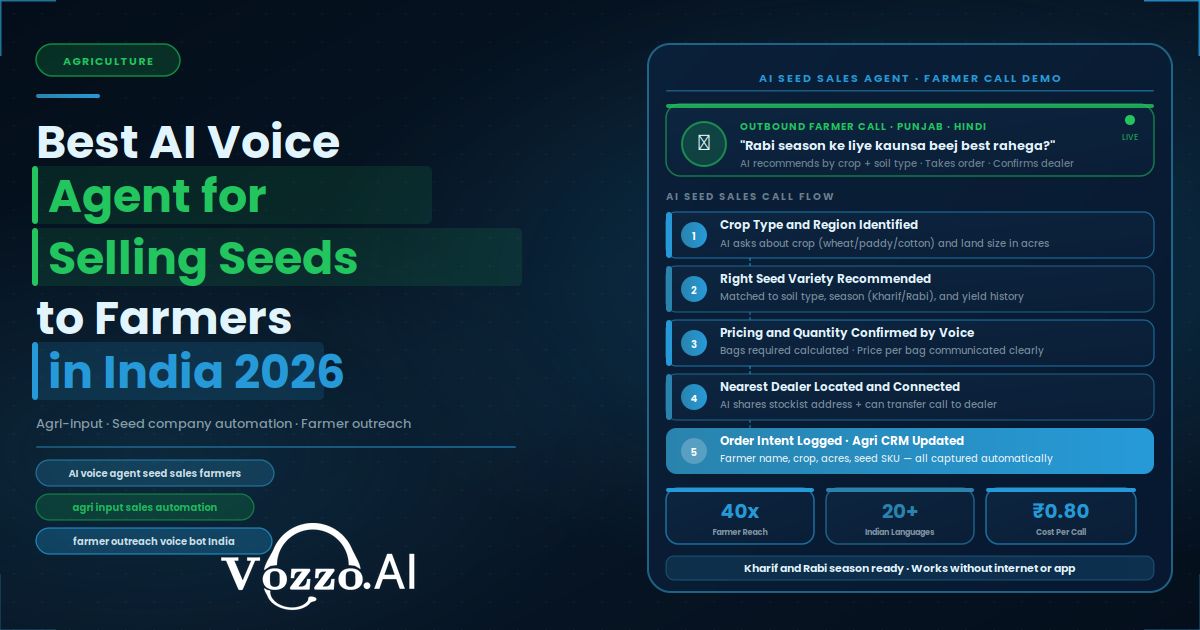
- The AI voice agent for selling seeds to farmers India launches outbound calls to all farmers simultaneously — 80,000 calls completed in 3-4 days, not stretched across six weeks of field visits.
- The AI greets each farmer by name in their language, asks about this season's crop plan and acreage.
- Based on the farmer's crop and location, the AI recommends the right seed variety from the company's product catalogue — trained on variety performance data and regional suitability.
- Farmer interest gets captured: hot leads are flagged and routed straight to the nearest field rep for a follow-up visit, and order intent is captured directly for dealer routing.
- Objection handling is built in. If a farmer mentions a competitor's variety, the AI presents the company's yield advantage for that farmer's specific crop and region.
- Undecided farmers get a follow-up call scheduled automatically, five days before the sowing window closes.
Before vs After AI Voice Calling for a Seed Company — Kharif Season
Before:
- 12 field reps, 4,320 farmer contacts in six weeks
- Remaining 75,680 farmers in the territory never reached
- Competitor sales teams and local dealers fill the gap
- No systematic follow-up on undecided farmers
- Rep visit notes inconsistent, incomplete, and rarely make it back to head office
After:
- 80,000 farmers called in four days
- Hot leads routed to reps with a full conversation summary attached
- Undecided farmers followed up automatically before the window closes
- Field reps spend their time closing sales, not prospecting cold
What Seed Companies Specifically Need From a Voice AI Platform
Regional language depth, not just translation. A farmer in Vidarbha speaks Marathi loaded with specific agricultural vocabulary — variety names, pest terms, local measures. Translation-layer AI sounds unnatural on that vocabulary and loses farmer trust in the first ten seconds of the call.
Crop and variety knowledge base. The AI must be trained on your actual seed catalogue — variety names, yield data, crop suitability, pest resistance, and regional performance. Generic AI cannot recommend the right hybrid for black cotton soil in Yavatmal.
Dealer and distributor integration. When a farmer is ready to buy, the AI has to point him to the nearest dealer stocking that exact variety. A buying signal with no purchase path attached is a wasted conversation.
TRAI compliance for rural outbound. Commercial agricultural advisory calls have to comply with DND regulations and CLI requirements. Non-compliant calls get blocked at the carrier level and damage brand trust with the very farmers you are trying to win.
Results Seed Companies See in One Season With Voice AI
- 18x increase in farmer reach during the sowing window, without adding a single field headcount.
- 34% improvement in lead-to-dealer conversion when the AI's recommendation is matched to the farmer's specific crop and region.
- 60% reduction in cost per farmer contact versus field rep visits — roughly Rs 3-6 per AI call against Rs 180-350 per field visit.
- 40% increase in field rep productivity, because reps spend their day on farmers flagged as hot leads instead of cold prospecting.
Seed companies that reach every farmer in their territory before the sowing window closes do not need a bigger field team. They need an AI voice agent that makes 80,000 calls in the time it takes 12 reps to make 4,000, in the farmer's own language, with variety recommendations that account for regional soil and pest conditions instead of a generic sales pitch. The companies building that capability now — before the next kharif window opens — will own farmer relationships that competitors spend years trying to win back.