A fertilizer company's district sales manager in Guntur has 60,000 farmers in his territory and four weeks before kharif sowing begins. His team of nine agronomists can physically reach 2,160 of them in that window — the other 57,840 will buy from whoever calls them first, and right now that's his competitor.
Why Fertilizer Sales in India Is a Race Against the Sowing Calendar
- Fertilizer purchase decisions are made two to four weeks before sowing — the window is fixed by the monsoon calendar, not by sales team availability.
- Farmers buy from the brand that reaches them with the right product recommendation at the right time — not necessarily the cheapest or the best-known.
- Crop-specific recommendation is critical — a DAP recommendation for paddy in coastal Andhra Pradesh is different from a recommendation for cotton in Vidarbha. Generic outreach does not convert.
- Dealer availability varies by district — knowing which product is in stock at the nearest dealer is as important as the product recommendation itself.
This combination of speed, crop-specific accuracy, and dealer awareness is exactly what fertilizer company voice AI India deployments are built to deliver inside a sowing window that no field force alone can cover.
What an AI Voice Agent Does in a Fertilizer Company Sales Campaign
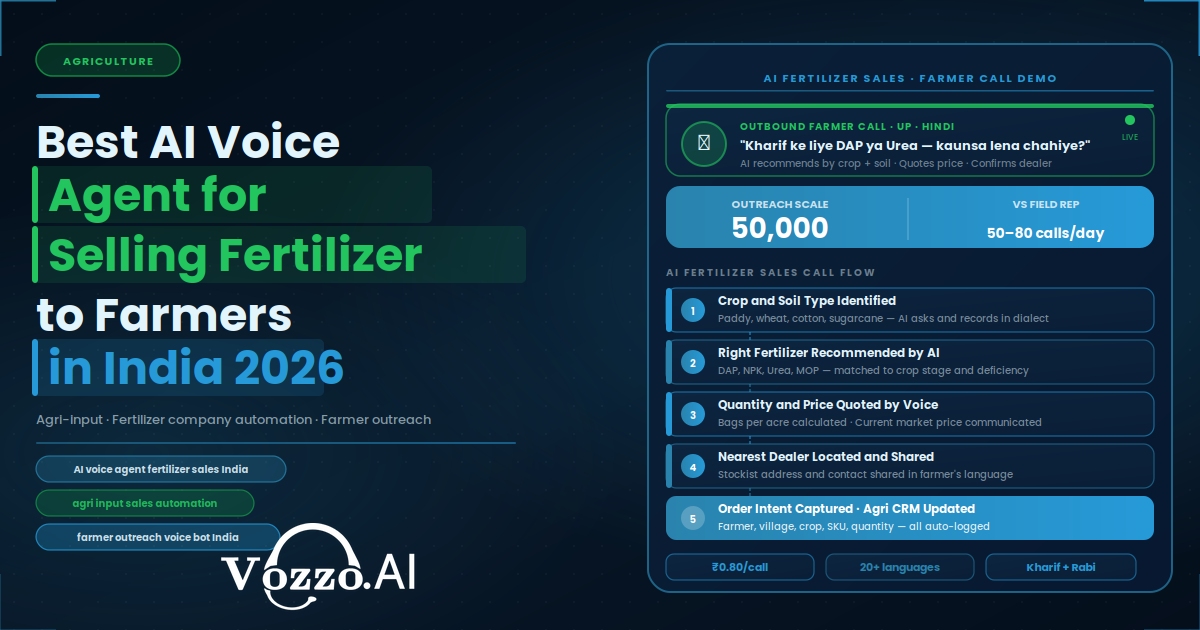
Step 1 — The fertilizer company uploads its farmer database with name, district, crop history, soil type where available, and language preference — Telugu, Hindi, Marathi, Kannada, Tamil, or Punjabi tagged per farmer.
Step 2 — The AI launches simultaneous outbound calls across the entire territory. This is the mechanism behind an AI voice agent for selling fertilizer to farmers India completing 60,000 calls in three to five days instead of four weeks.
Step 3 — The AI greets each farmer by name in their own language and asks about this season's crop plan and the acreage under cultivation.
Step 4 — Based on crop, district, and soil type, the AI recommends the right fertilizer grade and application schedule from the company's product portfolio, trained on the company's own agronomic data and regional crop response trials.
Step 5 — The AI checks dealer availability in the farmer's block and directs them to the nearest stocking point carrying that product.
Step 6 — Interested farmers are flagged as hot leads with a full conversation summary — crop, acreage, product interest, nearest dealer — routed to an agronomist for a follow-up visit.
Step 7 — Subsidy and scheme information is delivered where relevant: PM-KISAN linkage, soil health card recommendations, and government fertilizer subsidy scheme details communicated accurately on the same call.
Before vs After AI Voice Calling for a Fertilizer Company — Kharif Season
Before: Nine agronomists, 2,160 farmer contacts in four weeks, 57,840 farmers unreached, a competitor filling the gap, no systematic follow-up on interested farmers, and agronomist visit notes written inconsistently on paper.
After: 60,000 farmers called in four days in their own language, product recommendations delivered based on crop and region, hot leads routed to agronomists with full conversation context, dealer stock direction given on every call, and agronomists spending their time on closing visits instead of cold outreach.
What Makes Fertilizer Sales Calls Different From Generic Outbound Calling
Agronomic credibility matters more than persuasion. A farmer will reject a fertilizer recommendation from a voice that sounds scripted or uninformed. AI trained on a product's crop response data and regional trial results sounds knowledgeable, not like a telemarketer reading a script.
Subsidy and regulatory accuracy is non-negotiable. Fertilizer in India is subsidized and regulated, and the AI must communicate accurate subsidy information, MRP, and government scheme linkages. Wrong information about subsidy eligibility destroys farmer trust permanently, not just for that call.
Dialect and regional vocabulary hold the conversation together. A farmer in Telangana speaks Telugu with agriculture-specific vocabulary that differs from formal Telugu, and the AI must handle agricultural terms, local crop names, and regional pest names naturally to be taken seriously.
Timing within the season changes everything. The same farmer who ignores a call in January is a high-intent buyer in May. The AI must be deployable on a campaign schedule aligned with the company's regional sowing calendar, not a fixed monthly cadence that ignores it.
Results Fertilizer Companies See in One Season With Voice AI
- 25x increase in farmer reach during the sowing window without adding agronomist headcount.
- 38% improvement in dealer offtake in districts where AI voice campaigns ran, compared with control districts running field-rep-only outreach.
- 55% reduction in cost per farmer contact — Rs 4–7 per AI call versus Rs 200–380 per agronomist field visit.
- Hot lead quality up sharply: farmers who received an AI product recommendation and expressed interest converted to purchase at 3.2x the rate of cold dealer walk-ins.
What Fertilizer Companies Need From a Voice AI Platform for Farmer Outreach
- Agronomic knowledge base training. The platform must be trainable on your specific product portfolio — grades, crop suitability, application timing, tank mix compatibility. Generic agriculture AI is not enough for a conversation a farmer will act on.
- Regional language depth. Fertilizer companies operating across states need Telugu, Kannada, Marathi, Hindi, Tamil, and Punjabi at minimum, and accuracy in agricultural vocabulary in each language is the baseline requirement, not a bonus feature.
- Dealer inventory integration. AI directing a farmer to a dealer that is out of stock wastes the call and damages trust. Real-time or daily dealer stock sync is essential for any fertilizer outreach campaign built on this model.
- TRAI-compliant outbound infrastructure. Commercial agricultural advisory calls must comply with DND scrubbing, CLI registration, and commercial communication timing rules. Non-compliant calls get blocked by telecom networks and invalidate your campaign reach before it starts.
Conclusion
The fertilizer companies that reach every farmer in their territory before the sowing window closes are not the ones with the largest field force. They are the ones that make 60,000 calls in the time it takes nine agronomists to make 2,000 — with the right crop recommendation, in the right language, directed to the right dealer. That is the operational capability that wins the season before it starts.