
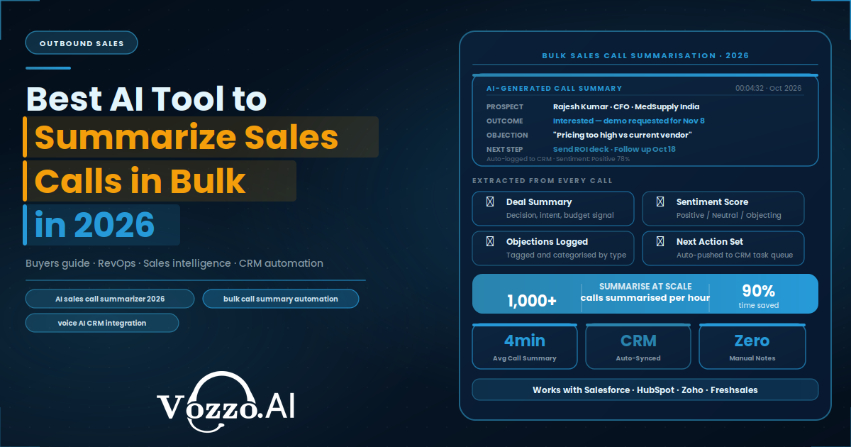
A sales manager opens Monday morning to 200 recorded calls sitting in a folder from last week, with no time to listen to a single one. She has no idea which deals moved forward, which objections killed a deal, or which reps need coaching before their next call. The intelligence already exists — it is just locked inside audio nobody has time to hear.
Why Bulk Sales Call Summarization Is Now a Competitive Necessity
Enterprise sales organizations have hit a scale problem that manual review cannot solve, and the gap is widening every quarter.
- Enterprise sales teams generate hundreds of calls daily across reps, regions, and campaigns — manually reviewing even 10% of that volume is mathematically impossible for any sales operations team.
- CRM notes written by reps after calls are incomplete, biased toward what the rep chooses to remember, and inconsistent from one rep to the next, making pipeline data unreliable.
- Sales managers spend 3 to 4 hours a week reviewing call recordings instead of coaching reps on the deals that actually need their attention.
- Deal intelligence — objections, competitor mentions, buying signals — sits locked inside call recordings, inaccessible to anyone who doesn't have hours to spare listening.
- This is exactly the gap bulk sales call summarization AI is built to close, turning an unreviewable stack of recordings into structured, searchable intelligence overnight.
What the Best AI Call Summarization Tool Must Do
- Accurate transcription across accents and audio quality. The tool must handle Indian English, regional accents, and mobile call quality without degrading accuracy, since enterprise call volume spans every geography and network condition.
- Structured summary output. A transcript dump is not a summary — the output must extract key decisions, objections raised, next steps, and a sentiment score for every single call.
- Bulk processing. The system must handle 500+ calls overnight, not process them one at a time, or it simply cannot keep pace with enterprise call volume.
- CRM auto-sync. Summaries must push directly to the correct deal or contact record without manual copy-paste, or the tool just creates a second data entry task.
- Coaching flags. The tool must automatically surface calls where objection handling failed or a competitor was mentioned, so managers know exactly which calls need review.