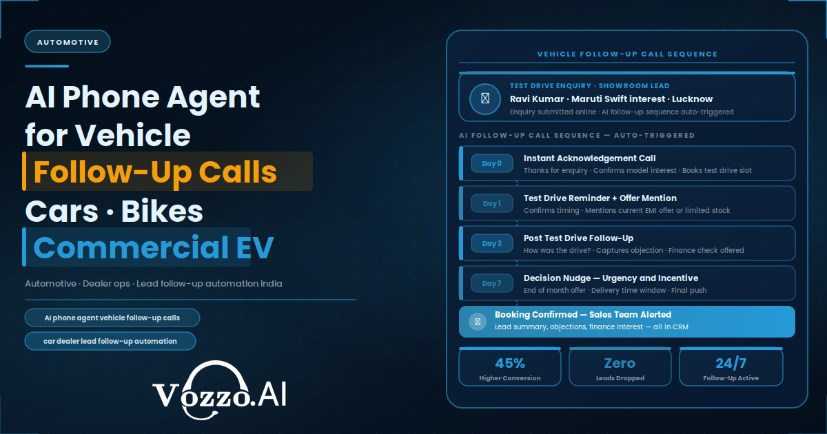
A Maruti Suzuki dealership in Lucknow logs 140 walk-ins and test drives in October, with a sales team of 11 — each executive manually following up 12–15 leads a day while also working the showroom floor, booking test drives, and handling documentation for closures. By day 7, the leads from day 1 still have not received a second follow-up call. By day 14, they have bought from the dealership down the road.
Why Follow-Up Is Where Vehicle Sales Are Won and Lost in India
- The decision window is long and contested. The average Indian car buyer visits 2.3 dealerships and takes 3–6 weeks from first inquiry to purchase decision. The dealership that stays consistently in touch through that window wins the sale.
- Sales executives cannot cover every lead. At high-volume dealerships, executives are structurally unable to follow up every lead every 3–4 days. They prioritize hot leads and let warm ones go cold — which means 40–60% of test drive leads receive inadequate follow-up.
- Two-wheeler dealerships have it worse. Daily footfall of 30–80 customers, 60–70% of them price-sensitive and comparing 3–4 brands, with a follow-up window of just 48–72 hours before the purchase decision is made.
- After-sales revenue leaks quietly. Service reminders, insurance renewals, and AMC follow-ups are high-revenue touchpoints that dealerships consistently underperform on, because they need systematic outreach at scale. This is exactly where automotive dealership call automation in India pays for itself.
The Five Vehicle Follow-Up Call Types an AI Phone Agent Handles
1. Test Drive Follow-Up — 24 to 48 Hours After the Test Drive
An AI phone agent for vehicle follow-up calls India dealerships can deploy calls every test drive customer within 24–48 hours to capture feedback on the vehicle, address objections, and understand the decision timeline. The sales executive receives a structured summary: customer sentiment, the specific objection raised, the competing model being considered, and the likelihood of purchase within 30 days. Follow-up frequency and messaging then adjust to the customer's response. Hot leads are escalated to the sales executive immediately.
2. Inquiry Nurture Calls — Weekly for 4 to 6 Weeks
Customers who inquired online or visited without a test drive receive weekly AI nurture calls covering product updates, EMI offers, festive discounts, and new colour availability. This keeps the dealership top of mind through the 3–6 week consideration window. None of it consumes sales executive time on cold follow-up.
3. Service Reminder Calls — 7 Days Before the Due Date
Every vehicle owner in the dealer's database receives an AI service reminder call 7 days before the service due date — by name, vehicle model, registration number, and service type due. The appointment is booked during the call and confirmed in the service management system. Service bay utilization rises significantly when reminders reach 100% of due vehicles, not just the ones the service advisor had time to call.
4. Insurance Renewal Calls — 30 Days Before Expiry
Every customer whose vehicle insurance expires in the next 30 days gets an automatic call from the dealership's insurance desk. The AI confirms renewal interest, quotes the premium, and connects the customer to an insurance executive for closure. Most dealerships leave this revenue stream to the insurer — and lose the commission with it.
5. Post-Delivery Follow-Up — Day 7 and Day 30
The AI calls every customer 7 days after delivery to check satisfaction, answer accessory questions, and flag concerns for the service team. The day 30 call covers satisfaction with the vehicle and the service experience, and introduces the AMC package. Consistent post-delivery engagement drives referrals and long-term service loyalty.
Before vs After AI Phone Agent for a Mid-Size Car Dealership — Monthly View
Before
- 140 test drives in October handled by 11 sales executives
- Only 60 leads receive adequate follow-up; 80 go cold by day 7
- Conversion rate of 18% of test drives
- Service reminders made manually, covering 25% of due vehicles
- Insurance renewal calls made to 30% of expiring policies
- Post-delivery follow-up ad hoc and inconsistent
After
- All 140 test drive leads receive AI follow-up within 24 hours and weekly thereafter
- Conversion rate improves to 27% of test drives — roughly 38 sales instead of 25 from the same footfall
- 100% of service reminders made automatically
- Insurance renewal calls made for every expiring policy
- Post-delivery calls made for every customer
- Sales executive time focused on closing and relationship management only
Why Multilingual Follow-Up Matters for Indian Vehicle Dealerships
A dealership in Coimbatore serves Tamil-speaking customers, a dealership in Nagpur serves Marathi and Hindi speakers, and a dealership in Amritsar serves Punjabi speakers. A follow-up call in the customer's native language gets measurably higher response rates than a call in Hindi or English from a salesperson who does not share that language. For two-wheeler dealerships in tier 2 and tier 3 cities — where the customer base is regional-language-first — Hindi or English follow-up calls are effectively ignored. AI that matches the call language to the customer is not a feature; it is a commercial necessity for dealerships outside the top 8 metros.
What Vehicle Dealerships Need From an AI Follow-Up Phone Agent
DMS integration. The AI must pull customer data, vehicle details, service due dates, and insurance expiry from your Dealer Management System automatically. Manual list preparation defeats the purpose of automation.
Configurable follow-up cadence per customer segment. Test drive follow-up, service reminders, and insurance renewals each run on a different cadence. The platform must support multiple parallel workflows with different triggers and frequencies.
Indian language capability for your dealership geography. For dealerships outside the metros, this is not optional. Response rates on regional-language follow-up calls run 2–3x higher than on English or mismatched Hindi calls.
Hot lead escalation with call summary. When the AI detects high purchase intent — a customer wants to visit again, asks about delivery timelines, or names a specific variant — the sales executive must get an instant alert with the full conversation summary. The window to close is hours, not days.
Follow-Up Is the Product
In Indian automotive retail, the dealership with the best follow-up system beats the dealership with the best product, because most customers buy from whoever stays in touch most consistently through their decision window. AI follow-up calls make that consistency operationally achievable for every lead, every service due date, and every insurance renewal — without adding headcount. The dealerships building this in 2026 are turning their customer database into a predictable revenue engine instead of an underused contact list.
See how Vozzo AI automates follow-up calls for vehicle dealerships →