A dermatology clinic in Jaipur runs on one receptionist, 80 appointments a day, and a phone that rings 120 times. Forty of those calls are patients trying to book, reschedule, or confirm; twenty more want directions or timings — while the same receptionist handles walk-ins, billing, and patient records. Fifteen calls go unanswered, and those fifteen patients book at the clinic down the road.
Why Appointment Scheduling Is the Highest-Volume Repetitive Task in Any Clinic
- Appointment booking, confirmation, and rescheduling calls make up 50–65% of all inbound calls in a typical specialist clinic or polyclinic. They are routine, repetitive, and need no clinical judgment — which makes them the first workload clinic appointment booking automation should take over.
- Every missed booking call is a lost patient. In urban India, where patients have several clinic options within 2 km, an unanswered phone converts directly into a competitor's booking.
- Manual appointment management creates double-bookings, missed slots, and no-show rates of 25–35% when reminder calls are not made consistently.
- Staff tied up on booking calls are unavailable for the work that actually needs a human present — patient check-in, billing, clinical assistance, and in-room support.
What an AI Phone Agent Does for Clinic Appointment Scheduling End to End
Here is how a complete booking cycle runs, from the first ring to the patient walking in.
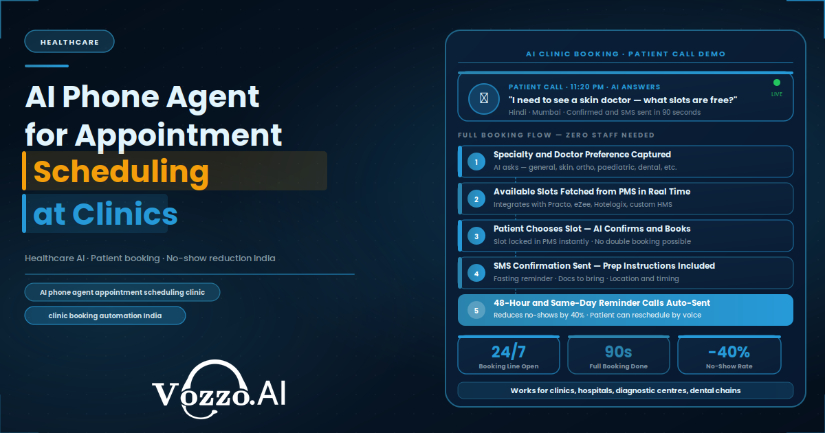
Step 1 — Instant answer in the patient's language. The patient dials the clinic number and the call is picked up immediately — no hold, no busy tone. A well-configured AI phone agent for appointment scheduling clinic workflows detects the caller's language from their speech and responds in Hindi, Tamil, Telugu, Marathi, Kannada, Malayalam, Bengali, or English.
Step 2 — Intent identification. The AI works out why the patient is calling: a new appointment, a reschedule, a cancellation, or a question about timings and doctor availability. Simple queries are answered on the spot; booking requests move to the next step.
Step 3 — Live availability check. For new appointments, the AI checks doctor availability in your clinic management system in real time and offers open slots. Preferences like "morning only", "after 5 pm", or "next Tuesday" are handled conversationally, the way an experienced receptionist would.
Step 4 — Booking and confirmation. Once the patient picks a slot, the AI books it directly in the system and reads back the confirmation — patient name, date, time, doctor name, and any preparation instructions, such as fasting before a blood test or bringing previous reports.
Step 5 — Reminder 24 hours before. An automatic reminder call goes out a day before the appointment in the patient's language. The patient can confirm, reschedule, or cancel within that same call.
Step 6 — Cancellation recovery. When a patient cancels, the AI immediately offers alternative slots, and the freed slot goes straight back into availability for the next caller. No slot sits empty because a cancellation arrived by SMS and nobody updated the register.
Step 7 — Second reminder for high-risk patients. First-time and elderly patients receive a second reminder call 2 hours before the appointment. These are the segments with the highest no-show risk, and one extra call closes most of that gap.
Before vs After AI Phone Agent for a 60-Appointment-Per-Day Specialist Clinic
Before
- One receptionist handling calls, walk-ins, and billing at the same time
- 15–20 calls missed every day
- No-show rate of 28%
- Manual reminder calls covering only 30% of appointments
- Double-booking incidents every month
- Receptionist unavailable for walk-in patients during peak call hours
- Estimated revenue loss from empty slots: Rs 25,000–40,000 per week
After
- 100% of booking calls answered instantly
- No-show rate drops to 10–12%
- Reminder calls made for every appointment, automatically
- Zero double-bookings, because the AI books against the live system
- Receptionist focused entirely on in-clinic patient management
- Empty slots from cancellations refilled on the same call
Specific Clinic Types Where AI Appointment Scheduling Delivers Immediate ROI
Specialist clinics — dermatology, orthopedics, ophthalmology, and gynecology practices run 15–30 minute slots that are often booked weeks ahead. Every no-show or missed booking call is a fixed-cost slot that generates zero revenue. AI scheduling keeps slot utilization at its maximum.
Diagnostic centers and pathology labs — high volume, short appointment windows, and price-sensitive patients who will call three labs before booking. The AI answers instantly and confirms the slot before the patient dials the next lab.
Dental clinics — appointment-heavy, with scheduling spread across multiple treatment steps. The AI handles the full sequence — consultation, X-ray, procedure, follow-up — without the patient needing to call in each time.
Polyclinics and multi-doctor practices — scheduling across several doctors with different availability windows. The AI manages every doctor's calendar simultaneously, something a single receptionist cannot do accurately under call pressure.
Ayurveda and wellness centers — the patient base skews toward middle age and above, with lower digital literacy and a strong preference for voice. AI in Hindi and regional languages reaches this demographic better than any app or WhatsApp booking flow.
What Clinics Need From an AI Phone Agent for Appointment Scheduling
Real-time clinic management system integration. The AI must book into your actual appointment system, not a parallel calendar. Disconnected systems create double-bookings and defeat the purpose of automation.
Indian language depth for your patient catchment. A clinic in Chennai needs Tamil and Telugu; a clinic in Pune needs Marathi and Hindi. Language-matched AI calls see up to 3x higher patient confirmation rates than language-mismatched SMS or English-only AI.
Two-way appointment update capability. When a patient reschedules or cancels during the AI call, that change must update the system instantly. One-way calling without system write-back is notification, not automation.
Clean escalation to the receptionist for complex cases. The AI handles routine scheduling, but patients with urgent symptoms, multiple conditions needing coordination, or complaints must reach a human immediately. The escalation trigger has to be instant and seamless.
The Revenue Impact of Reducing No-Shows by 15 Percentage Points
Take a specialist clinic with 60 appointments per day and an average consultation fee of Rs 800.
- At a 28% no-show rate: 17 empty slots per day — Rs 13,600 in daily revenue lost, or Rs 4,08,000 a month.
- At a 12% no-show rate after AI reminder automation: 7 empty slots per day — Rs 5,600 lost daily, or Rs 1,68,000 a month.
- Recovered revenue: Rs 2,40,000 per month from no-show reduction alone.
That figure comes before counting the new revenue from booking calls that were previously going unanswered — which, for most clinics, is the bigger number.
The Bottom Line for Clinic Owners
For Indian clinics running lean front desk teams, an AI phone agent for appointment scheduling is not a technology upgrade — it is an operational necessity. Every unanswered call is a patient decision made in favor of a competitor. The clinics that answer every call, remind every patient, and refill every cancelled slot are the ones building patient retention that compounds over years.
See how Vozzo AI automates appointment scheduling for clinics and hospitals →