A seed company sales head walks into the kharif season budget meeting and asks the right question — not "can we afford AI voice calling" but "what does it cost us per farmer reached versus what our field reps cost per farmer reached right now?" That single question changes the entire budget conversation, because most agri input companies have never actually run the comparison.
Why Cost Per Call Is the Wrong Metric — Cost Per Farmer Reached Is the Right One
Field rep cost per farmer contact includes salary, TA/DA, vehicle, and time per visit — and it typically works out to Rs 180-400 per farmer contact in most agri input companies. That number rarely shows up on a single line item, which is exactly why it gets underestimated.
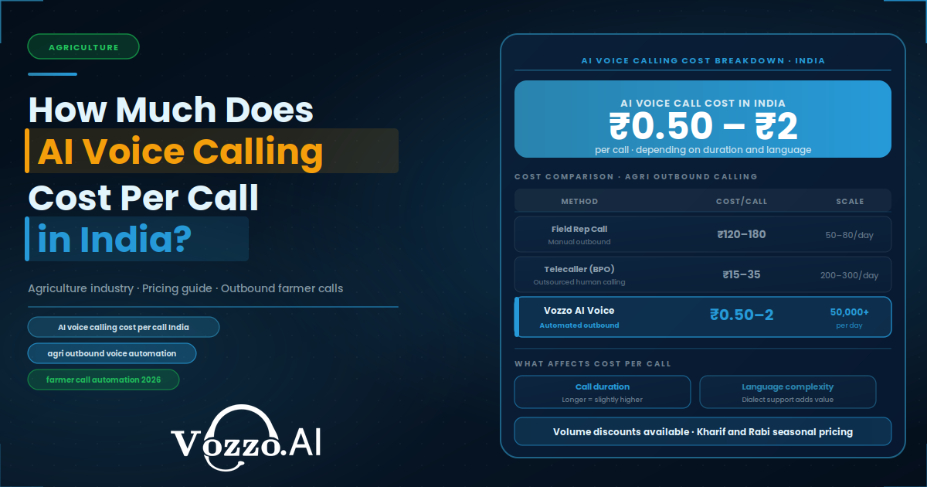
AI voice call cost per call in India typically ranges from Rs 1.50 to Rs 6 per minute, depending on the platform, the language, and your call volume. An average farmer outreach call runs 90-120 seconds, which means you are looking at roughly Rs 2.25 to Rs 12 per farmer contact via AI.
The comparison is not AI versus free — it is AI at Rs 3-8 per farmer versus a field rep at Rs 200-400 per farmer. Once you frame it that way, the budget conversation stops being about whether to adopt AI voice calling and starts being about how fast you can scale it. This is the core logic behind agri input voice AI pricing: you are not paying for calls, you are paying for farmer contacts, and the per-contact math favors AI by a wide margin.
What Determines AI Voice Calling Cost Per Call in India
Call duration — most platforms charge per minute, so a 60-second IVR-style call costs half of a 2-minute conversational AI call. Know your average handle time before comparing quotes.
Language complexity — Hindi outbound calls are cheapest to process. Regional languages like Telugu, Tamil, or Marathi with high accuracy add 15-30% to per-minute cost depending on the platform.
Call volume — agri input companies doing 50,000+ calls per season get significantly lower per-call rates than those doing 5,000. Volume pricing is the biggest lever in negotiations.
Conversational AI vs IVR — basic press-1-press-2 IVR is cheaper but delivers poor farmer engagement. Conversational AI costs more per minute but completion rates are 3-4x higher — making it cheaper per successful interaction.
Platform vs managed service — buying API access and building yourself is cheaper per call but requires engineering. A managed voice AI service costs more per call but includes campaign management, language support, and reporting.
Real Cost Comparison — Field Rep vs AI Voice Calling for Kharif Season Outreach
Take a realistic scenario: an agri input company wants to reach 50,000 farmers before the kharif sowing window closes.
The field rep model looks like this. 25 field reps, each covering 80 farmers per day, over 25 working days, gets you to 50,000 farmer contacts. Cost works out to salary plus TA/DA plus vehicle at roughly Rs 35,000 per rep per month, across 25 reps, for a total of Rs 8,75,000. Timeline: 25 working days, which means you miss the early sowing window for many regions. Coverage is limited to your reps' geographic zones — farmers outside those zones simply do not get reached.
The AI voice calling model looks very different. 50,000 calls get completed in 2-3 days at peak capacity. Cost at roughly Rs 5 per call averages out to Rs 2,50,000 for the entire campaign. Timeline: the entire outreach is done before the sowing window even opens. Coverage extends to any farmer in your database, regardless of geography.
That is a nearly 3.5x cost difference and a 10x speed difference for the same 50,000 farmer contacts. For a business making a real AI voice calling cost per call India agriculture decision ahead of a sowing window, speed is not a nice-to-have — it is the difference between farmers hearing about your product before they buy inputs, or after.
What Agri Input Companies Actually Pay — Realistic Budget Ranges
A small agri input company running 10,000 calls per season in Hindi only should expect to pay Rs 15,000 to Rs 50,000 per season.
A mid-size company running 1,00,000 calls across 3 languages, covering both kharif and rabi, should budget Rs 3,00,000 to Rs 8,00,000 per year.
A large agri input brand running 5,00,000+ calls, pan-India and multilingual, with full campaign management, should expect Rs 15,00,000 to Rs 40,00,000 per year.
For context, a single field rep costs Rs 4,20,000 to Rs 6,00,000 per year in salary and expenses alone — before you factor in the limited geographic coverage and the days lost to travel between farmer visits.
Questions to Ask Before Signing Any AI Voice Calling Contract for Agriculture
Is pricing per minute or per call. Per-call pricing is more predictable for campaign budgeting, while per-minute pricing is cheaper for short calls — know which model fits your typical call length before you sign.
What languages are included at the base rate and which cost extra. Some platforms charge a premium for regional Indian languages, and if your farmer base spans multiple states, that premium adds up fast across a season.
What is the minimum commitment. Some platforms require annual contracts with minimum call volumes that do not suit seasonal agri use cases, where your real need is a concentrated burst of calls around kharif and rabi sowing windows.
Who owns the call data and farmer response data. Your farmer database is your most valuable sales asset — make sure the contract is explicit about data ownership before you hand over a single phone number.