
At 7:14 p.m., a 68-year-old cardiac patient calls her hospital pharmacy to refill a blood pressure prescription before her Monday dose runs out. The line rings through to voicemail the pharmacy closed at 7:00 p.m., with no callback option available. She skips Monday's dose and waits until Tuesday morning to try calling again.
Why Prescription Refill Is the Highest-Volume Repeatable Call in Healthcare
Refill requests are not a minor operational detail — they are the single largest driver of inbound call volume in hospital pharmacy departments, and the pattern holds consistently across multi-location chains.
- Refill calls make up 35–40% of all inbound pharmacy calls in hospital chains, according to internal call center audits across multi-location pharmacy networks.
- The majority are routine: same patient, same medication, same dosage, with no clinical judgment required from the pharmacist.
- Staff time spent processing routine refills is time not spent resolving complex patient queries — drug interactions, insurance rejections, or dosage changes that genuinely require clinical judgment.
- After-hours refill requests routinely go unanswered, and unanswered calls translate directly into missed doses and unmanaged patient risk, particularly for chronic conditions like hypertension, diabetes, and anticoagulation therapy.
- This is precisely the gap that pharmacy voice bot automation closes: a system that treats routine refills as a solved problem, freeing staff for the calls that genuinely require a licensed professional.
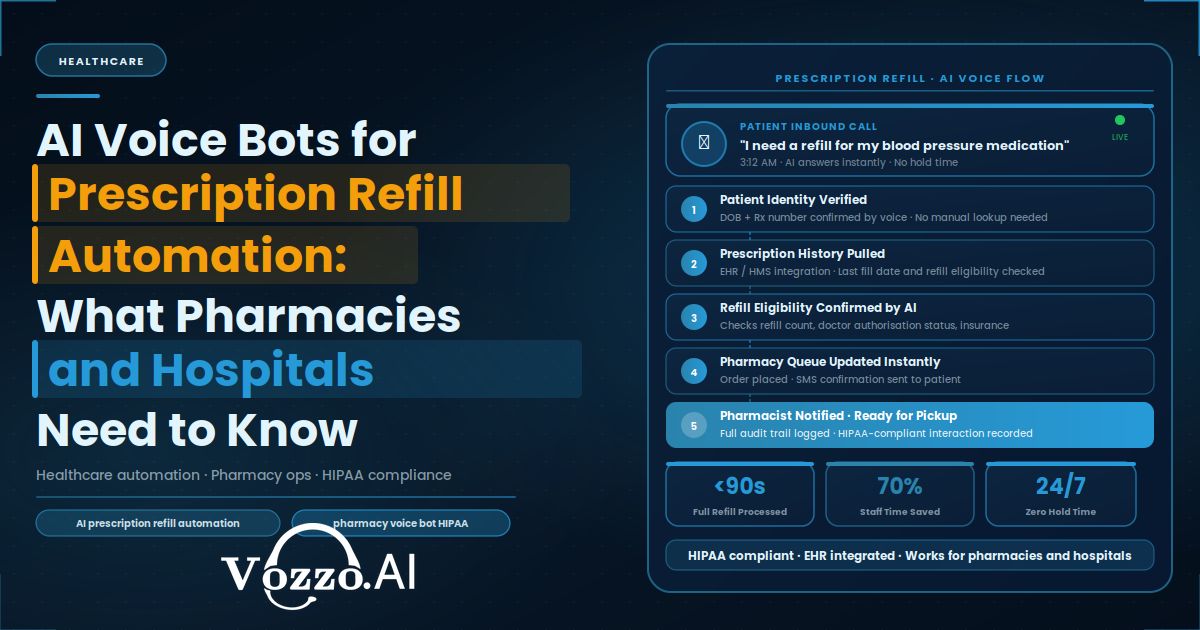
The Complete Prescription Refill Workflow Automated by Voice AI
- Step 1 — Instant Answer, Any Language: The patient calls the pharmacy's existing number, and the AI answers on the first ring, in the patient's preferred language. Every call handled by a prescription refill AI agent begins the same way, with immediate availability regardless of time of day.
- Step 2 — Identity Verification: The AI verifies the caller's identity using full name, date of birth, and registered mobile number, cross-checked against the pharmacy management system in real time. This happens conversationally, in under 15 seconds, without the patient navigating a menu.
- Step 3 — Prescription Lookup: Once identity is confirmed, the AI pulls the patient's active prescriptions directly from the pharmacy management system, including dosage, last fill date, and refills remaining. This gives an accurate, current view of what is eligible for refill without a staff member touching the record.
- Step 4 — Medication Confirmation and Stock Check: The patient confirms which medication to refill, and the AI checks real-time stock availability at the fulfilling location. If stock is insufficient, the AI immediately offers the nearest alternate location or an adjusted pickup timeline instead of leaving the patient without an answer.
- Step 5 — Order Confirmation and Logging: The AI confirms the refill request, logs the order directly in the pharmacy system, and provides a pickup or delivery timeline based on current queue and staffing conditions. No manual data entry is required from pharmacy staff for this transaction.
- Step 6 — SMS Confirmation: The patient receives an SMS confirmation containing the order number, medication name, and collection details immediately after the call ends, creating a written record for later reference.
- Step 7 — Escalation for Controlled Substances: For controlled substances or first-time refills requiring pharmacist approval, the AI recognizes the exception, flags the case, and routes it to a human staff member with full conversational context attached — patient identity, medication requested, and reason for escalation — so no information is lost in the handoff.
Before vs After Voice AI for Prescription Refills
Before: The patient calls and holds for 8 to 12 minutes before reaching a live technician. The technician manually looks up the patient in the pharmacy system, reads back prescription details for confirmation, and logs the order by hand. Average handle time for a single routine refill runs approximately 18 minutes, including hold time.
After: The same call is answered by the AI in under one second. Identity is verified in roughly 15 seconds, and the prescription is confirmed with the order logged within 90 seconds of the call starting. An SMS confirmation follows automatically, and no staff member touches the transaction at any point.
Clinical and Operational Impact
- 73% of prescription refill calls are fully resolved by the AI without any human handoff, based on deployment data across hospital pharmacy networks.
- Average handle time for routine refills drops from 18 minutes to approximately 90 seconds.
- The system operates 24/7, meaning after-hours refill requests are handled without requiring on-call pharmacy staff to be scheduled or paged.
- Chronic patients with round-the-clock refill access see a 28% reduction in missed doses, a direct consequence of removing the after-hours gap that causes patients to simply skip a dose rather than wait until morning.
Compliance and Integration
All patient interactions are encrypted end to end, both in transit and at rest. The voice AI integrates directly with leading pharmacy management systems and hospital HIS platforms, so refill data flows into existing infrastructure rather than creating a parallel system. Every interaction is logged with patient ID, timestamp, and medication details, producing a complete audit trail for compliance review. For deployments in Indian hospitals, data handling is aligned with HIPAA-equivalent standards and the Ayushman Bharat Digital Mission (ABDM) framework.
For hospital pharmacy chains handling thousands of refill calls daily, voice AI is no longer positioned as an efficiency upgrade — it is a patient safety tool, closing the after-hours gap that causes missed doses. The pharmacy chains earning patient loyalty in 2026 are the ones answering the phone at 7 p.m., not the ones sending patients to voicemail.