A patient who does not show up for their appointment costs a clinic far more than the value of that single visit. There are staff hours wasted, equipment held idle, and follow-up care delayed. Multiply that by even five percent of a busy practice's weekly schedule, and the financial and operational impact becomes significant. For hospitals and specialty clinics, patient no-show reduction is not a nice-to-have — it is a bottom-line priority.
The True Cost of Patient No-Shows
No-show rates across healthcare settings typically range from 10 to 30 percent depending on specialty, patient demographics, and reminder practices. Beyond lost revenue, no-shows create operational cascades: staff are overscheduled for expected patient volumes, supply and equipment planning becomes inaccurate, and physicians end up with unproductive gaps in their days.
Traditional reminder methods — SMS blasts, automated robocalls with no interaction capability, or manual calls from front desk staff — are either too passive or too resource-intensive. Patients ignore generic messages and front desk teams rarely have time to follow up on every unconfirmed appointment.
How AI Appointment Reminders Work
AI appointment reminders powered by voice agents go well beyond a basic notification. They initiate a two-way conversation with the patient — confirming the appointment, giving directions if needed, and offering the ability to reschedule in the same call if the patient cannot make it.
Here is what an effective AI reminder flow looks like in a clinical setting:
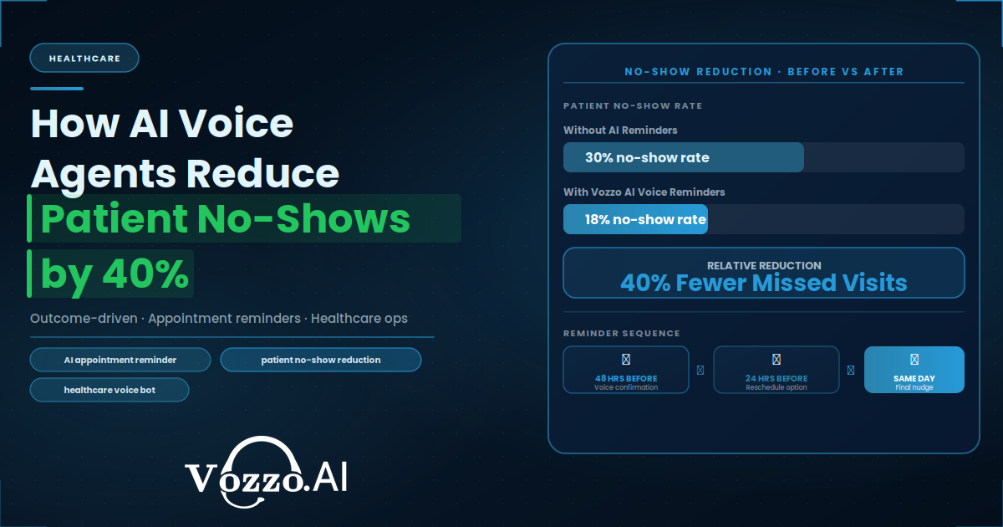
48-hour reminder call: The voice agent calls the patient two days before the appointment, confirms attendance, and answers basic FAQs about preparation or location.
Same-day confirmation: A shorter call on the morning of the appointment catches last-minute cancellations early, giving the clinic time to fill the slot from a waitlist.
Integrated rescheduling: If a patient indicates they cannot attend, the AI voice agent immediately presents available alternative slots and books the new appointment without requiring front desk involvement.
Achieving a 40% Reduction in No-Show Rates
A 40 percent reduction in no-show rates is an achievable benchmark for healthcare providers that deploy a well-configured AI reminder system. The key drivers are consistency, timing, and two-way engagement. Unlike static SMS reminders, a voice-based AI appointment reminder creates a real interaction that prompts patients to actively confirm or reschedule — rather than passively ignoring a text.
The compounding effect matters too. When a cancellation is captured early, the clinic can fill that slot from a waitlist — turning a potential revenue loss into a recovered appointment. Over weeks and months, this adds up to a measurable improvement in both utilization and patient satisfaction.
Why Healthcare Providers Are Choosing Voice Over Text
Many healthcare providers have tried SMS and email reminders and found them insufficient for reducing no-shows among older patients, patients in rural areas with limited digital access, or those who simply do not read notifications. Voice calls reach a broader patient population and feel more personal — closer to receiving a call from the clinic's own team.
A healthcare voice bot built on Vozzo AI can operate in multiple languages, adapt its tone for different patient segments, and integrate directly with your practice management system — so appointment data flows automatically without any manual exports or imports. The voice agent knows who to call, when to call them, and what to say based on live scheduling data.
Start Reducing No-Shows with Vozzo AI
If your clinic or hospital is losing revenue and productivity to avoidable no-shows, Vozzo AI's voice agents for healthcare can help. Our AI-powered appointment reminder system integrates with your scheduling platform, handles multi-language patient outreach, and delivers measurable improvements in show rates from week one. Book a demo to see how Vozzo AI can transform patient engagement at your facility.s