
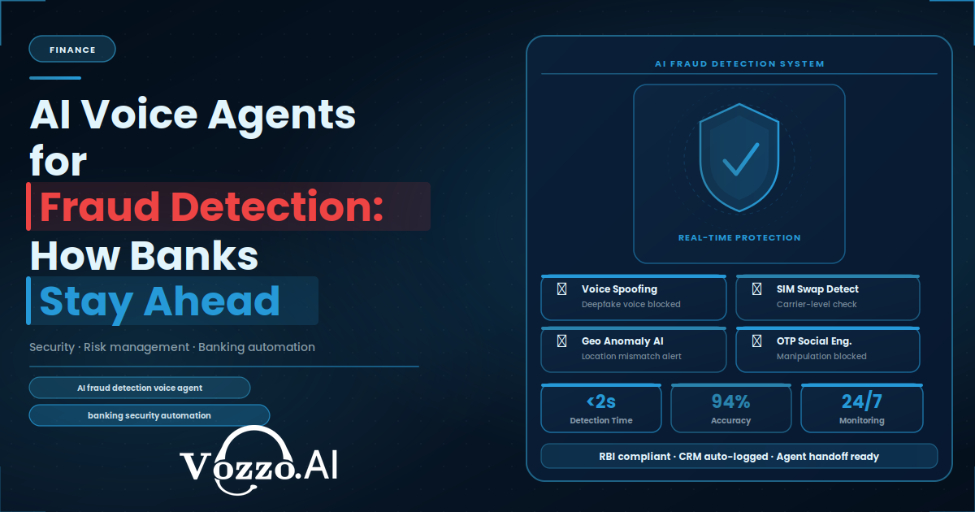
India's banking sector is fighting a fraud problem that grows faster than most institutions can respond to. UPI fraud, phishing schemes, SIM-swap attacks, and account takeover attempts have surged in step with digital adoption, and fraud volumes on digital payment rails keep climbing year over year. Most banks still rely on detection systems that flag suspicious activity only after a transaction has cleared, leaving fraud teams to chase losses rather than prevent them. Reactive fraud management means slower resolution, frustrated customers, and mounting reputational risk. Banks need a way to intervene at the moment risk appears, not after the damage is done. This is where AI voice agents are changing the equation for fraud detection and customer verification.
How AI Voice Agents Fit Into Fraud Detection
AI voice agents give banks a way to close the gap between detection and action. When a core banking or fraud-monitoring system flags an unusual transaction, a voice agent can place an outbound call to the customer within seconds, not hours. The agent verifies the transaction details, confirms the customer's identity through pre-set authentication steps, and either clears the transaction or escalates it based on the response. Because the call happens in real time, banks can pause a suspicious transfer before funds leave the account rather than starting a lengthy dispute process afterward. Voice agents also solve the volume problem: a single fraud team member can only make so many calls per hour, but a voice agent can run thousands of verification calls simultaneously across multiple languages, so no flagged transaction sits unaddressed while a human queue backs up.
Key Capabilities Banks Should Look For
Not every voice AI platform is built for the realities of BFSI operations. Banks evaluating vendors should look for real-time trigger integration with their core banking system so alerts fire the moment a rule engine flags an anomaly, rather than on a delayed batch cycle. Multilingual support matters just as much: a fraud alert call needs to work in Hindi, Tamil, Bengali, or whichever language the customer prefers, not just English. Call recording and audit trails are non-negotiable for both internal risk review and regulatory reporting. Every automated flow also needs a clean escalation path to a human fraud analyst when a customer disputes the transaction, sounds distressed, or the case falls outside the agent's decision boundaries. Platforms that skip this step create more friction than they remove.
Vozzo AI Labs in Banking Security Workflows
Vozzo AI Labs has built its voice agent platform specifically around BFSI workflows rather than adapting a generic customer service bot for banking use. Its deployments with Indian banking clients focus on compliance-friendly automated alert calling: verified caller ID, structured authentication prompts, and recorded, time-stamped call logs that fraud and compliance teams can pull for audit purposes. Rather than replacing human fraud analysts, Vozzo AI Labs' voice agent platform is designed to sit ahead of them, handling first-line verification calls at a scale no manual team could match, then routing anything unresolved straight to a live agent. For banks weighing whether to build this capability in-house or bring in a specialized partner, that mix of speed, compliance awareness, and escalation logic is usually the deciding factor.
What This Means for RBI Compliance
Automated fraud alert calling isn't just an efficiency play, it also supports the customer protection principles the RBI has built into its digital payments and outsourcing guidelines. Banks are expected to notify customers promptly about suspicious activity, maintain clear records of customer interactions, and ensure any third-party system handling customer data operates within India's data residency expectations. A well-built voice agent workflow gives banks documented, timestamped proof that a customer was contacted and given the chance to confirm or reject a transaction, which strengthens the bank's position in dispute resolution and regulatory review alike.
Fraud doesn't wait for banks to catch up, and neither should fraud detection. AI voice agents give risk and operations teams a proactive layer that flags, verifies, and resolves suspicious transactions in the window that actually matters, before money moves. If your fraud alert process still depends on manual call queues or next-day follow-ups, it is worth evaluating how a purpose-built voice AI platform could close that gap. Talk to your risk and compliance teams about piloting AI voice agents as part of your fraud detection stack this quarter.