A clinical research team at a 400-bed hospital in Chennai needs post-discharge outcome data from 2,400 patients enrolled in a six-month cardiac intervention study — patients who speak Tamil, Telugu, Hindi, and Malayalam. Monthly follow-up calls to every patient add up to 14,400 calls, and the four-person coordinator team can realistically make about 1,800. That leaves 12,600 data points missing from the study before the first patient is even discharged.
The Data Collection Problem That Is Limiting Healthcare Research in India
Clinical research in India runs on patient follow-up data — and that data is chronically undercollected. Not because patients are unwilling to share it, but because phone-based data collection infrastructure cannot scale to the sample sizes that statistically valid research requires.
Post-discharge outcome studies, disease registry updates, treatment adherence tracking, and public health surveillance all depend on repeated patient contact over months. Human research coordinator teams cannot sustain that cadence across large, multilingual patient populations while also managing site visits, ethics paperwork, and data queries.
The consequence is systematic bias. Studies overrepresent the patients who are easiest to reach — urban, English-speaking, smartphone-literate — and produce findings that do not reflect the population the research was designed to serve. India's linguistic diversity compounds the problem: a research team based in Delhi cannot collect reliable data from Tamil Nadu patients without Tamil-speaking coordinators, and most research budgets cannot fund that for every language in the catchment.
This is the gap that voice AI healthcare data collection is built to close: consistent, scheduled, multilingual patient contact that does not depend on how many coordinators a study can afford.
What an AI Voice Agent Does for Healthcare Research — End to End
- Step 1 — Language-tagged patient list. The research team uploads the enrolled patient contact list with a language tag per patient — Tamil, Telugu, Hindi, Malayalam, Marathi, Bengali, Kannada — based on registration data or location.
- Step 2 — Scheduled outbound calls. The AI voice agent initiates an outbound call to each patient on the research schedule — monthly, weekly, or at study-defined intervals — automatically, without coordinator involvement.
- Step 3 — Introduction and consent. The agent introduces the call as a follow-up from the hospital's research team, obtains verbal consent confirmation, and begins the structured data collection protocol. This is where an AI voice agent for healthcare research differs from a generic calling tool: consent is part of the protocol, not an afterthought.
- Step 4 — Conversational questionnaire delivery. The validated research questionnaire is delivered conversationally in the patient's language — not robotic IVR, but natural dialogue that handles partial answers, clarification requests, and unexpected responses.
- Step 5 — Outcome capture. For post-discharge outcome studies, the agent asks about symptom status, medication adherence, functional recovery, and adverse events since discharge, capturing structured fields per patient per call.
- Step 6 — Real-time clinical escalation. Patients reporting concerning symptoms — chest pain, breathlessness, high fever — are flagged immediately for a clinical team callback within the same call interaction.
- Step 7 — Structured data delivery. Data flows into the research database per patient per call — no transcription lag, no data entry queue, and no coordinator involved in routine follow-up calls.
The Specific Healthcare Research Use Cases Where Voice AI Is Being Deployed in 2026
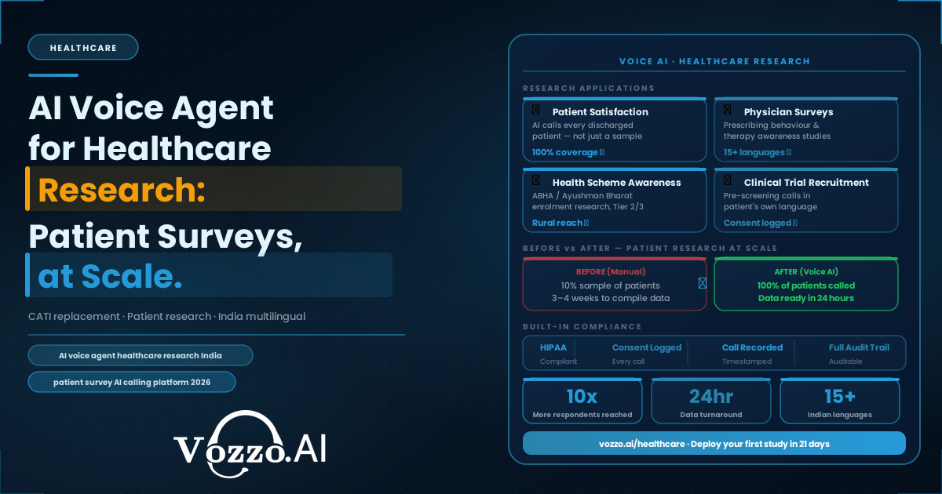
Post-discharge outcome studies. Hospitals running cardiac, orthopaedic, and oncology outcome research need monthly patient contact for 6–12 months after discharge. AI voice agents make every scheduled call automatically, in the patient's language, capturing validated questionnaire data directly into the research database. Completion rates on AI-managed follow-up protocols are significantly higher than on coordinator-managed protocols because the call is made on schedule regardless of coordinator workload.
Disease registry data collection. National and state registries for diabetes, hypertension, tuberculosis, and cancer require periodic patient data updates that human teams cannot sustain at population scale. AI voice agents contact registered patients on the update schedule, capture structured data fields, and flag patients lost to follow-up for clinical team review. Registry data completeness improves from the 40–60% typical of manual follow-up to 80%+ with AI-managed outreach.
Treatment adherence monitoring. Chronic disease programmes for diabetes, hypertension, and psychiatric conditions depend on knowing whether patients are taking their medication and attending follow-up appointments. Weekly AI check-in calls to high-risk patients capture adherence data and flag non-adherent patients for clinical intervention before the next scheduled appointment. Coordinators stop spending their week dialling stable patients and start spending it on the ones who need intervention.
Public health surveillance. State health departments tracking communicable disease, maternal health outcomes, and immunisation coverage need rapid, wide-scale patient contact that manual teams cannot deliver in the required timeframes. AI voice agents can reach 50,000 survey respondents in 48 hours across multiple languages — timelines that are impossible with human caller panels. For programmes running AI voice surveys for medical research in India in 2026, that speed turns surveillance from a retrospective report into an early-warning signal.
Clinical trial patient retention. Clinical trials lose statistical power when patients drop out or miss assessment visits. AI voice agents make retention calls on the trial schedule — visit reminders, adverse event checks, and protocol adherence queries. Dropout rates fall without consuming site coordinator time on routine contact.
Before vs After AI Voice Agents for a Post-Discharge Research Study
Before — manual coordinator follow-up:
- 2,400 patients enrolled, 4 research coordinators
- 1,800 of 14,400 scheduled follow-up calls completed across 6 months
- 75% of scheduled data points missing
- Study power reduced below statistical significance
- Findings published with significant data limitations noted
After — AI voice agent follow-up:
- 2,400 patients, all 14,400 scheduled calls made by the AI agent
- 88% response rate achieved
- Structured data captured per patient per call, adverse events flagged in real time
- Coordinator team focused on clinical escalations and complex patient interactions only
- Study data complete and statistically valid
What Healthcare Research Teams Need From a Voice AI Platform
- Validated questionnaire fidelity. The AI must deliver the research questionnaire exactly as validated — correct sequence, correct response options. Any deviation from the validated instrument invalidates the data for publication, so the platform must support locked questionnaire versions with audit trails showing what was asked and when.
- Indian language coverage matching your patient catchment. A Chennai hospital's patient base requires Tamil and Telugu; a Mumbai hospital requires Marathi and Hindi; a pan-India study requires 8+ languages. Coverage must match your actual enrolled patient demographics, not a curated list of supported languages.
- ABDM and data protection compliance. Patient health data collected via voice AI must be handled in line with Ayushman Bharat Digital Mission data standards and India's DPDP Act. Ask any vendor for their ABDM alignment documentation before deploying on a research study.
- IRB and ethics approval documentation support. Ethics committees reviewing studies under ICMR guidelines need documentation of every data collection method, including automated voice calls. The platform must provide technical documentation covering the protocol description, data security measures, consent confirmation process, and data handling procedures.
The Research Quality Argument for Voice AI Over Human Callers
Human research coordinators introduce interviewer bias — their tone, phrasing variations, and responses to patient cues affect data quality in ways that are difficult to control and impossible to eliminate at scale. AI voice agents deliver the same validated questionnaire in exactly the same way to every patient, in their language, at every call in the study protocol. This standardisation of the data collection instrument is not just an efficiency advantage — it is a research quality advantage that strengthens the validity of findings. For multicentre studies where coordinator variation across sites is a known source of data heterogeneity, AI-administered data collection is the methodologically stronger approach.
Conclusion
The constraint on Indian healthcare research has never been the quality of clinical expertise or the availability of patient populations — it has been the infrastructure for reaching those patients consistently, in their language, at the frequency the research protocol requires. AI voice agents remove that constraint. The research teams deploying them in 2026 are not just collecting more data — they are collecting better data from populations that were previously unreachable at research scale.
Running a follow-up-heavy study, registry, or surveillance programme? See how Vozzo AI supports hospital and research teams with multilingual voice AI.